

10
10Cloud computing is one of the biggest disruptors in today’s technological era. Because of its myriad financial and operational benefits, enterprises are now flocking to leverage the advantages of the cloud. However, with the benefits of the cloud come its associated costs. As a result, it is not uncommon for enterprises to encounter large cloud bills, which are complicated to manage. Cloud FinOps and cloud cost optimization are areas that have become increasingly popular among enterprises in a bid to improve cloud efficiency, cloud cost reduction, etc.
In today’s topic, we dive into cloud budgeting and cloud cost forecasting - both key elements in your cloud FinOps strategy, that will help you manage cloud cost overruns and deal with budget shocks in your journey.
What is cloud budgeting?
Cloud budgeting involves estimating, allocating, and controlling the financial resources dedicated to cloud services. It is a financial plan that estimates how much money you will spend on cloud computing over a fixed period. Cloud budgeting is always a proactive approach that aims to manage cloud expenditures by setting up cost thresholds, managing cost overruns, cost allocation, etc., and ensuring that your costs align with your overall business objectives.
How does cloud budgeting work?
The first step towards effective cloud budgeting starts with a clear understanding of the company’s cloud usage patterns and requirements. It includes identifying the necessary resources, estimating their costs, and allocating some of the organization's financial resources for these expenses.
A critical element of budgeting also involves monitoring your cloud spending to ensure it doesn’t run over your set limits. In cases, where budgets exceed the threshold, organizations can take corrective actions such as revising the budget and removing a few resources from the pool. There are several tools to help you with this, for example, cost alerts, calculators, etc.
Why is accurate forecasting important in Cloud FinOps?
“The goal of forecasting is not to predict the future but to tell you what you need to know to take meaningful action in the present.” - Paul Saffo
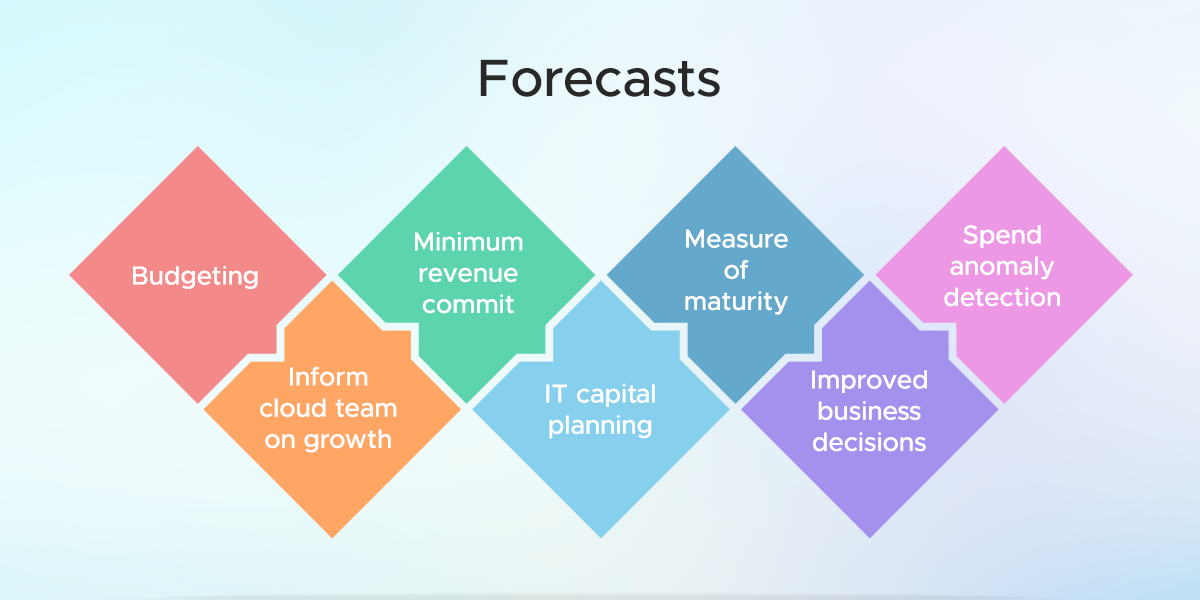
Accurate cloud cost forecasting is important in a company’s cloud journey for several reasons.
1. Cost management: With accurate cloud cost forecasting, enterprises can predict their cloud costs more precisely, thus budget allocation becomes more efficient, and cost spikes can be avoided.
2. Resource optimization: Cloud cost forecasting allows organizations to optimize resource utilization and allocation by right-sizing instances, dynamic scaling of resources, workload consolidation, etc. This results in cloud cost optimization while also meeting performance requirements.
3. Performance optimization: Accurate cloud cost forecasting enables organizations to anticipate changes in workload demand and performance requirements. This allows them to proactively adjust resources and configurations to maintain optimal performance levels and ensure a positive user experience.
4. Risk management: Accurate forecasting helps organizations identify potential risks and anomalies related to cloud usage and costs. By anticipating fluctuations in demand, pricing changes, or other factors that may impact costs, organizations can develop contingency plans and mitigation strategies to minimize financial risks and ensure business continuity.
Common challenges in cloud cost forecasting
1. Poor cloud visibility: Poor cloud cost visibility can set you back in your forecasting efforts. Cloud bills are generally very complex and challenging to understand. Even with a cloud bill at hand, it is very difficult to gauge how much money you spent on a product, feature, team, or service. Unless you truly understand what drives your cloud costs, it is not easy to make a forecast on your budgets.
2. Challenges with cloud tagging: Cloud tagging is assigning meta-data or labels to cloud resources for easy identification. Cloud tagging can help you track usage, performance, etc, hence setting up a strong foundation for correct forecasting.
However, the challenges with cloud tagging are many. There are challenges with a consistent tagging strategy, changing teams, manual processes, and more.
3. Multi-cloud adds to the complexity: Tracking cloud costs across multi-cloud is incredibly complicated. Making sense of tags or labels from shared or multi-tenant environments is also challenging. Amidst all these, forecasting remains a tough nut to crack.
4. Alignment between finance and engineering: The priorities of both the finance and engineering teams are poles apart.
Finance’s objective is to maximize the cloud ROI. Engineering’s is to improve functionality, speed, availability, and security. Finance would find it seemingly difficult to invest in a feature that does not improve profitability. Similarly, engineering cannot make architectural decisions that can lead to better cost management. This misalignment makes budgeting and forecasting very challenging.
5. The variety makes it challenging: Figuratively speaking, cloud comes in different shapes, sizes, and types.
Cloud service providers like AWS offer numerous cloud services. The number of choices in a simple thing like instance type can also be quite overwhelming. With so many offerings, forecasting how much cloud resource you will need, and of what type is next to impossible.
Different types of cloud cost forecasting
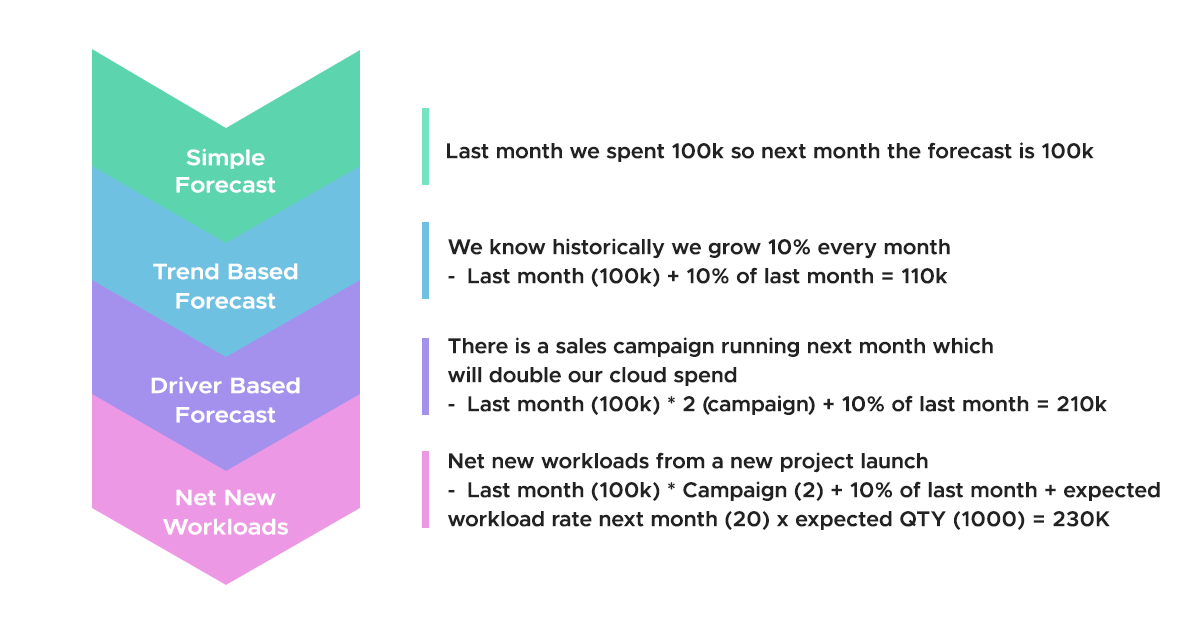
Forecasting is of different types corresponding to different FinOps maturity phases.
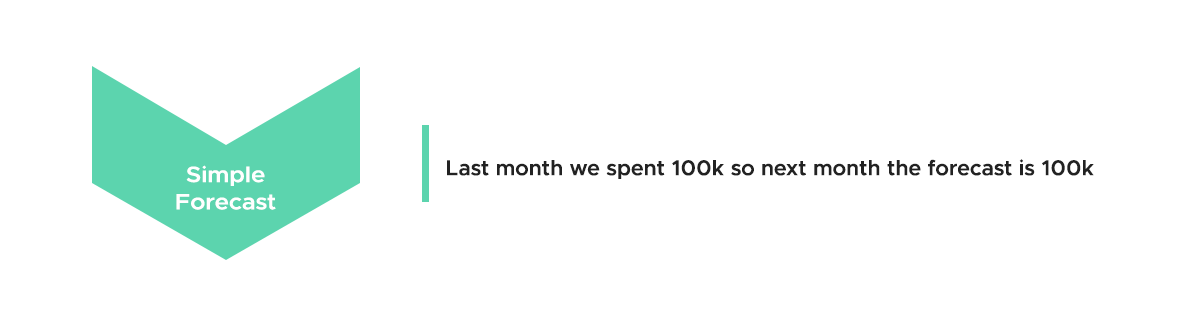
1. Simple forecasting: In simple cloud cost forecasting, you assume that your spending for the next period will be the same as the current period. It is also called “naive forecasting”. Accuracy with simple forecasting is very low since businesses are always evolving and so are their costs.
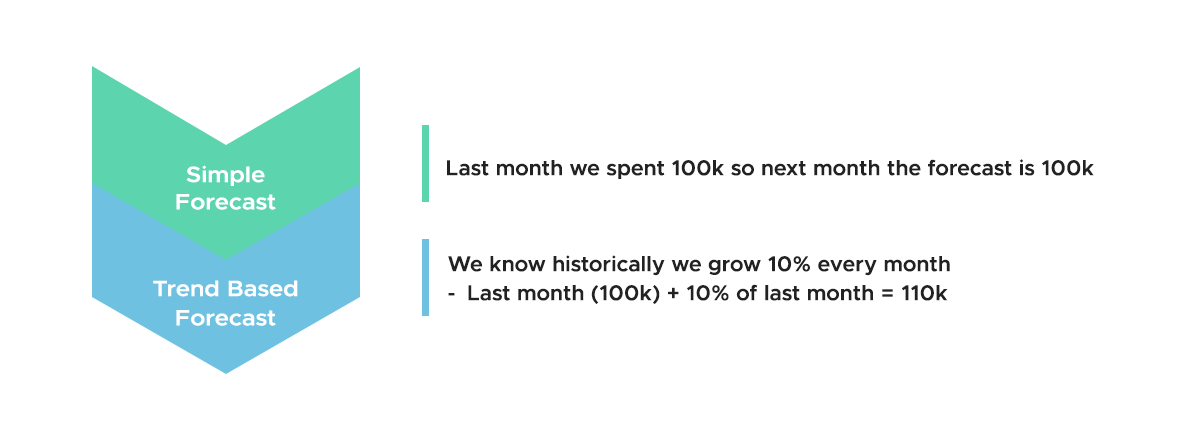
2. Trend-based forecasting: It uses historic cloud spend to predict the future. Trend forecasting generally picks up the trend of growth from a past period and assumes the growth will be similar in the future. For a company growing at a steady rate, trend-based cloud cost forecasting offers a pretty accurate forecast concerning cloud spending.
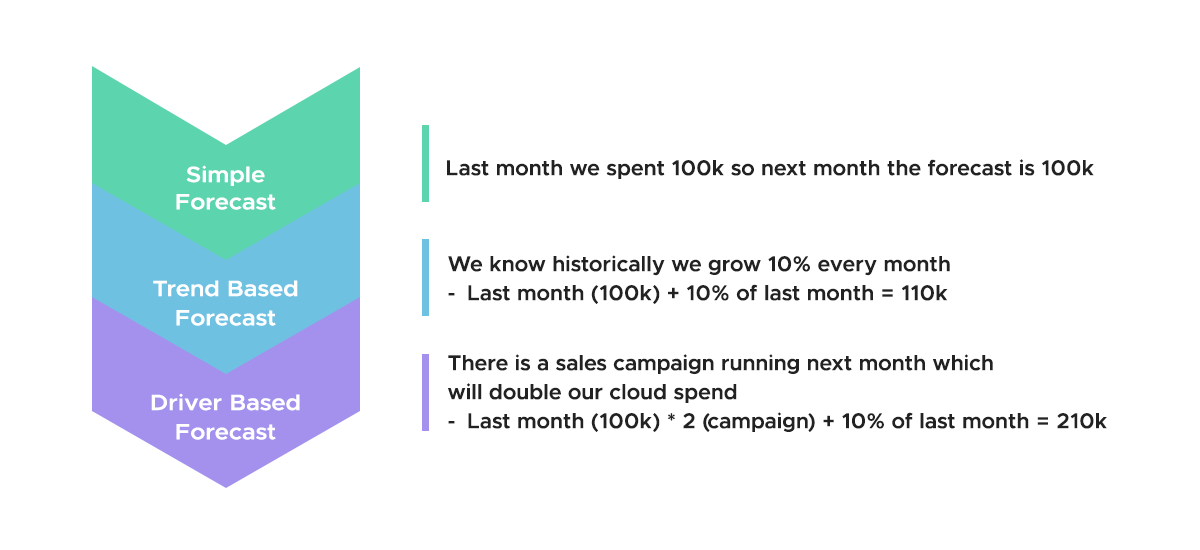
3. Driver-based forecasting: Driver-based forecasting utilizes the business KPIs to predict future demand. The forecast reflects what the business is planning, whether this is a release of a new product, a promotion that is expected to increase demand, etc. This forecasting requires working closely with business stakeholders, and hence the accuracy of this method is a little tricky to achieve.
4. Net new workloads forecasting: Net new workloads forecasting is based on new pipelines or workloads that an organization might be planning. There are different models for new workload forecasting - based on existing applications, publicly available forecasting calculators, third-party data sources, etc.
Strategies to improve accuracy in cloud cost forecasting
1. Monitor cloud spending regularly: Cloud budgets need to be monitored closely and regularly to keep track of unnecessary costs, idle resources, etc. Cloud cost monitoring tools can be of great help in making the tracking process seamless.
2. Understand your cloud bill: Make use of native tools like AWS cost explorer, cost and usage report, etc. to nail your cloud bill. Cloud costs are operational expenses and keep on fluctuating based on resource usage and demand. So, cloud cost visibility is crucial to know how specific workloads utilize your cloud resource units. Only with a precise view of your cloud spending, you can forecast your cloud costs accurately.
3. Get everyone on board: Accurate cloud cost forecasting requires that everyone - finance, developers, system operators, DevOps specialists, SecOps, and other stakeholders who affect cloud costs be on board to discuss, deliberate, and join hands for budgeting.
4. Play around with your last budget: One of the easiest ways to land close to an accurate cloud cost forecast is to add or subtract a certain percentage from your last budget. Whether to add or subtract, you can decide based on your business plans. If there is no substantial change, you can stick to your last budget which would be a good forecast in itself.
5. Set a trial budget based on experience: If you have set budgets and costs on-premise, you should have no difficulty in setting up a trial budget. Then refining and reviewing it should get you to the level of accuracy you aim for. If you want more granular insights, you can consult an expert or get hold of a cloud cost visibility platform like CloudKeeper Lens.
6. Review and iterate: Cloud forecasting is not a one-time process but a continuous improvement process. Your business will evolve, along with your budgeting requirements. The key step is to track your changes as far as cloud costs are concerned and adapt your budget accordingly. You should then stick to your budget to avoid cost overruns.
How CloudKeeper can help?
Being able to accurately forecast cloud costs is a critical pillar in your cloud cost optimization journey. However, cloud cost forecasting is easier said than done. In order to set yourself up for success, begin your journey with small, achievable goals that can be built on over time as you mature, continually improving as you go.
CloudKeeper’s FinOps Consulting and Support team consists of 300+ cloud FinOps professionals who can help you with FinOps maturity assessment, cost governance guardrails, cloud cost visibility, waste management, and much more. CloudKeeper Lens, its proprietary cloud cost visibility platform for AWS and Azure can help you track and monitor your cloud expenses so that you set a strong foundation for your cloud cost forecasting. Partnering with CloudKeeper can help you sail through your cloud cost optimization journey effortlessly, and achieve much greater effectiveness with your cloud cost forecasting.
Book a free demo today to learn how CloudKeeper can simplify your FinOps and cloud cost optimization efforts.