Introduction to Multi-Cloud Management
Enterprises today are adopting a multi-cloud management strategy at an unprecedented pace. As organizations operate across AWS, Azure, Google Cloud, Kubernetes, and on-prem environments, they face growing complexity in managing distributed workloads. Traditional, provider-specific tools cannot keep up with the demands of modern architectures. This has made the multi-cloud management platform one of the most essential components of enterprise cloud management.
According to Gartner 90% of organizations will adopt a hybrid cloud approach by 2027, highlighting the rapid shift toward distributed cloud models. This rapid adoption is driven by rising AI workloads, the need for resilience, cost pressures, and the strategic desire to avoid vendor lock-in. At the same time, IDC predicts global public cloud spending will exceed $1.35 trillion by 2027, a figure that underscores why companies urgently need a unified approach to cloud cost optimization, governance, automation, visibility, and security.
A multi-cloud environment allows companies to leverage AWS for compute scale, GCP for analytics and AI efficiency, Azure for enterprise identity, and Kubernetes for workload portability. But these benefits can only be realized when enterprises use a multi cloud management platform capable of integrating operations, automating governance, and offering full cloud visibility and monitoring across all environments.
Why Enterprises Are Shifting to Multi-Cloud
The move toward multi-cloud is intentional rather than accidental. Enterprises now recognize that no single cloud delivers optimal performance for all workloads. AI training may run most efficiently on GCP TPUs, while real-time transactional workloads may perform best on AWS, and enterprise security frameworks may rely on Azure’s identity ecosystem. A modern multi-cloud management platform allows organizations to mix and match services without operational fragmentation.
The Strategic Drivers Behind Multi-Cloud Adoption are :
- Cost Efficiency at Scale - Cloud pricing models vary widely across providers. Without central oversight, cost structures quickly become opaque. A multi-cloud management platform provides a unified view of cloud spending and helps organizations run workloads where costs are lowest and performance is highest.
- Built-In Resilience and Uptime - Single-cloud outages no longer meet enterprise uptime expectations. By distributing workloads across providers and managing them through a multi-cloud management platform, organizations reduce risk, ensure continuity, and maintain performance even during regional disruptions.
- Freedom from Vendor Lock-In - Companies want the freedom to adopt best-of-breed offerings. A multi-cloud strategy preserves negotiating power and flexibility while the multi cloud management platform ensures that this flexibility does not result in operational chaos.
What are the Benefits of Multi-Cloud Management
The benefits of multi-cloud management extend far beyond choice and flexibility. When supported by a multi-cloud management platform, these advantages translate into measurable financial, operational, and strategic value.
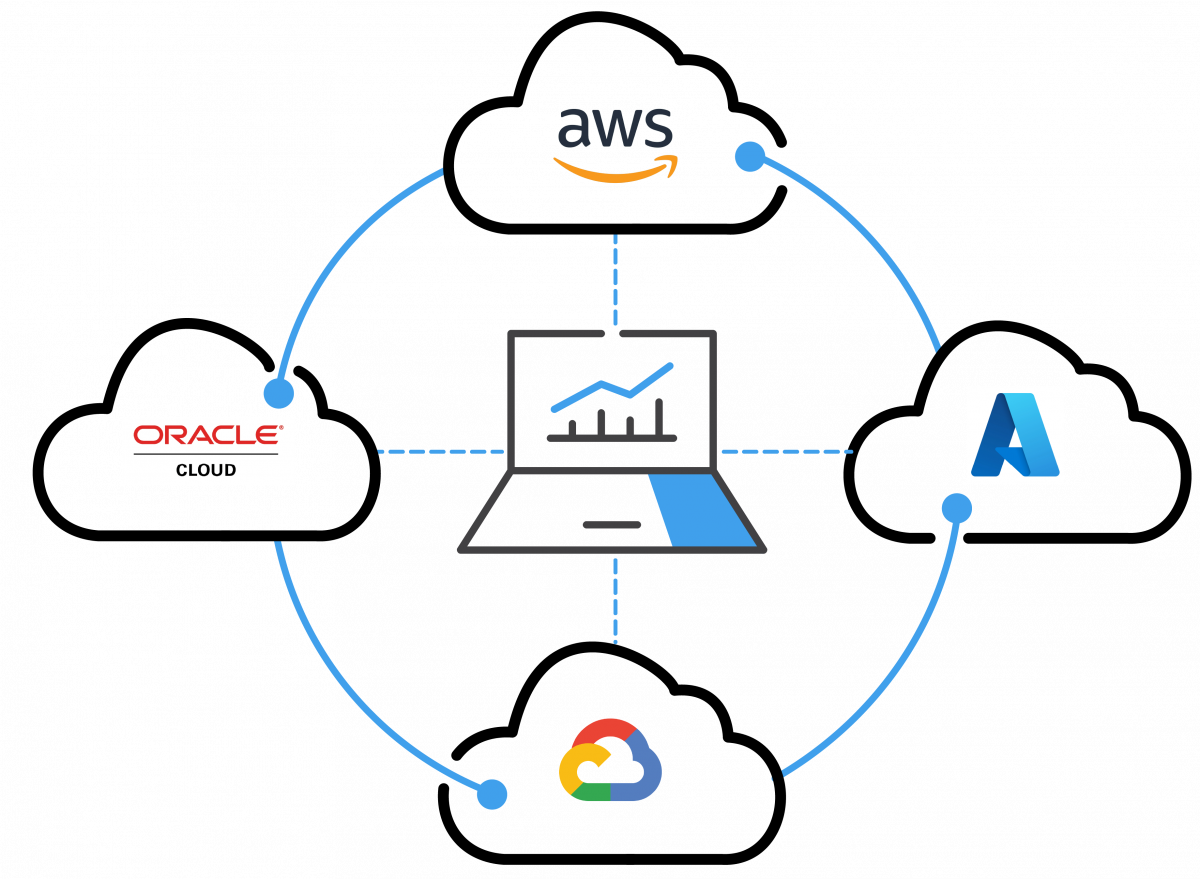
- Cost Optimization - A multi cloud management platform gives FinOps and engineering teams complete visibility into usage patterns and cost drivers, enabling dynamic optimization of compute, storage, data transfer, and commitments.
- Built-In Resilience - By spreading workloads across AWS, Azure, and GCP, enterprises eliminate the risk associated with regional outages or provider-specific disruptions.
- Optimized Performance - Running the right workloads on the right cloud improves speed and efficiency, with consistent monitoring across all environments.
- Unified Governance & Compliance -Regulatory requirements such as GDPR, HIPAA, and PCI-DSS require consistent controls regardless of cloud provider. Without a multi-cloud management platform, each cloud becomes a separate governance challenge. Centralized cloud governance allows enterprises to enforce consistent IAM, encryption, network segmentation, tagging standards, and audit trails across all environments.
- Strategic Flexibility - As organizations grow through expansion, mergers, AI adoption, or industry-specific digital initiatives, they need a cloud foundation that does not constrain innovation. A modern multi-cloud management platform becomes the enabler of this flexibility.
Key Features of a Multi-Cloud Management Platform
A mature multi-cloud management platform acts as a unified control plane that ties together observability, automation, cost governance, security, and orchestration across AWS, Azure, GCP, Kubernetes, and hybrid infrastructures.
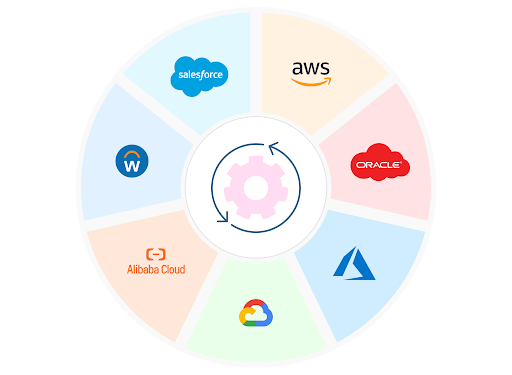
- Unified Visibility Across Clouds - A multi-cloud management platform aggregates logs, metrics, traces, cost data, security findings, and performance insights into a single, coherent view. This not only improves operational efficiency but dramatically enhances cloud visibility and reduces mean time to resolve incidents.
- Automated FinOps Governance - Continuously identifies cost inefficiencies, recommends rightsizing, forecasts usage, and optimizes commitments across dynamic pricing models.
- Policy-Based Cloud Governance - A multi-cloud management platform enforces uniform governance through automated policy controls, compliance frameworks, and drift detection capabilities.
- Centralized Multi-Cloud Security - Security is foundational. As multi-cloud architectures expand, so does the attack surface. The platform centralizes identity, access, vulnerability scanning, misconfiguration management, and threat detection. It establishes a unified security baseline across environments, enabling consistent multi-cloud security without manual overhead.
- Infrastructure Automation & Orchestration - Automates provisioning and remediation using Infrastructure as Code, ensuring predictable deployments across clouds.
- Hybrid & Kubernetes Workload Management - Support for hybrid and multi-cloud workloads, including Kubernetes multi-cloud clusters, is increasingly important. Enterprises often run containerized applications simultaneously on EKS, GKE, AKS, and on-prem Kubernetes clusters. The platform manages these environments cohesively, delivering consistent lifecycle management across all deployments.
- AI-Driven Cloud Operations - As AI becomes deeply embedded in cloud operations, the multi-cloud management platform leverages machine learning to optimize autoscaling, detect anomalies, predict resource requirements, and drive autonomous optimization of workloads and cost structures.
Challenges in Multi-Cloud Management
Despite its advantages, multi-cloud comes with inherent challenges that cannot be addressed without a unified platform such as:
- Fragmented Visibility - Each cloud provider exposes data differently, making it difficult to correlate performance issues, understand cost anomalies, or enforce consistent governance. A modern multi cloud management platform resolves this by offering a single data fabric across all environments.
- Multi-Cloud Skill Gaps - Skill gaps also hinder multi-cloud success. Engineers who are specialists in AWS may lack deep knowledge of Azure networking or GCP IAM hierarchies. Without unified guardrails and automation, these skill gaps introduce operational risk. A platform reduces this dependency by standardizing workflows and providing consistent automation across clouds.
- Shadow IT Proliferation - Shadow IT is another growing concern. Teams often deploy workloads without proper governance or tagging, leading to financial and security exposure. Centralized governance through a multi-cloud management platform eliminates unauthorized deployments and enforces compliance automatically.
- Interoperability Complexity - Interoperability challenges arise because cloud providers use different APIs, services, and architectural approaches. Moving workloads or integrating cross-cloud data becomes complex and costly. The platform abstracts these differences and offers a common orchestration layer.
- Inconsistent Security Posture - Security inconsistencies also surface in multi-cloud environments. IAM configurations vary widely between AWS, Azure, and GCP, and misalignments often lead to vulnerabilities. A unified platform ensures consistent multi-cloud security and reduces misconfiguration risk.
Best Practices for Multi-Cloud Management
Successful multi-cloud implementations are anchored in a strong operating model and a well-designed multi-cloud management platform.
- The first best practice is establishing a clear cloud operating model. This model defines governance roles, decision structures, provisioning workflows, and escalation paths across environments. A platform ensures that these standards are enforced consistently.
- FinOps should be integrated from the start. Rather than treating cost control as a late-stage reporting activity, enterprises that adopt FinOps early benefit from continuous optimization, real-time cost transparency, and proactive budget enforcement. The multi cloud management platform operationalizes this discipline.
- Standardizing policies across providers is equally critical. IAM, network security, encryption, and tagging standards must be uniform across all clouds. The platform ensures compliance through automated rule enforcement and drift detection.
- Automation is essential for reducing complexity. From provisioning to remediation, automation ensures predictable outcomes and frees teams from low-value tasks. A multi-cloud management platform orchestrates these processes across AWS, Azure, GCP, Kubernetes, and hybrid systems.
- Continuous monitoring, powered by AI-driven analytics, enables companies to detect performance degradation, cost anomalies, and security risks early. The platform becomes the engine that drives both proactive and autonomous cloud operations.
Future Trends in Multi-Cloud Management
The next wave of cloud innovation will be defined by automation, intelligence, and architectural convergence, each accelerated by the multi-cloud management platform.
- AI-driven cloud operations will become mainstream, enabling autonomous scaling, predictive optimization, automated anomaly detection, and self-healing workloads. Enterprises will increasingly rely on AI-powered orchestration to manage the complexity of distributed cloud environments.
- Autonomous optimization agents software components capable of adjusting workloads, commitments, and configurations automatically will become a core feature of advanced platforms. These agents will run continuously, optimizing performance and cost across clouds in real time.
- Edge computing will merge with multi-cloud as organizations deploy low-latency workloads closer to customers. A unified platform will orchestrate application flows across edge nodes, Kubernetes clusters, and hyperscale cloud environments.
- Unified security fabrics will standardize multi-cloud security by providing a central policy plane across all infrastructure layers. A multi-cloud management platform will serve as the foundational policy engine for identity, access, encryption, and threat detection.
- Industry-specific cloud stacks will grow rapidly. Healthcare, BFSI, insurance, and retail organizations will adopt specialized cloud blueprints tailored to compliance and performance requirements. The platform will manage and govern these vertical solutions.
- The rise of supercloud architectures, an emerging model where applications operate seamlessly across cloud providers, will further increase the need for a robust multi-cloud management platform as the control plane for orchestration, data fabric, and governance.
Conclusion: Why Multi-Cloud Management Is Essential in 2026 and Beyond
Multi-cloud is no longer an experimental strategy, it is becoming the default architecture for global enterprises. As organizations scale AI workloads, modernize legacy systems, expand geographically, and face rising regulatory pressures, they require a multi-cloud management platform that unifies governance, improves cloud visibility, automates optimization, enforces security, and delivers continuous cost control.
With the right platform, multi-cloud becomes not just a distributed infrastructure model but a powerful competitive advantage. Enterprises that invest in intelligent, AI-driven, enterprise-grade multi-cloud management platforms today will be best positioned to lead in 2026 and beyond.
Planning to move to a multi-cloud setup? CloudKeeper offers an enterprise-grade multi-cloud management platform for AWS and GCP delivering real-time cost visibility, automated savings, unified governance, continuous compliance, and AI-driven optimization.
Whether you’re modernizing workloads or scaling AI, CloudKeeper gives you a single pane of glass to manage it all.
Sign up for a demo and see how CloudKeeper simplifies and optimizes your multi-cloud environment.