


Senior Devops Engineer
Neetesh specializes in designing, automating, and managing scalable DevOps pipelines across cloud-native infrastructures.
 Webinar
20 May, 2026 | 5 Min read
This article is part of a five-blog series where we share a customer use case — how we reimagined their cloud infrastructure strategy with Crossplane, GitOps, and a hybrid Terraform approach.
Terraform got us here. But when our client’s platform grew to 50+ microservices across multiple regions, it started to crack. State files clashed, ephemeral environments dragged, and drift became a silent enemy. That’s when we looked beyond — and found the missing piece in Crossplane.
AWS Cloud isn’t just changing how companies run applications — it’s redefining what’s possible. What starts as a simple setup for Dev, QA, Stage, and Production can quickly balloon into a sprawling ecosystem:
This speed is powerful — but the wrong tools collapse under scale. That’s exactly what happened in our client’s case.
A leading digital commerce platform, operating across 35+ cities, was preparing to scale globally. Their platform connected customers and merchants across fine dining, spas, and travel experiences — while also offering merchants a powerful branding channel to reach nearby customers.
The platform ran on a microservices-heavy architecture with more than 50 services, each requiring:
The next phase of growth demanded:
At first, Terraform was the tool of choice. But as the system grew, so did the pain points.
Takeaway: Terraform handled the first phase well, but scaling exposed cracks.
Terraform has proven itself as a robust tool for building both small and large-scale, complex infrastructure. However, as our client’s environment grew and became more dynamic, we encountered practical challenges:
State file complexity → With multiple teams and regions, managing and securing Terraform state files became fragile and error-prone. Ownership disputes and state locking often slowed collaboration.
Slow ephemeral environments → Developers faced delays when spinning up and tearing down short-lived environments because of state locking/unlocking, which wasn’t designed for high-frequency, Git-driven workflows.
Fire-and-forget model → Terraform provisions infrastructure and exits. If an AWS resource drifts or is modified outside Terraform, it won’t self-correct until the next apply.
In short, Terraform remained excellent for foundational and static infrastructure, but it struggled in scenarios demanding continuous reconciliation, rapid ephemeral environments, and high developer velocity — exactly where Crossplane excels.
Terraform automates creation, but Crossplane automates continuity. That shift — from provisioning to reconciliation — made all the difference.
In short, Terraform remained excellent for foundational and static infrastructure, but it struggled in scenarios demanding continuous reconciliation, rapid ephemeral environments, and high developer velocity — exactly where Crossplane excels.
Before finalizing Crossplane, we evaluated multiple Infrastructure-as-Code (IaC) and control-plane tools — Pulumi, AWS CDK, and Terraform Cloud.
Each had strengths, but none solved the “always in sync” problem:
Terraform (State File) → Pulumi (Code SDK) → CDK (Language SDK) → Crossplane (Kubernetes-native Reconciliation)
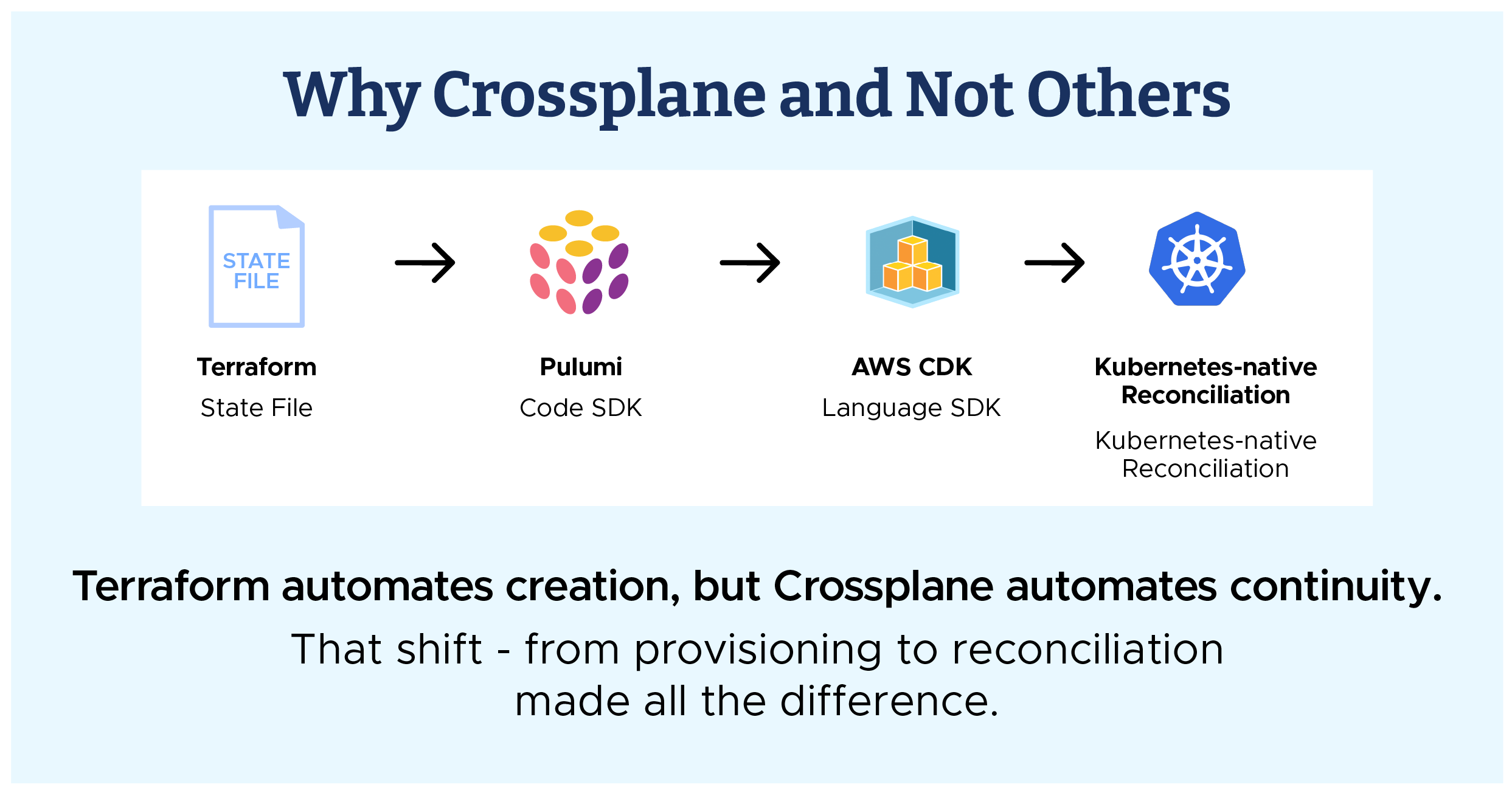
Takeaway: Terraform automates creation, but Crossplane automates continuity. That shift — from provisioning to reconciliation — made all the difference.
When we compared Crossplane and Terraform, one distinction stood out: execution model.
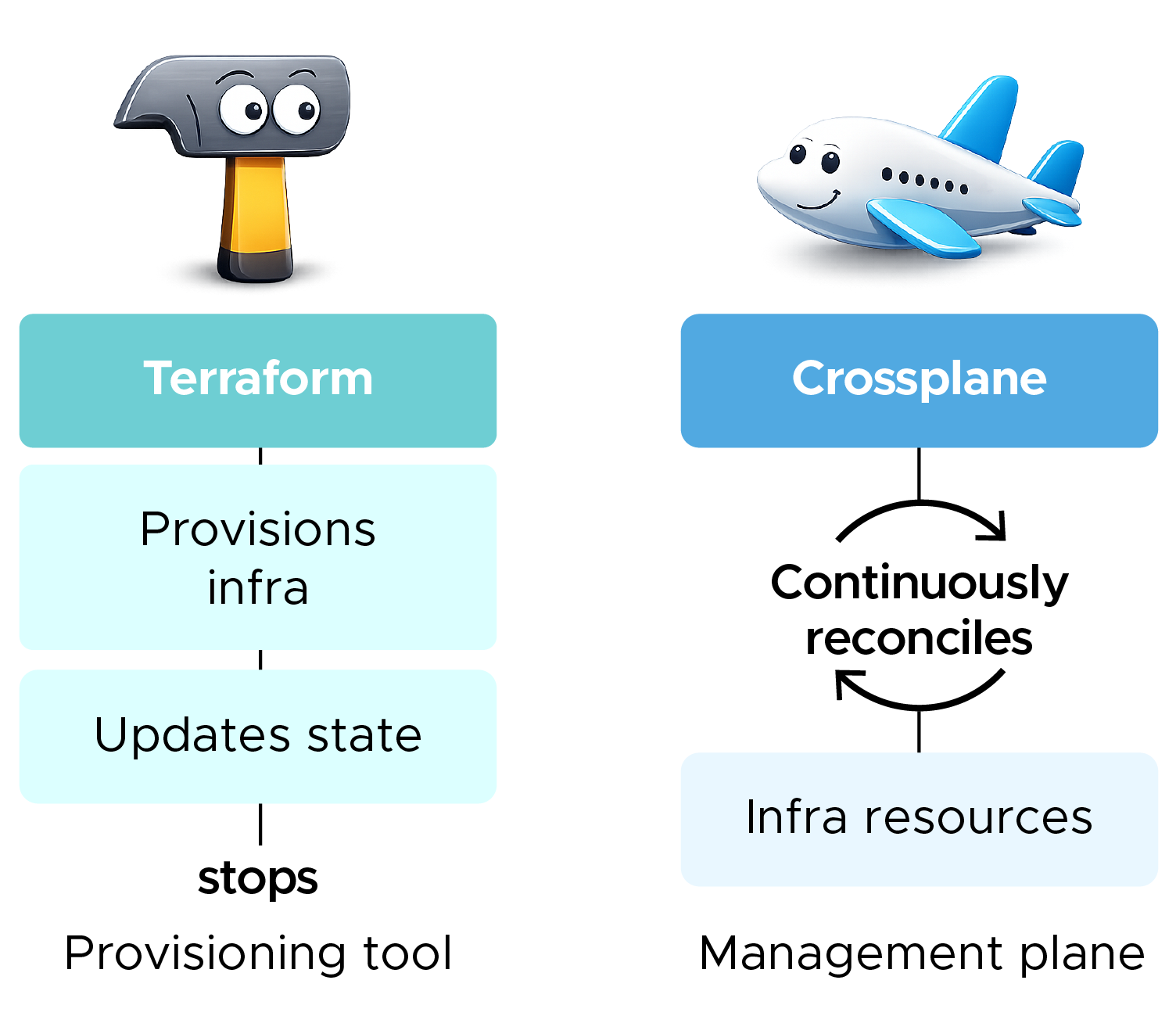
That continuous reconciliation loop is the critical advantage that makes Crossplane ideal for global, dynamic infrastructures.
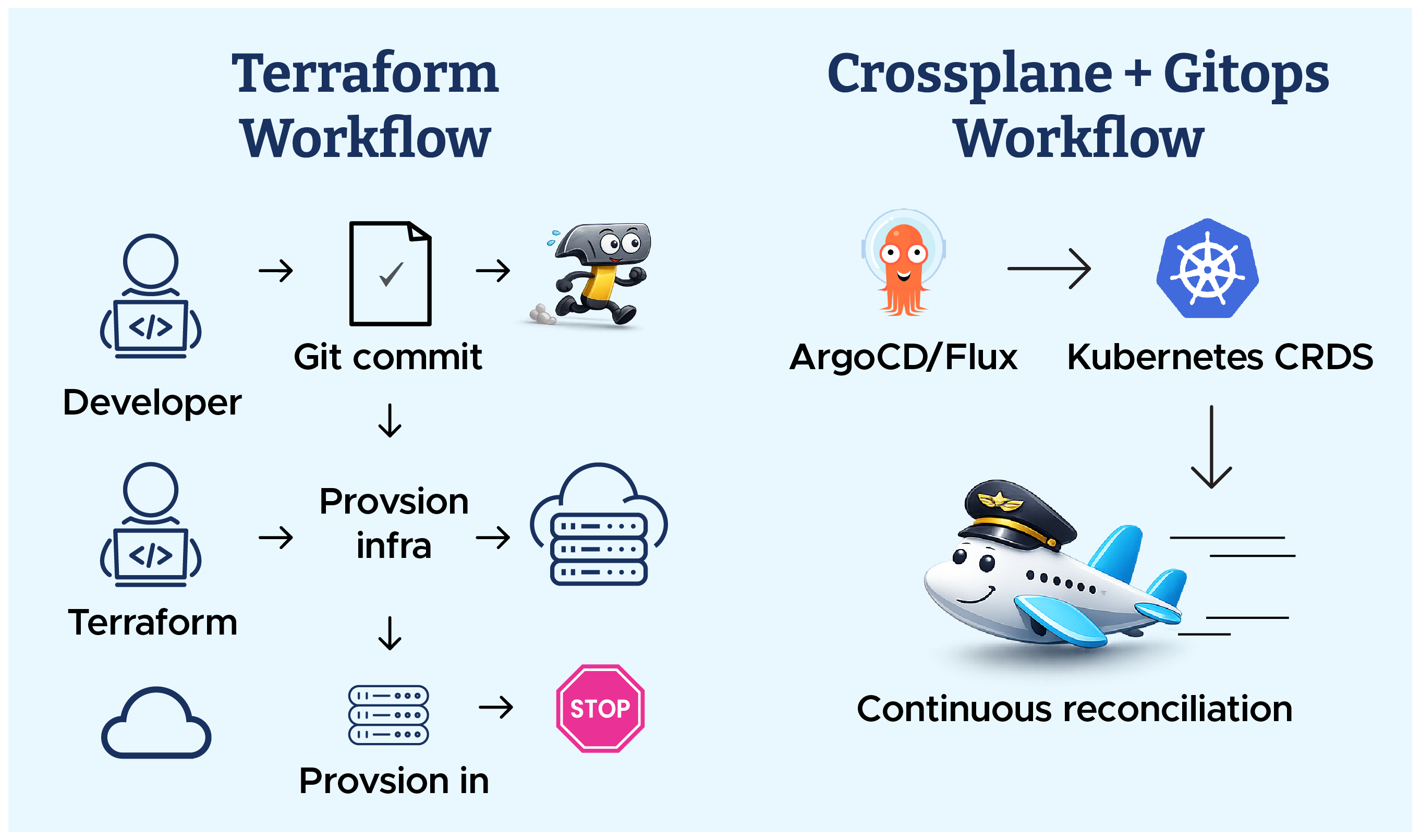
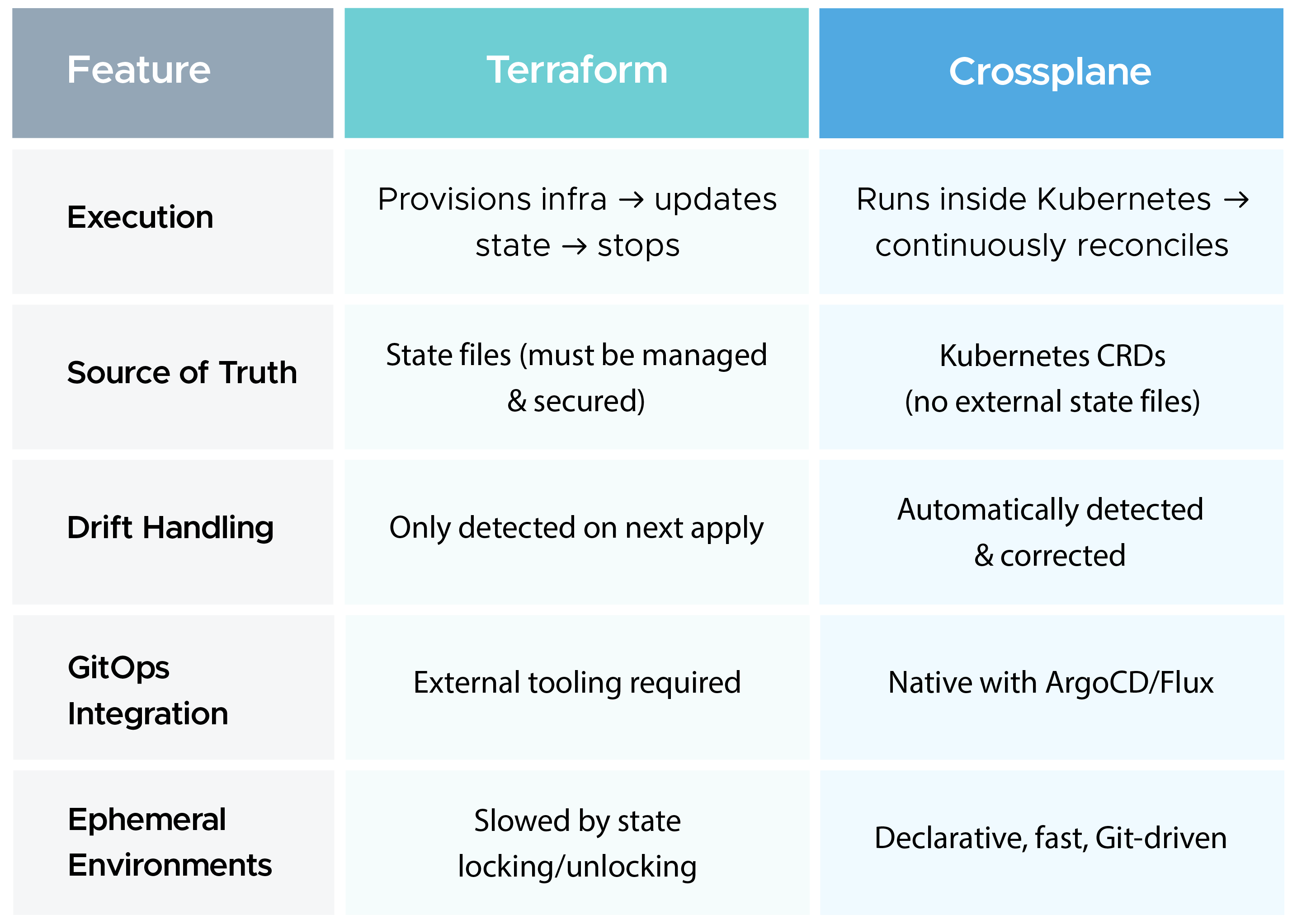
Takeaway: Terraform is a provisioning tool. Crossplane is a management plane. At a global scale, that difference is game-changing.
The “aha moment” was realizing Terraform lacked continuous reconciliation.
Kubernetes ensures pods match their declared state. Crossplane extends the same principle to cloud infra:
This was the missing piece in our puzzle.
Takeaway: Crossplane brings Kubernetes-style reconciliation to infra — always on, always in sync.
We didn’t start with abstractions (XRDs). Instead, we went straight to Crossplane Managed Resources (MRs):
Takeaway: Starting with MRs gave us speed without losing control — fast adoption with governance built in.
We didn’t throw Terraform away. Instead, we embraced a hybrid model:
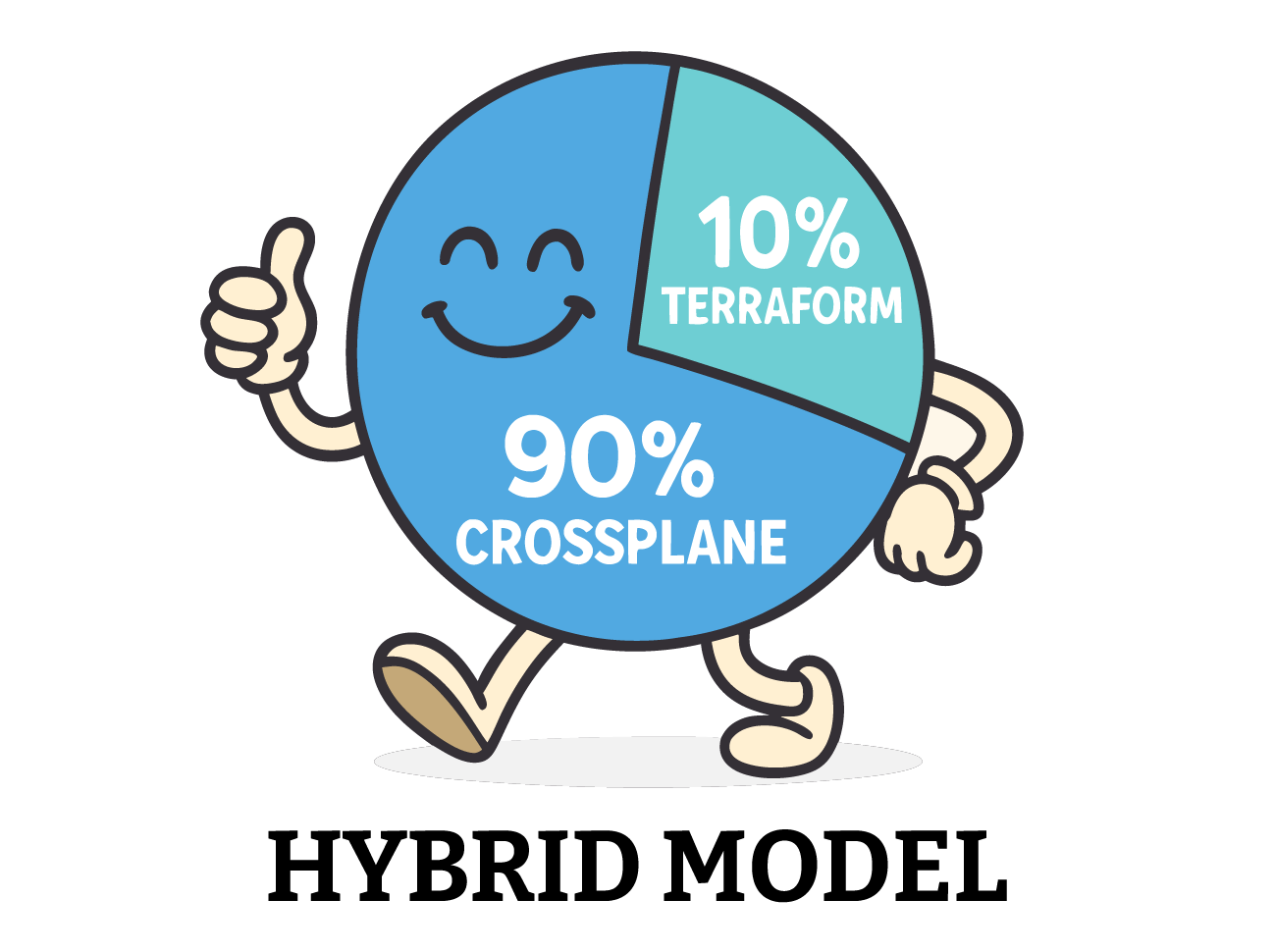
Takeaway: Crossplane powers the lifecycle; Terraform handles the edge cases.
Looking beyond Terraform wasn’t rejection. It was recognition of its limits at scale.
For a platform with global reach, 50+ microservices, and ephemeral infra needs, Crossplane’s reconciliation model was the missing piece.
With this decision, we laid the foundation for a GitOps-native infra strategy that:
Next: Blog 2 – Designing a Hybrid Crossplane Architecture, where we share the blueprint behind our production-ready hybrid model.
99% of companies saved up to 15% monthly with this plan & achieved peak performance.