



10
10Cloud cost management once depended on spreadsheets, static dashboards, and monthly reports to track cloud spend. That worked when cloud environments were smaller. It does not work anymore.
Modern cloud infrastructure changes every minute. Containers scale up and down. AI workloads consume unpredictable resources. Multi-cloud environments create thousands of billing data points every day. Finance teams need cloud cost visibility. Engineering teams need speed. Traditional FinOps tools struggle to keep up.
According to the 2025 State of FinOps report, 63% of organizations already manage AI-related cloud spending, up from 31% the previous year. At the same time, cloud waste is rising again. Recent industry reports estimate that nearly 29% of cloud spend is wasted, with AI workloads contributing to the increase for the first time in five years.
This is where AI FinOps is becoming important.
AI in FinOps helps businesses move from manual reporting to intelligent cloud cost decision-making. Instead of only showing cost data, AI systems can detect patterns, predict future spend, identify waste, and automatically recommend actions.
Cloud cost optimization involves tracking usage, but building cost intelligence across the organization.
What does cloud cost intelligence mean today?
Cost intelligence goes beyond dashboards and budget alerts.
Modern cloud environments generate massive volumes of usage, billing, and performance data every hour. AI FinOps platforms combine this data with operational context to help teams understand where cloud spend is increasing, why it is increasing, and what actions to take next.
The focus is no longer limited to cloud cost visibility. Organizations now need real-time insights that connect infrastructure usage with business priorities, application performance, and engineering efficiency.
AI in FinOps helps teams move from static reporting to continuous analysis. Modern platforms can process millions of cloud events in real time, identify underutilized resources, forecast spend trends, detect cloud anomalies, and recommend cloud optimization opportunities before costs escalate.
This creates a more proactive approach to cloud cost optimization. Instead of reacting to billing surprises after they occur, teams can make faster, more informed decisions as cloud environments evolve.
What are the limitations of traditional FinOps approaches?
Traditional FinOps practices helped organizations gain visibility into cloud spending. But cloud infrastructure has become far more dynamic than the systems for which these processes were designed.
Many FinOps teams still depend on reporting cycles, manual analysis, and disconnected tooling to manage costs. As cloud environments grow across containers, Kubernetes architecture, multi-cloud infrastructure, and AI workloads, these approaches become harder to scale.
Reactive reporting cycles
Many organizations still review cloud spending through daily, weekly, or monthly reports. By the time cost spikes are identified, unnecessary spending has often already accumulated.
Heavy dependence on manual analysis
Finance and engineering teams spend significant time manually reviewing billing exports, utilization reports, and usage logs. This slows optimization efforts and makes it harder to identify hidden inefficiencies across large cloud environments.
Fragmented tools and data silos
Cloud cost data is often distributed across observability platforms, billing systems, monitoring tools, spreadsheets, and cloud provider consoles. Without a unified view, teams struggle to connect usage patterns with business impact.
Delayed optimization actions
Traditional FinOps tools can surface recommendations, but execution still depends heavily on manual intervention. Delays in approvals or remediation workflows often lead to ongoing waste of resources.
These limitations are driving the adoption of AI FinOps platforms that can automate analysis, improve forecasting accuracy, and enable continuous cloud cost optimization.
How AI is transforming FinOps?
AI is changing how teams manage cloud costs. Traditional FinOps tools were built for reporting and visibility. AI FinOps platforms are built for continuous analysis and faster action.
Modern cloud environments generate massive amounts of billing, infrastructure, observability, and application data. AI in FinOps helps teams identify cloud cost patterns, detect inefficiencies, forecast spending, and automate optimization decisions with far less manual effort.
Finding patterns across large-scale cloud data
AI models can process millions of cloud events, usage records, and billing entries in real time. This helps teams detect spending behavior that would be difficult to identify manually.
For example, AI systems can identify workloads that scale inefficiently during peak hours, flag persistent idle resources, or detect services with unusually high storage or network costs.
This becomes especially important in AI infrastructure environments where GPU usage can spike unexpectedly. A single training workload or inference deployment can increase cloud costs within hours if usage is not monitored closely.
More accurate cloud spend forecasting
Forecasting cloud costs has always been difficult in fast-changing environments. Static forecasting models often fail when infrastructure usage changes suddenly due to deployments, migrations, seasonal traffic, or AI workloads.
AI-powered forecasting models analyze historical usage patterns, infrastructure behavior, application demand, and operational trends together. This improves forecast accuracy and helps finance teams plan budgets with better confidence.
This is becoming more important as AI spending grows rapidly across enterprises. According to the 2026 State of FinOps report, 98% of organizations now manage AI-related spend, compared to 31% two years ago.
Real-time anomaly detection
One of the biggest advantages of AI in FinOps is faster anomaly detection.
Traditional monitoring systems often identify billing issues hours or days later. AI-based systems can detect unusual spending behavior much earlier by continuously analyzing workload activity, resource consumption, and usage deviations.
This helps teams respond faster to issues like misconfigured deployments, abandoned GPU instances, unexpected traffic spikes, or uncontrolled Kubernetes scaling events.
Real-time visibility is increasingly important as cloud costs grow more dynamic and harder to predict.
Smarter recommendation engines
Modern AI FinOps platforms do more than generate static cost recommendations.
AI recommendation engines continuously learn from infrastructure usage, engineering behavior, and previous optimization outcomes. This helps generate more context-aware recommendations for rightsizing, storage optimization, workload scheduling, commitment planning, and resource allocation.
The recommendations improve over time as systems learn which optimization actions create savings without affecting application performance.
This matters because cloud optimization decisions are no longer limited to virtual machines and storage. Organizations now manage AI models, GPU clusters, token consumption, and inference workloads with highly variable usage patterns.
Continuous learning and automation
AI systems improve as they process more operational data.
Instead of relying solely on fixed thresholds or rule-based alerts, AI FinOps platforms automatically adapt to changing infrastructure behavior. This helps reduce false alerts and improves optimization accuracy over time.
Many organizations are also adopting AI agents for cloud cost management. These systems can continuously monitor environments, automatically recommend actions, and, in some cases, trigger remediation workflows without manual intervention.
This is pushing FinOps toward a more automated operating model, in which cloud cost optimization becomes an ongoing process rather than a monthly review.
What are the use cases of AI in FinOps?
Organizations are already using AI FinOps across day-to-day cloud operations. What started as reporting and budgeting has expanded into continuous monitoring, optimization, forecasting, and workload analysis.
AI in FinOps is helping teams respond faster to cloud cost changes while reducing manual effort across engineering and finance operations.
Resource rightsizing
One of the most common AI FinOps use cases is resource rightsizing.
AI systems analyze historical utilization, workload behavior, memory consumption, and traffic patterns to identify compute and storage resources that are oversized or underused.
Instead of relying on fixed utilization thresholds, recommendations are based on actual workload behavior over time. This helps teams reduce waste without affecting application performance.
Kubernetes cost optimization
Kubernetes environments are difficult to manage with traditional cost-optimization methods because workloads constantly scale.
AI helps teams track pod utilization, cluster efficiency, node sizing, and autoscaling behavior in real time. This makes it easier to identify idle capacity, overprovisioned clusters, and inefficient scaling configurations.
As container adoption grows, Kubernetes cost management is becoming a major focus area for AI FinOps platforms. (reddit.com)
Cloud anomaly management
Unexpected cloud spend often stems from deployment issues, abandoned resources, misconfigurations, or sudden traffic spikes.
AI-based anomaly detection systems continuously monitor infrastructure usage and billing activity to identify unusual spending behavior early. This helps teams investigate problems before costs increase significantly.
For example, AI systems can detect inactive GPU instances, excessive data transfer activity, runaway Kubernetes scaling events, or workloads consuming resources outside normal operating patterns.
Multi-cloud cost visibility
Many enterprises now run workloads across AWS, Azure, and Google Cloud simultaneously. Managing costs across multiple providers creates visibility challenges because billing structures, pricing models, and reporting systems differ across platforms.
AI-powered analytics platforms help unify cost data across cloud environments and identify optimization opportunities that may not be visible within individual provider dashboards.
This gives engineering and finance teams a more complete view of infrastructure efficiency across the organization.
AI workload optimization
AI infrastructure is becoming one of the fastest-growing areas of cloud spend.
Training models, running inference workloads, storing vector data, and managing GPU clusters can create highly unpredictable costs. Traditional FinOps tools were not designed for token based pricing, GPU allocation tracking, or model usage analysis.
AI FinOps platforms now help organizations monitor token consumption, GPU utilization, inference efficiency, model performance, and AI workload costs in real time.
This is becoming critical as enterprises increase investment in generative AI applications and large language model deployments. According to recent industry reports, GPU-related infrastructure demand is now one of the biggest drivers of cloud cost growth across enterprise environments.
What does Agentic AI mean in Cloud Cost Management?
One of the biggest developments in AI FinOps is the rise of intelligent agents. Agentic AI refers to systems that can make decisions and take actions with limited human involvement.
In cloud cost management, these agents continuously monitor infrastructure, identify inefficiencies, and automatically trigger optimization workflows.
Autonomous monitoring and remediation
AI agents can detect idle resources, shut down unused workloads, resize infrastructure, or adjust scaling policies without waiting for manual approval in low-risk scenarios.
This reduces operational overhead for engineering teams.
Closed-loop optimization systems
Traditional optimization workflows often stop after generating recommendations. Agentic AI creates closed-loop systems in which monitoring, analysis, recommendations, and remediation occur continuously.
This improves response times and reduces cloud waste.
Human in the loop governance
Automation still requires governance.
Most enterprises prefer human approval for high-impact optimization actions. AI systems should provide explainable recommendations and maintain clear audit trails.
This creates a balance between automation and operational control.
Conversational cost intelligence
Another major development in AI FinOps is conversational cost intelligence.
FinOps teams have traditionally relied on dashboards, exports, filters, and manual reports to answer cloud cost questions. This often slows down analysis and limits access to FinOps expertise.
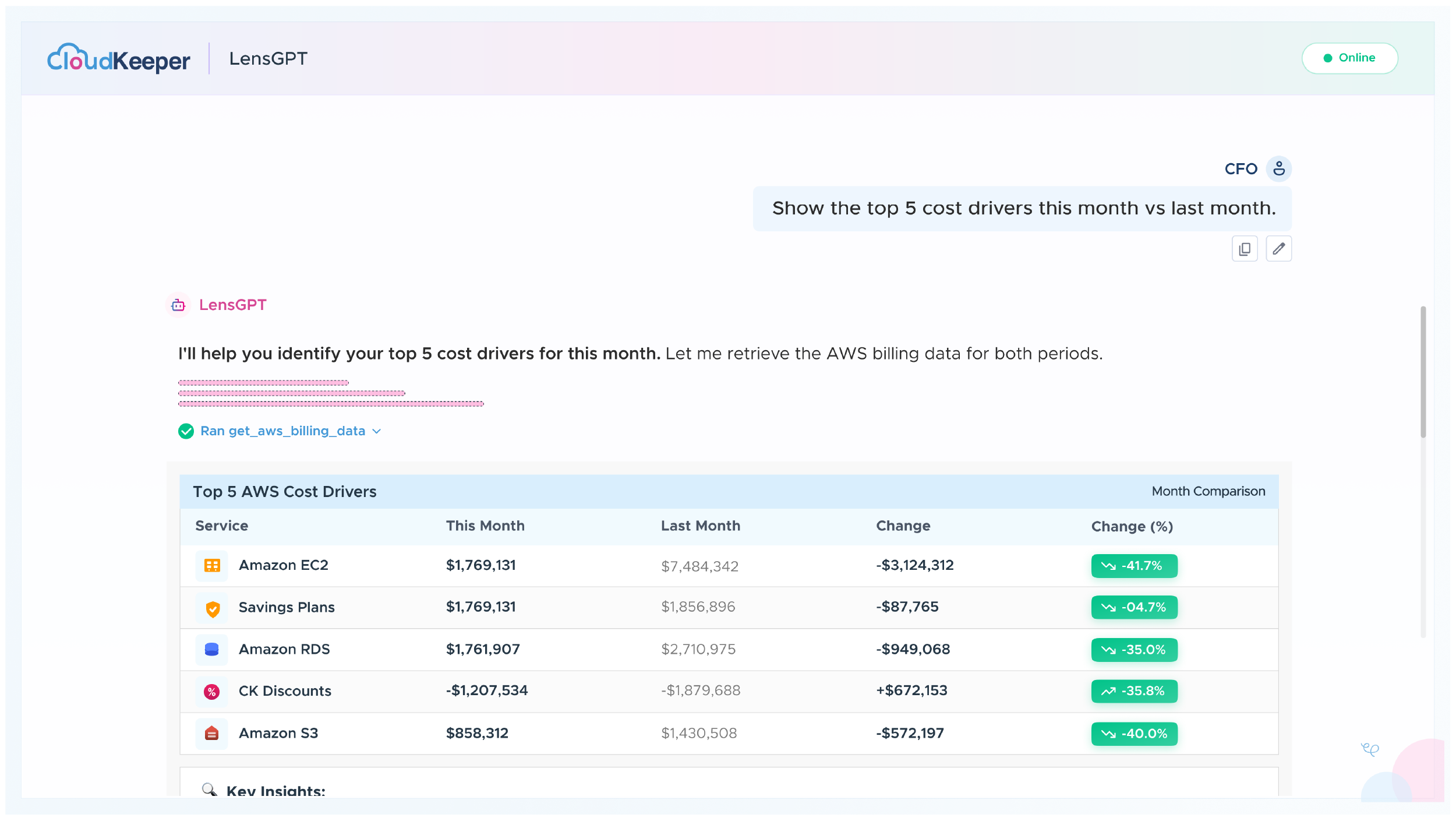
Platforms like CloudKeeper LensGPT are changing this model.
LensGPT acts as an agentic FinOps consultant, combining the capabilities of multiple AI-driven systems across finance, engineering, cloud operations, and optimization workflows.
Instead of manually navigating dashboards, teams can ask questions in natural language about cloud spending, workload efficiency, anomaly detection, optimization opportunities, or infrastructure trends.
The platform responds with contextual analysis, custom dashboards, root cause insights, projected savings opportunities, and implementation guidance in real time.
This makes cloud cost intelligence more accessible across engineering, finance, leadership, FinOps, and CloudOps teams.
LensGPT also addresses one of the biggest operational gaps in FinOps today. In many organizations, cloud cost expertise is concentrated within a small team. This creates bottlenecks for decision-making and slows optimization efforts.
By enabling teams to interact directly with cloud cost data through natural language, AI FinOps platforms democratize access to cloud financial insights.
Another important difference is infrastructure awareness.
Traditional reporting tools mostly analyze billing exports. LensGPT combines cost data with account structure, service relationships, cloud architecture context, regions, and environment-level intelligence to generate more relevant recommendations.
This helps organizations move from reactive reporting to more proactive cloud cost-optimization workflows.
What are the challenges in adopting AI for FinOps?
AI FinOps adoption also comes with practical challenges.
One of the biggest issues is data quality. Incomplete tagging, inconsistent resource naming, fragmented billing structures, and disconnected monitoring systems reduce the accuracy of AI-driven analysis.
Governance is another major concern.
Organizations need clear approval processes, role-based access controls, and operational boundaries before introducing automated remediation workflows. Without proper controls, automation can create operational risks rather than reduce them.
There is also the challenge of balancing optimization with performance.
Cloud cost recommendations should account for application reliability, latency requirements, engineering priorities, and security considerations. Reducing spend alone is not enough if it affects customer experience or business operations.
Many organizations are also facing a growing FinOps skills gap.
AI in FinOps now requires collaboration across finance, engineering, cloud operations, data teams, and AI practitioners. Teams need a stronger understanding of cloud economics, automation workflows, AI infrastructure costs, and governance practices.
What is the future of AI in cloud cost intelligence?
Cloud cost management is moving toward continuous and increasingly autonomous optimization systems. Future AI FinOps platforms will combine cloud billing intelligence, observability, infrastructure telemetry, AI analytics, automation, and governance into connected workflows.
Organizations will rely less on static monthly reviews and more on real-time optimization systems that operate continuously across cloud environments. AI will also play a larger role in GPU cost management, AI infrastructure optimization, sustainability tracking, workload efficiency analysis, and business-aligned governance models.
As AI workloads continue to grow, cloud cost management will become more closely connected with engineering operations, infrastructure planning, and business strategy.
Organizations that adopt AI FinOps early will be better positioned to improve operational efficiency, control cloud spend, and manage increasingly complex infrastructure environments.
Practical roadmap to get started with AI for FinOps
Organizations do not need to rebuild their FinOps strategy all at once.
The first step is improving visibility into cloud usage, billing, and infrastructure data. Strong tagging standards, centralized cost reporting, and clean resource metadata create the foundation for effective AI analysis.
From there, teams can gradually introduce AI-powered anomaly detection, forecasting, and optimization recommendations.
Automation should happen in phases. Start with low-risk workflows such as anomaly alerts, idle resource detection, or development environment scheduling before expanding into automated remediation.
Governance should remain a priority throughout the process. Organizations need clear approval models, access controls, policy guardrails, and audit visibility before scaling AI-driven optimization systems.
Most importantly, AI FinOps should be treated as an ongoing operational capability rather than a one-time cost reduction initiative.
The long-term goal should not be only to reduce cloud bills, but to build smarter, more adaptive cloud operations that can scale with modern infrastructure demands.