



7
7Introduction
Enterprises don’t suffer from missing information; they struggle with turning insight into immediate control, yet overspending continues.
Industry research highlights the scale of the issue. Gartner estimates that organizations can overspend on cloud infrastructure by as much as 70% without disciplined optimization practices, while the FinOps Foundation reports that nearly 28% of cloud spend is wasted due to idle or misconfigured resources. These findings point to a deeper gap in how cloud cost management is structured and executed.
AI is beginning to reshape FinOps strategies. Generative AI has improved cost analysis, reporting automation, and forecasting accuracy. Now, organizations are exploring a more advanced approach, Agentic AI, which enables systems to autonomously monitor cloud environments, make optimization decisions, and execute them in real time.
Evolution of AI in FinOps: From Dashboards to Actionable Intelligence
AI in FinOps has evolved in clear stages, each improving insight but not execution.
The first phase focused on dashboards and reporting. Organizations gained better transparency into cloud spending and stronger governance, but optimization required manual analysis and coordination across teams.
Machine learning then introduced forecasting and anomaly detection. Enterprises could predict overruns and spot inefficiencies earlier, improving financial planning. Still, cost corrections depended on human intervention.
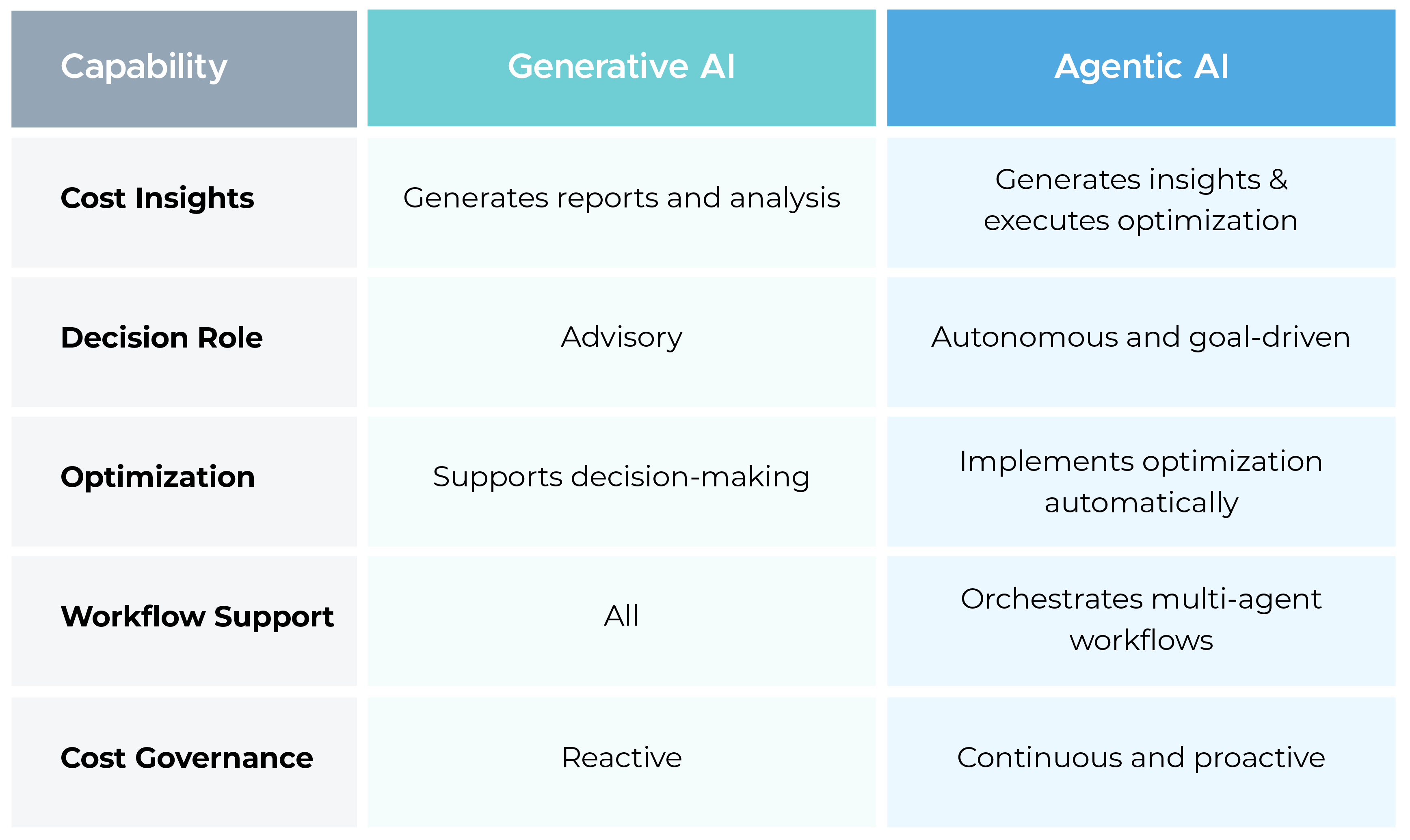
Generative AI accelerated this further. FinOps teams began using AI-driven cloud spend analysis tools to generate summaries, simplify billing data, and speed up collaboration. However, it remained advisory. Recommendations became faster, but execution stayed manual.
While cost intelligence has improved significantly, real-time execution has not, and that is exactly where Agentic AI will make the difference.
Generative AI in FinOps Today
Generative AI has already transformed several FinOps workflows.
1. Faster Cost Analysis and Reporting
Modern FinOps teams use AI to convert billing data into actionable insights, enabling:
- Automated reporting workflows
- Improved financial transparency
- Faster executive decision-making
2. Improved Forecasting and Budget Planning
Generative AI analyzes historical usage trends to support accurate financial forecasting and capacity planning. McKinsey research shows that cloud adoption delivers 5-9% absolute EBITDA lift across various industries, with some sectors experiencing even higher returns.
3. Advanced Anomaly Detection
AI models can detect unusual cost spikes by monitoring real-time consumption patterns and highlighting misconfigured infrastructure or inefficient resource allocation.
4. The Execution Gap
Despite these advantages, Generative AI remains advisory. FinOps teams still coordinate with engineering teams to implement optimization recommendations. This delay often reduces the financial impact of cost-saving opportunities.
Why 2026 Marks a Turning Point for AI in Cloud Cost Management
Several industry trends are driving the transition toward Agentic AI in FinOps
- Rising Multi-Cloud Complexity - Enterprises increasingly operate across multiple cloud providers to improve resilience and performance. According to MarketsandMarkets, the Cloud FinOps market is expected to grow to $26.9 billion by 2030, reflecting the growing need for unified cost governance across distributed environments.
- AI Workloads Are Increasing Cost Volatility - AI-driven applications are introducing new cost challenges. IDC reports that over 84% of AI infrastructure investments are now cloud-based, significantly increasing spending variability and optimization complexity.
- Automation Is Becoming an Enterprise Imperative - McKinsey research indicates organizations implementing AI-powered automation achieve 20–30% efficiency improvements. These gains are accelerating enterprise adoption of autonomous operational models, including cloud cost optimization.
How Agentic AI Advances Beyond Generative AI in Cloud FinOps
Agentic AI introduces autonomous intelligence into Cloud FinOps by combining monitoring, decision-making, and execution.
1. Autonomous Cloud Cost Optimization- Agentic AI continuously evaluates infrastructure performance and automatically implements optimization strategies such as:
- Rightsizing compute instances
- Eliminating idle workloads
- Adjusting storage configurations
- Enforcing budget governance policies
These capabilities enable continuous cloud optimization strategies. By shifting from reactive cost management to proactive, autonomous optimization, organizations build a self-regulating cloud environment. The result is sustained savings, improved performance, stronger compliance, and reduced operational overhead, all without increasing manual effort from FinOps or engineering teams.
2. Proactive Execution Instead of Reactive Alerts -Traditional FinOps tools rely on alert-based responses. Agentic AI strengthens automated FinOps governance frameworks by initiating optimization actions immediately, reducing cost leakage.
3. Multi-Agent Collaboration Across FinOps Workflows - A mature Agentic AI platform deploys specialized agents responsible for different tasks:
- Monitoring agents track infrastructure performance
- Financial agents manage forecasting and budget alignment
- Governance agents enforce compliance policies
This collaborative architecture enables seamless coordination across finance, engineering, and operations teams.
Key Trends in Agentic AI for FinOps
Agentic AI is more than an upgrade in analytics. It brings autonomous intelligence into cloud cost management, enabling systems to move beyond recommendations and take action. As enterprises look to strengthen Cloud FinOps outcomes, several clear trends are shaping how Agentic AI is being implemented.
1. Real-Time Cost Visibility with Automated Remediation - Enterprises increasingly require real-time monitoring combined with automated remediation to eliminate inefficiencies instantly.
2. Context-Aware Optimization - Agentic AI evaluates workload dependencies and business priorities before implementing cost optimization actions, ensuring performance stability.
3. Integration with Automation Ecosystems - Agentic AI integrates with:
- CI/CD pipelines
- Infrastructure-as-Code platforms
- Enterprise cloud infrastructure automation strategies
Benefits for FinOps Teams
In simple terms, Agentic AI helps FinOps teams move from reviewing costs to actively controlling them. Instead of spending time analyzing reports and coordinating fixes, teams can rely on intelligent systems to monitor usage, prevent waste, and optimize spending continuously. This leads to clear operational and financial gains.
- Increased Productivity - Automation reduces manual analysis tasks, allowing teams to focus on strategic governance.
- Faster Optimization Cycles - Autonomous execution ensures cost savings are captured in real time.
- Stronger Financial Accountability - Continuous monitoring improves budget compliance and financial transparency.
- Expanded FinOps Scope - FinOps Foundation research indicates that 65% of organizations now include SaaS cost management and FinOps is expanding into enterprise-wide cost governance.
Challenges and Considerations
While Agentic AI offers clear advantages for Cloud FinOps, adoption requires careful planning. Autonomous systems can improve efficiency, but they must operate within defined boundaries. Enterprises need the right governance, skills, and data foundation to ensure AI-driven optimization delivers consistent and reliable outcomes.
- Governance of Autonomous AI Actions - Enterprises must define guardrails that ensure AI-driven optimization aligns with compliance and performance objectives.
- Workforce Transformation - FinOps professionals must evolve from cost analysts into AI supervisors responsible for monitoring agent behavior.
- Data Quality and Integration - Reliable optimization depends on consistent billing and usage data across multi-cloud environments.
Preparing for Agentic AI in Your FinOps Strategy
- Integrate Agentic AI with Generative AI Workflows - Organizations should begin by leveraging reporting automation and forecasting intelligence before introducing autonomous optimization. This approach supports sustainable AI-driven FinOps transformation frameworks.
- Establish Governance and Risk Policies - Clear policies and audit mechanisms help maintain control over AI-driven decisions.
- Choosing the Right Tools and Platforms – LensGPT - Selecting a robust Agentic AI platform is critical to successful adoption. LensGPT combines predictive intelligence, automated execution, and governance controls to help enterprises strengthen Cloud FinOps practices while maintaining operational transparency.

Agentic AI as the Future of Intelligent FinOps
Cloud investments continue to grow, increasing financial governance complexity. Generative AI has improved cost intelligence, but Agentic AI is redefining how enterprises execute optimization strategies.
By enabling:
- Autonomous decision-making
- Real-time remediation
- Multi-agent collaboration
Agentic AI is transforming Cloud FinOps into a self-optimizing discipline.
Organizations that adopt this approach will gain stronger cost control, improved operational agility, and sustained cloud ROI. As cloud environments grow more complex, autonomous financial governance will become essential for maintaining efficiency and competitive advantage.
Frequently Asked Questions
- Q1. What is Agentic AI in FinOps?
Agentic AI refers to autonomous AI systems that monitor, analyze, and optimize cloud spending while executing optimization strategies without manual intervention.
- Q2. How is Agentic AI different from Generative AI?
Generative AI provides cost insights and recommendations, while Agentic AI can execute optimization decisions independently.
- Q3. Why is Agentic AI important for Cloud FinOps?
It enables continuous optimization, reduces manual workload, and strengthens financial governance across multi-cloud environments.
- Q4. How can enterprises adopt Agentic AI?
Organizations can begin by integrating Generative AI workflows with autonomous optimization platforms and establishing governance frameworks.