



DevOps Engineer
Ankit specializes in Google Cloud Platform (GCP) and architecting GCP WAR optimization strategies and automations that simplify, scale, and secure cloud workloads.
 Webinar
17 Jul, 2026 | 13 Min read

Google Cloud Platform (GCP) Committed Use Discounts (CUDs) allow organizations to exchange predictable long-term cloud consumption for discounted pricing, reducing costs compared to fully on-demand infrastructure. By providing Google Cloud with greater demand predictability, commitments enable more efficient capacity planning while giving customers lower costs and improved price stability. This creates a strategic trade-off between flexibility and savings, making CUDs not merely a billing optimization tool but a key component of infrastructure planning, FinOps governance, cloud cost optimization, and long-term cloud cost management.
Before we move forth deep diving into the corners of CUDs, it is imperative that we remove the confusion between CUDs and SUDs:
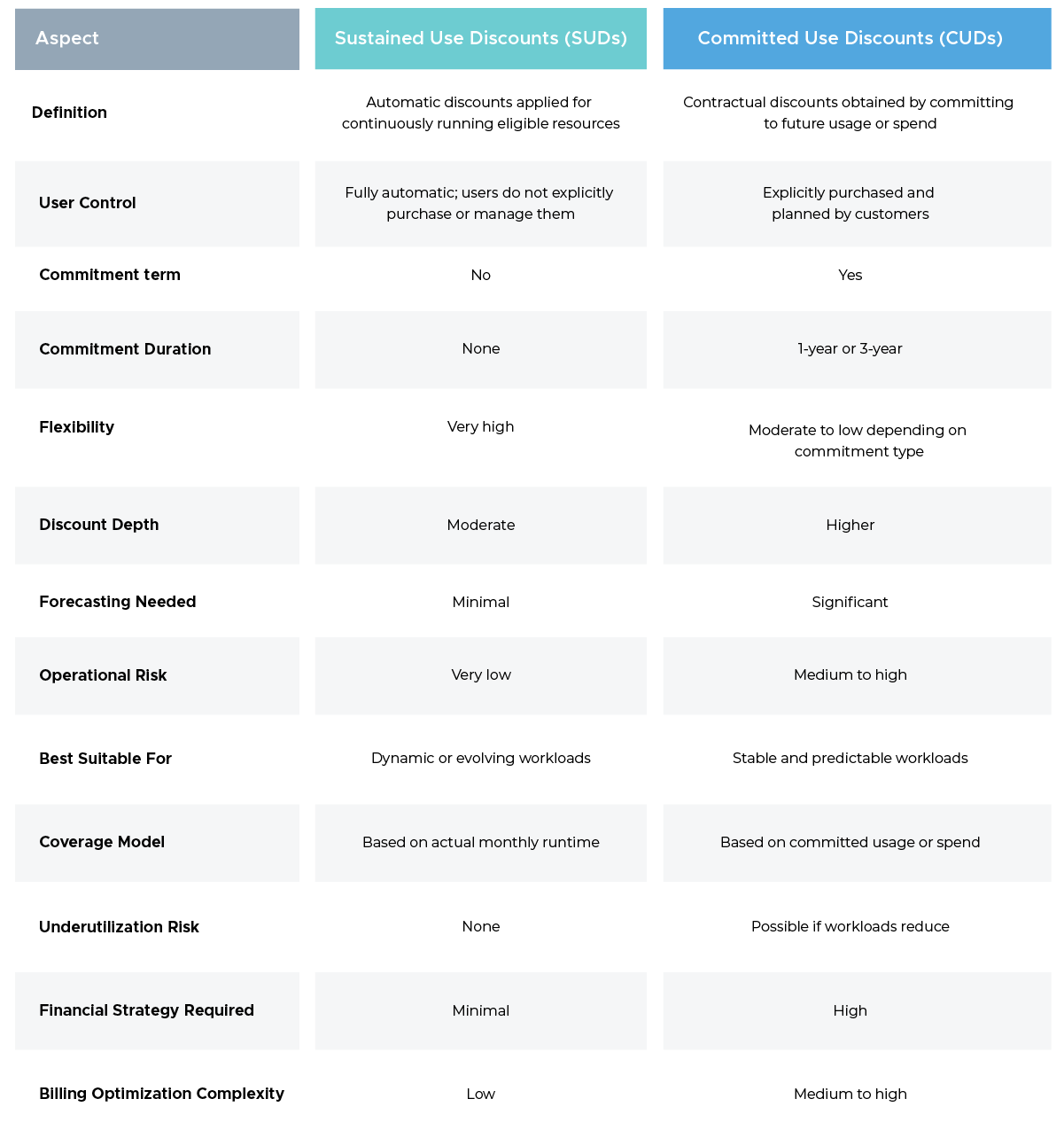
Google Cloud offers multiple commitment structures, each designed around different workload predictability patterns, infrastructure flexibility requirements, and operational behaviors, broadly divided into two commitment models:
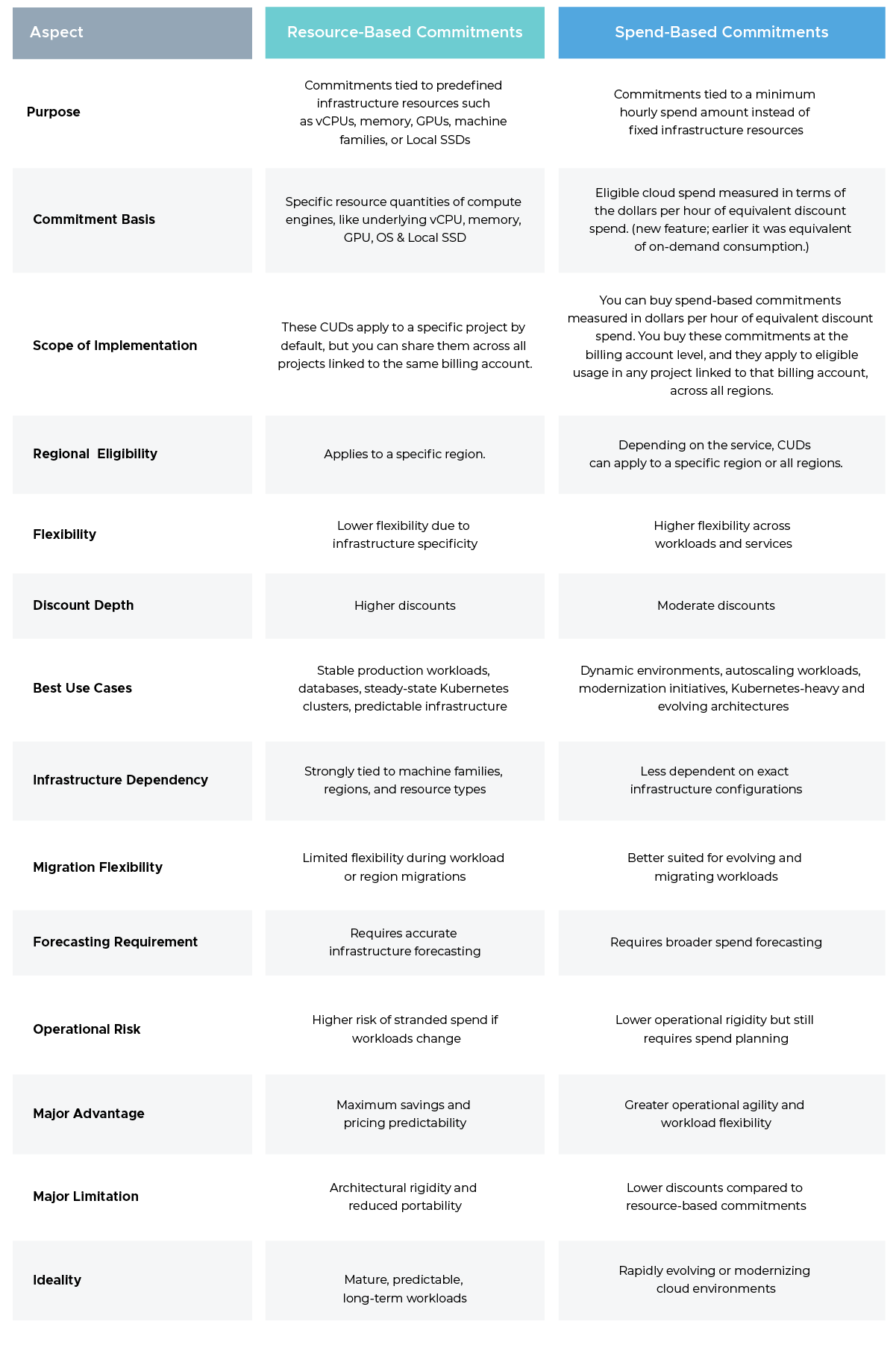 Spend-based commitments
The discount applies to the set of eligible resources for each service, and the commitment term is one or three years.
With spend-based CUDs, you keep receiving discounted rates until your hourly spend on eligible resources and services meets your hourly committed spend amount. Any overage usage that takes your hourly spend amount over your committed amount is charged at the on-demand rate. Spend-based CUDs apply to eligible usage in any projects that the Cloud Billing account pays for.
Depending on the Google Cloud service that you use, you can purchase spend-based commitments in one of the following ways:
Service-specific spend-based CUDs are available for the following Google Cloud services. Some commitments from this list (*) are no longer available for purchase, but Google supports any existing, active commitments until they expire.
You can purchase Compute Engine resource-based commitments for the following hardware and software resources for a term duration of one or three years:
Commitments for hardware resources are separate from the ones for OS licenses. You can purchase both categories of commitments for the same virtual machine (VM) instance, but you cannot purchase a single commitment that covers both hardware resources and licenses.
Strategizing commitment purchase is a major requirement for running an efficient cloud infrastructure that manages a smooth cloud FinOps structure and achieves effective GCP cost optimization There are plenty of methods you can utilize to employ strategies as mentioned ahead to buy safe and smart commitments for your cloud infrastructure.
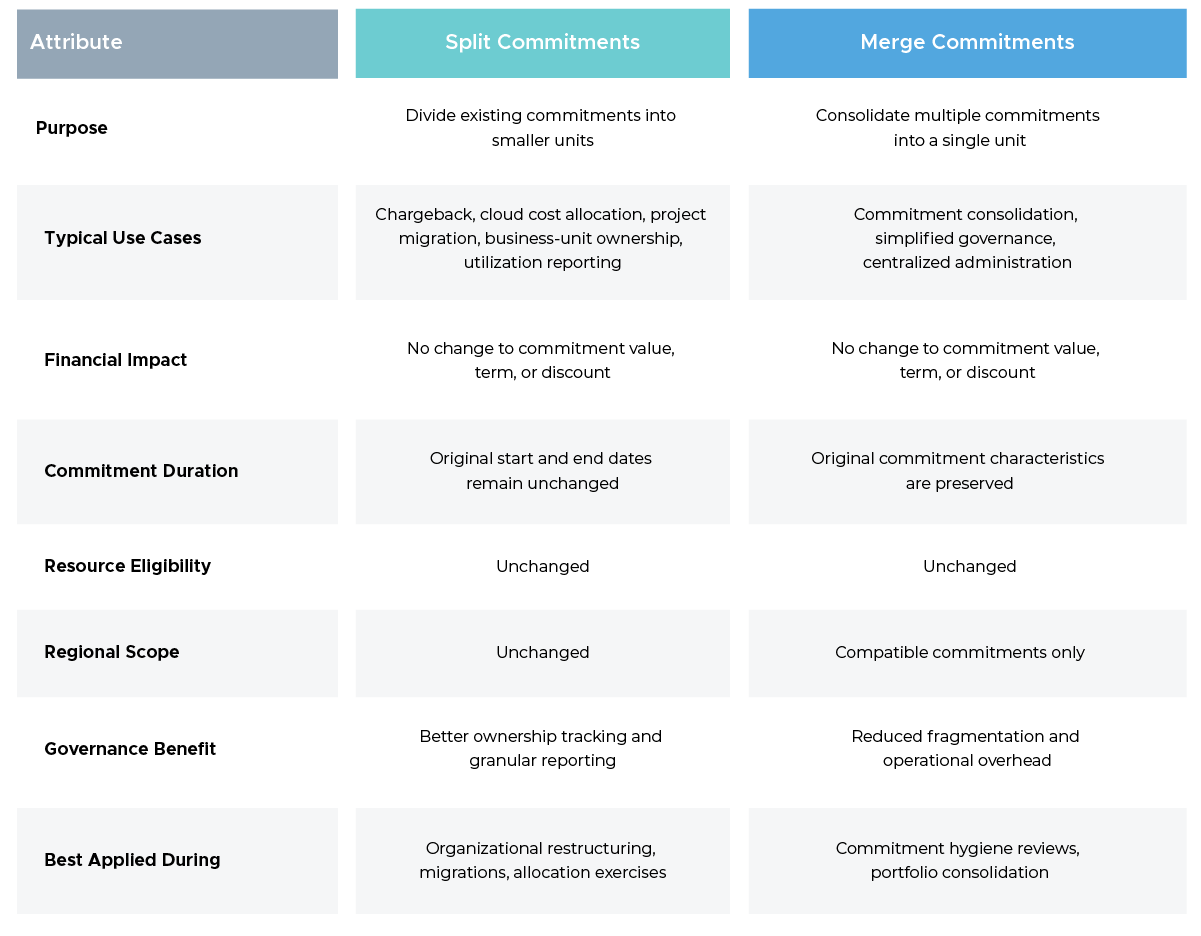 For cloud FinOps teams, split and merge operations are less about cloud cost optimization and more about commitment lifecycle management. They help organizations maintain clean commitment inventories, support evolving organizational structures, and preserve reporting accuracy without disrupting existing commitment benefits.
Google Cloud commitments are typically available in 1-year terms and 3-year terms. However, one of the lesser-known strategic capabilities in Google Cloud is commitment term extension. Google allows eligible resource-based commitments to be extended before expiration through the Term Extension Eligibility Window.
Google Cloud allows eligible resource-based commitments to be extended after the first five months of the original commitment term, enabling organizations to proactively lock in discounted pricing and maintain long-term cost predictability. By strategically extending commitments before expiration, organizations can preserve favorable pricing, align commitments with future infrastructure plans, and reduce exposure to potential pricing changes.
This capability is particularly valuable for long-lived production environments, AI infrastructure growth, and organizations seeking multi-year pricing stability. However, extensions are only supported for eligible resource-based commitments, and they do not alter existing resource, machine-family, or regional constraints associated with the commitment.
Google Cloud applies commitments using predefined attribution rules that determine how eligible usage consumes available commitments. This becomes particularly important in environments with overlapping commitments, shared billing structures, or layered commitment strategies, as attribution behavior directly influences utilization and realized savings. Mature organizations account for these rules when designing workload placement, billing architecture, and commitment portfolios to maximize commitment efficiency and minimize unused coverage.
In enterprise environments, the effectiveness of a CUD strategy depends not only on what commitments are purchased but also on where they are purchased and how billing structures are designed. Multi-project architectures, centralized billing models, shared platforms, and organization-wide FinOps governance can significantly influence commitment utilization, coverage, and flexibility, making organizational and billing design a critical component of long-term commitment optimization and cloud cost management.
One of the most powerful commitment optimization capabilities in Google Cloud is commitment sharing across projects within the same Cloud Billing Account. Spend-based commitments are inherently purchased and applied at the billing-account level, allowing eligible usage across all attached projects to automatically consume the commitment and benefit from discounted pricing.
Resource-based commitments, however, are project-scoped by default. Google Cloud provides CUD scope and sharing controls that allow eligible resource-based commitments to be shared at the billing-account level, enabling multiple projects to consume the same commitment pool. This significantly improves commitment utilization, reduces the risk of stranded capacity within individual projects, and simplifies commitment management for organizations operating centralized billing models.
While shared commitments increase flexibility, they do not remove the underlying commitment constraints. Resource-based commitments must still satisfy matching requirements such as machine family, resource type, and regional eligibility. As a result, commitment sharing improves utilization across projects, but it does not convert resource-based commitments into universally applicable discounts.
When a project is migrated from one Cloud Billing account to another, the resulting CUD behavior primarily depends on two factors:
The outcome of a project migration is largely determined by the scope of the commitment. Because spend-based commitments are tied to Cloud Billing Accounts, moving a project to a different billing account immediately changes which commitments the project can consume. The project will either benefit from commitments available in the destination billing account or revert to on-demand pricing if no eligible commitments exist.
Resource-based commitments behave differently. Project-scoped commitments generally continue applying after migration, while shared resource-based commitments remain associated with the billing account where they were configured and therefore do not follow the project during the move. Whereas changing the billing account would simply mean direct wastage and termination of CUDs bought on the billing account scope, since they are not transferable until special case support is raised with Google, where CUD transfer may entirely depend on the transgression of Google Cloud Support.
The inverse is equally true: projects migrated into a billing account containing active shared commitments can automatically begin receiving commitment coverage. This highlights a key architectural principle of Google Cloud commitment planning; commitment consumption follows scope and ownership boundaries, not project movement.
Commitment efficiency and GCP cost optimization is heavily influenced by organizational and billing architecture. Since most commitment attribution in Google Cloud is governed at the Cloud Billing Account level, fragmented billing structures can reduce utilization, create isolated optimization pools, and complicate migrations or organizational changes.
Mature organizations typically centralize commitment ownership through shared billing models while maintaining operational separation through folders, projects, labels, and cloud cost allocation mechanisms. This approach maximizes commitment utilization, simplifies governance, and provides greater flexibility as infrastructure and organizational structures evolve.
Google Cloud's February 2026 update to spend-based Committed Use Discounts (CUDs) represents one of the most significant commitment-management enhancements since the introduction of Compute Flexible CUDs. While the announcement emphasized billing simplification and expanded service coverage, its broader impact extends far beyond reporting improvements. The update fundamentally changes how organizations purchase commitments, measure savings, monitor utilization, and govern commitment strategies across their cloud environments.
Historically, spend-based CUDs operated through a credit-based mechanism. Customers committed to a specified hourly spend level while infrastructure continued to be billed at on-demand rates. Savings were then applied separately as commitment credits.
Although financially accurate, this model made commitment analysis unnecessarily complex. FinOps teams often had to reconcile on-demand charges, commitment fees, and commitment credits before they could determine actual savings or effective infrastructure costs.
The February 2026 redesign replaces this approach with direct discounted pricing. Eligible usage is now billed directly at the discounted commitment rate, eliminating the need for separate credit reconciliation. As a result, commitment costs and realized savings become immediately visible within billing data.
For organizations managing large-scale cloud environments, this significantly simplifies budgeting, forecasting, chargeback models, savings validation, and commitment reporting. Instead of interpreting multiple billing constructs, teams can now evaluate commitments using the actual discounted cost of consumed infrastructure.
This pricing model change also alters how organizations think about commitment planning.
Under the legacy model, commitments were purchased against estimated on-demand spend. With the new model, commitments are effectively purchased against discounted eligible spend. While the economics remain unchanged, the commitment value itself is now expressed in terms of the discounted consumption amount rather than the original on-demand cost.
This shift encourages organizations to focus more directly on actual covered spend, commitment utilization behavior, and long-term consumption baselines when evaluating commitment opportunities.
The update also broadens the scope of Compute Flexible CUDs by extending eligibility to additional services and infrastructure categories, including Cloud Run, memory-optimized VM families, H3 and M-series machine families, GKE workloads, and other high-performance computing resources.
This expansion reflects how modern cloud environments operate today. Organizations increasingly run workloads across virtual machines, Kubernetes platforms, serverless services, and specialized compute infrastructure rather than relying solely on traditional Compute Engine deployments.
By extending Flexible CUD coverage to a broader set of services, Google enables organizations to optimize a larger share of their cloud spend with a unified commitment strategy, rather than managing multiple service-specific commitment models.
Effective commitment management and cloud cost visibility depend on understanding not only how much capacity is covered, but also when it is being consumed.
To support this, Google introduced hourly utilization and coverage visibility within the CUD Analysis experience. Previously, many commitment evaluations relied primarily on daily aggregated metrics, which often obscured short-duration utilization gaps and intermittent commitment wastage.
Hourly analysis enables FinOps teams to identify periods of underutilization, commitment saturation events, workload scheduling inefficiencies, and coverage fluctuations that would otherwise be hidden in daily averages. This level of visibility allows organizations to make more informed decisions about commitments and improve overall utilization efficiency.
The update also improves attribution accuracy for environments that use combinations of Compute Flexible CUDs, GKE commitments, and Cloud Run commitments.
Under previous reporting models, it was not always straightforward to determine which commitment generated specific savings. This occasionally introduced ambiguity into utilization reporting, coverage calculations, and commitment performance analysis.
The new spend-based framework provides more accurate attribution of commitment benefits across services, improving savings validation, internal chargeback processes, and organization-wide FinOps reporting.
To support advanced analytics and automation, Google has also introduced spend-based CUD metadata exports that integrate with Cloud Billing BigQuery exports.
This additional visibility allows organizations to build custom commitment dashboards, automate governance workflows, support FinOps automation, perform deeper utilization analysis, correlate commitment behavior with business metrics, and develop reporting frameworks tailored to their internal FinOps practices.
What These Changes Mean for FinOps Teams: Since the February 2026 enhancements, Google Cloud’s spend-based CUD program has evolved beyond a simple billing-system update into a more mature commitment management framework. By simplifying commitment economics, broadening the applicability of commitments across services, improving utilization visibility, enhancing attribution accuracy, and expanding programmatic access to commitment data, Google has made commitments significantly easier to purchase, monitor, govern, and optimize. The result is a commitment model that better reflects the complexity of modern multi-service cloud environments while enabling FinOps, Cloud Operations, and Finance teams to achieve more accurate reporting, stronger governance, improved commitment efficiency, and greater confidence in long-term cloud investment planning.
The primary concern behind purchasing any CUD is committing to future infrastructure consumption that may change due to modernization, migration, rightsizing, architectural redesign, or evolving business requirements.
Once purchased, commitment terms, pricing, and contractual duration are generally fixed for the lifetime of the commitment. However, depending on the commitment type, Google Cloud offers limited flexibility through mechanisms such as commitment sharing, split-and-merge operations, term extensions, project mobility, and reservation management. Not all commitment types support all modification options, making upfront planning critical.
Google Cloud does not provide a standard self-service process for canceling active commitments before their contractual end date, and official documentation generally treats commitments as fixed-term purchases.
In exceptional circumstances, organizations may engage Google Cloud Billing Support to review specific cases; however, Google provides no published SLA, guarantee, or documented entitlement for cancellation of commitments, and any mitigation remains subject to Google's review and approval. Hence, it is advisable to raise a Google Cloud Billing Support ticket and cooperate with the available support and follow the steps provided.
Not all Google Cloud services should be optimized using the same commitment strategy. While some services directly benefit from Compute CUDs, others rely on separate reservation or capacity-based models, making service-specific planning essential for effective cloud cost optimization.
BigQuery uses a capacity-planning model based on slot reservations and capacity commitments rather than traditional Compute CUDs, making workload concurrency and reservation utilization the primary optimization factors. Cloud Composer has no dedicated commitment model and is optimized indirectly through commitments applied to the underlying GKE, Compute Engine, and Cloud SQL resources it consumes.
For Cloud Run and GKE Autopilot, commitment optimization has increasingly shifted toward spend-based commitments as Google Cloud continues abstracting infrastructure management away from customers. In contrast, GKE Standard remains closely tied to the underlying Compute Engine infrastructure, making baseline node consumption a key consideration in commitment planning.
GPU and AI workloads require a different approach altogether, where infrastructure availability is often as important as pricing. In these environments, organizations commonly combine reservations for capacity assurance with commitments for cloud cost optimization, ensuring both resource availability and long-term pricing efficiency.
Purchasing a CUD creates savings potential, but sustaining those savings requires ongoing governance. As workloads evolve through rightsizing, migrations, and modernization efforts, commitment alignment can gradually drift from actual consumption patterns. Google Cloud's CUD analysis capabilities help organizations monitor utilization, coverage, and realized savings, enabling early identification of underutilized commitments, coverage gaps, and optimization opportunities before they become long-term inefficiencies.
Committed-use discounts are not merely a cost-saving mechanism; they are a strategic tool at the intersection of infrastructure planning, FinOps governance, and cloud economics. Organizations that extract the most value from CUDs are those that understand their workload behavior, align commitments with predictable consumption, and continuously adapt their commitment strategy as their cloud environment evolves.
Ultimately, successful commitment planning is not about maximizing commitments; it is about maximizing the value, flexibility, and efficiency of the commitments you choose to make.
99% of companies saved up to 15% monthly with this plan & achieved peak performance.