



7
7There was a time when AWS support was something you rarely thought about. It sat in the background, used only when issues came up. Today, it is much more involved. From faster response times to ongoing guidance, support has become closely tied to how teams run and manage their cloud environments.
With the introduction of updated support tiers, AWS is reshaping how businesses access technical expertise, proactive guidance, and operational assistance. While these changes bring new capabilities, they also introduce an important transition in how support is structured and priced.
To understand what this means, it is important to first look at how AWS support was structured earlier, and how the new model changes that approach.
What are the older AWS Support plans?
For years, AWS offered a tiered support structure designed to cater to organizations at different stages of cloud adoption. These tiers included Basic, Developer, Business, Enterprise On-Ramp, and Enterprise Support.
The Basic plan was free and provided access to documentation, whitepapers, and limited health checks. It was suitable for experimentation or early-stage usage but did not include direct technical support.
The Developer plan was the entry-level paid tier, offering business-hours access to support engineers and guidance for non-critical workloads. It was primarily used by small teams building and testing applications.
The Business plan was designed for production environments. It introduced 24/7 cloud support, faster response times, and access to tools like Trusted Advisor, making it a common choice for growing organizations.
Enterprise On-Ramp acted as a bridge between Business and Enterprise tiers. It offered improved response times and some level of proactive guidance, suitable for teams scaling their cloud footprint.
At the top, Enterprise Support provided the most comprehensive coverage. It included a dedicated Technical Account Manager, proactive cloud architecture reviews, and rapid response times for critical workloads.
While this model offered flexibility, it also created fragmentation. Choosing the right tier was not always straightforward, and the jump in cost between levels, especially toward Enterprise, was significant. As cloud environments evolved, this structure began to show its limitations.
What has changed in the new AWS Support model?
AWS continues to offer the Basic plan as the default, no-cost support tier, while restructuring its paid support offerings around three primary paid tiers: Business Support+, Enterprise Support, and Unified Operations.
Business Support+ is positioned as the new default paid tier, combining AI-powered troubleshooting with 24/7 expert access. It is set to replace both Developer and Business plans over time.
Enterprise Support continues to serve organizations running critical workloads but now comes with improved accessibility and deeper integration of AI-driven insights.
Unified Operations is the most significant addition. It moves beyond traditional support by introducing proactive monitoring, faster incident response, and deeper operational involvement.
At the same time, AWS is phasing out older tiers. Developer Support, Business Support, and Enterprise On-Ramp will be discontinued by 2027, with customers being guided toward the new structure.
Overall, the support model is moving towards fewer tiers, stronger capabilities, and more proactive, AI-assisted support.
What do the new AWS Support tiers offer?
Each tier is designed to align with a different level of workload criticality and operational maturity.
Business Support+
- AI-powered troubleshooting with contextual recommendations
- 24/7 access to AWS experts
- Response within 30 minutes for critical issues
- Proactive health checks via AWS Trusted Advisor and AWS Health
- AWS DevOps Agent for automated insights
- Cost optimization and billing guidance
- Best suited for production workloads that need reliable support without deep strategic involvement
Enterprise Support
- Dedicated Technical Account Manager (TAM)
- Response within 15 minutes for critical issues
- Well-Architected Reviews and architectural guidance
- AWS Countdown support for major events
- Built-in AWS Security Incident Response
- AI-powered insights combined with human expertise
- Ideal for business-critical workloads requiring strategic and operational alignment
Unified Operations
- 24/7 proactive monitoring and incident detection
- Response within 5 minutes for critical issues
- Dedicated AWS specialists working as an extension of your team
- Continuous architectural and performance reviews
- AI-driven incident prevention and root cause analysis
- Designed for mission-critical environments needing continuous operational oversight
How do the earlier and new support plans compare?
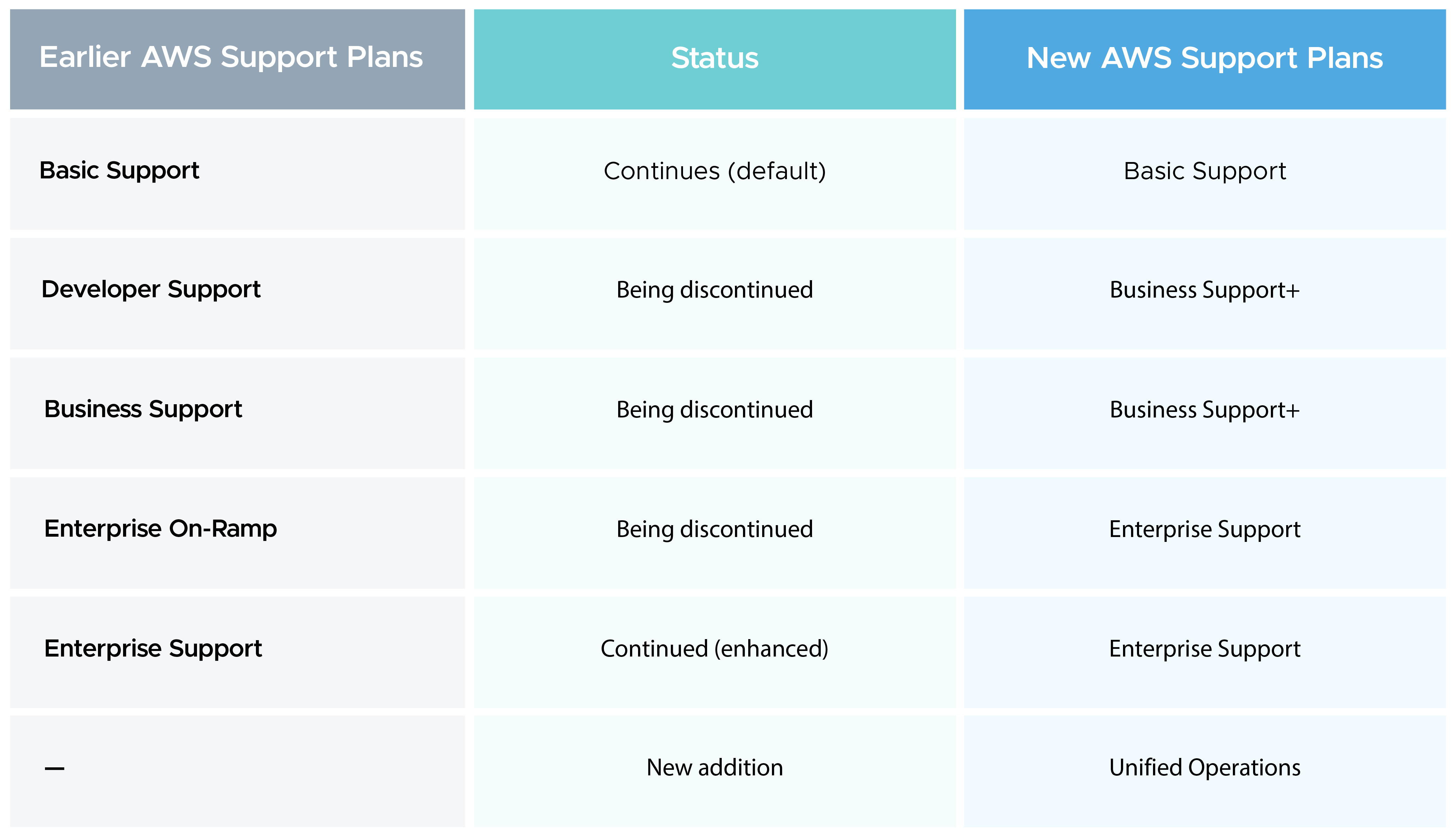
The key difference lies in consolidation and capability.
Earlier, AWS offered multiple tiers with gradual improvements in support access. The new model simplifies this into fewer tiers while expanding capabilities through AI integration and proactive operations.
Higher tiers like Unified Operations also indicate a deeper operational involvement, rather than just reactive support.
How are the new AWS Support Plans priced?
AWS support pricing continues to follow a percentage-based model tied to your monthly AWS spend, along with minimum monthly commitments.
- Business Support+ starts at $29/month or a percentage of AWS usage, beginning at 9% and decreasing as usage scales
- Enterprise Support starts at $5,000/month or usage-based pricing, beginning at 10% and tapering at higher spend levels
- Unified Operations starts at $50,000/month or usage-based pricing, with percentage tiers applied at higher spend brackets
In all cases, customers pay whichever amount is higher: the minimum fee or the calculated percentage of their AWS bill.
While the structure is straightforward, the implication is important. As your AWS usage grows, your support costs scale alongside it. Additionally, certain advanced services may still be offered at an additional cost depending on requirements.
(Recommended read: How AWS Enterprise Support Pricing Works: A Comprehensive Guide for Businesses)
What does this mean for businesses on existing support plans?
For organizations currently using Developer, Business, or Enterprise On-Ramp support, these changes require a clear transition in how support is consumed and paid for.
With AWS phasing out these tiers by 2027, businesses will need to move toward the newer support plans. While this brings improved capabilities, it also changes both the cost structure and the level of engagement expected from support.
Here’s what this means in practice:
- Mandatory transition to new tiers
Existing plans like Developer, Business, and Enterprise On-Ramp will be discontinued. Customers will either need to upgrade proactively or be migrated over time, reducing flexibility in staying on current plans. - Shift toward higher baseline support costs
While entry points like Business Support+ appear affordable, the percentage-based pricing model means costs increase as AWS usage grows. For teams previously on lower tiers, this can lead to a noticeable increase in support costs over time. - Re-evaluation of support needs
Teams that earlier operated comfortably on Business or On-Ramp tiers may now need to assess whether Business Support+ is sufficient, or if Enterprise-level engagement is required for their workloads. - Greater emphasis on proactive and AI-driven support
The new model introduces AI-powered cloud cost optimization and more proactive monitoring. While this improves response and visibility, it also expectations toward continuous engagement rather than occasional support usage.shifts - Potential increase in total cost of ownership
Beyond base pricing, certain advanced services and deeper operational support may involve additional costs, making it important to evaluate the full support investment rather than just the base plan.
For many organizations, this transition is a much bigger strategic choice than simply selecting a new support tier. The choice needs reassessing how support fits into their overall cloud strategy and cost structure.
Is There a More Flexible Alternative to AWS Support Plans?
As businesses evaluate these changes, many are looking for support models that offer the same level of reliability and expertise, without being tightly coupled to cloud spend.
This is where Partner-led Support becomes relevant.
Delivered by certified AWS partners like CloudKeeper, this model provides enterprise-grade support while introducing greater flexibility in pricing and scope. Instead of interacting directly with AWS for every support need, the partner becomes the primary point of contact, handling day-to-day support, guidance, and escalations.
What makes this model different is not just cost - it is the breadth of support.
With CloudKeeper’s Partner-led Support, organizations get access to capabilities comparable to AWS Enterprise Support, along with additional layers of support that extend beyond infrastructure:
- 24/7 personalized cloud support with defined SLAs
- Designated Technical Account Manager (TAM) backed by certified cloud experts
- Architecture reviews, business reviews, and continuous guidance
- Direct case management and escalation with AWS when required
- Application-level and third-party software support
In addition to these core capabilities, Partner-led Support also includes extended services that are typically not part of standard AWS support plans:
- DevOps support for modern cloud-native environments
- Cloud automation to reduce manual effort and improve efficiency
- Continuous performance optimization
- Guidance on adopting new AWS services
- Consulting and advisory for long-term cloud strategy
Perhaps the most important difference lies in pricing.
Unlike AWS support plans that scale as a percentage of cloud spend, Partner-led Support follows a custom, scope-based pricing model, allowing organizations to access enterprise-grade support at a significantly lower and more predictable cost.
For businesses that need deep support, ongoing optimization, and cost control, this model offers a practical alternative.
We will explore how Partner-led Support compares directly with AWS support plans in the next part.
What should you consider when choosing a support model?
Choosing the right support model needs a thorough understanding of how support impacts your overall cloud costs, how it scales with your infrastructure, and whether it aligns with your operational needs.
AWS’s updated support tiers bring stronger capabilities and a more structured approach. At the same time, they reinforce the importance of evaluating both cost and coverage as your cloud environment grows.
If you are scaling on AWS, this is the right time to reassess whether your current support model is helping you operate efficiently - or simply increasing your cloud spend.