


Chief Growth & Marketing Officer
Naman is a seasoned GTM leader with deep expertise in technology sales, marketing, & strategic planning.
 Webinar
30 Jun, 2026 | 9 Min read

Every FinOps team knows the quarterly ritual. Someone pulls twelve months of usage data, builds a forecast, argues about how aggressive to be, and then signs off on a big batch of Savings Plans or Reserved Instances. The commitment goes live, everyone moves on, and for a few weeks, the coverage numbers look great.
Then reality happens. A team migrates a workload to containers. A product gets sunset. An instance family gets refreshed, and your old generation suddenly costs more to keep than to leave. Usage drifts below the line you committed to - and now you're paying for capacity nobody is touching, with no way out until the term expires.
That gap, between what you committed to and what you actually use, is where cloud savings quietly leak. Intelligent laddering is the approach built to close it.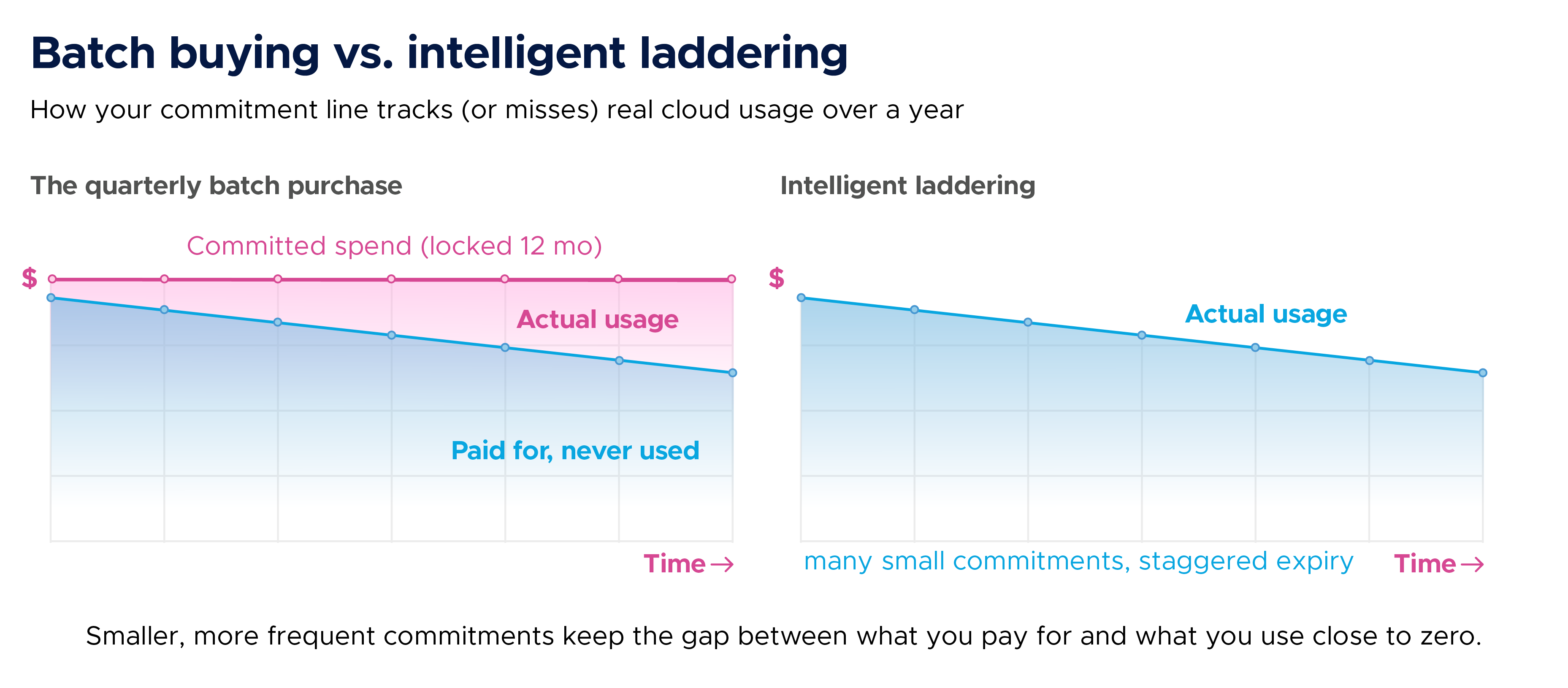
Commitment discounts are one of the best levers in cloud cost optimization. Reserved Instances and Savings Plans can knock 30–70% off on-demand rates, and for steady workloads, that's free money. But the discount comes with a string attached: you're promising to spend a certain amount for one to three years, whether or not the usage shows up.
The traditional way to handle that promise is to buy in bulk. Analyze the past, forecast the future, and purchase enough cloud commitment to cover roughly 70–85% of expected demand in one go. It's a reasonable plan in a world that doesn't change much.
The trouble is that cloud environments change constantly, and three things in particular have made the big batch bet riskier than it used to be.
Add it all up, and the conservative response is to under-commit: cap coverage at 70%, leave a buffer, and accept that the uncovered 30% runs at full on-demand rates forever. You've traded one kind of waste for another.
To understand better, think of it as two ways of climbing the same staircase.
The batch approach is one giant step. You commit to a high level all at once and stay locked there for the full term. If usage is below that step, the difference is pure waste until the cloud commitment expires.
Laddering breaks that one step into many small ones. Instead of a single large cloud commitment covering most of your usage for a year, you make a series of small, incremental commitments that expire on a rolling basis - some maturing every week, some sooner. As each small commitment comes up for renewal, you decide again: renew it, increase it, or let it lapse based on what your usage looks like right now, not what you guessed nine months ago.
If you've ever heard of dollar-cost averaging in investing - buying a little at regular intervals instead of betting one lump sum on a single day - the logic is the same. You're spreading the timing risk so no single decision can hurt you much.
The variable that makes laddering powerful is frequency. A quarterly rolling strategy gives you four chances a year to course-correct. A system that rebalances continuously - adjusting as often as your usage data updates - keeps the cloud commitment line glued to actual demand at all times. The gap that batch buyers live with simply never opens up.
Say a workload runs at a steady $10,000/month, and you're confident enough to cover 80% of it.
Same coverage, completely different downside. That asymmetry is the whole point.
Three metrics tell you whether laddering is working:
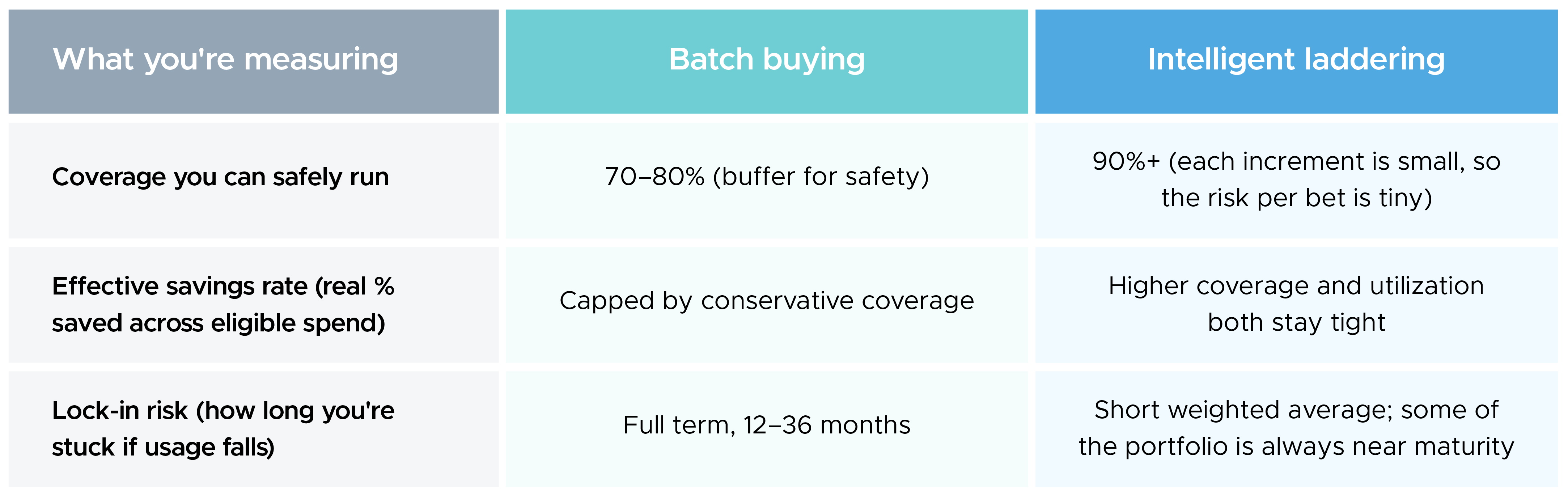
The Effective Savings Rate is the honest scorecard here - it folds coverage, utilization, and discount depth into one number instead of letting a high-coverage figure hide low utilization underneath. Most teams sit far below their ceiling not because they don't commit enough, but because their commitments don't track usage closely enough to push coverage higher without fear.
And lock-in risk is the quieter benefit. Because laddered cloud commitments expire on a rolling basis, part of your portfolio is always close to maturity. You can dial exposure down within weeks if the business changes - which means modernization stops being a fight with your own cloud commitments. Migrating from one instance generation to the next, or moving VMs to containers, no longer means "burn down the RIs first." The next set of small decisions just reflects the new reality.
Here's the honest catch: manual laddering is brutal. Continuous rebalancing means constantly analyzing usage, modeling the right instrument mix, timing purchases, tracking dozens of staggered expirations, and redoing the math every time something shifts. Nobody wants to run that on a spreadsheet on a Wednesday afternoon, and at any real scale, it's simply not feasible to do well.
This is the gap automation was built for, and it's exactly the problem CloudKeeper Commit - AI-driven Platform for AWS RI & Savings Plan Optimization is designed to solve. It runs the laddering strategy as a zero-touch, AI-driven layer across both AWS compute and databases - monitoring usage in near real-time, recalculating optimal cloud commitment levels dynamically rather than on fixed cycles, and executing purchases and exchanges automatically in an AWS-compliant way.
Instead of conservative quarterly bets, you get small, incremental, low-risk adjustments that keep coverage high and waste close to zero as your environment moves.
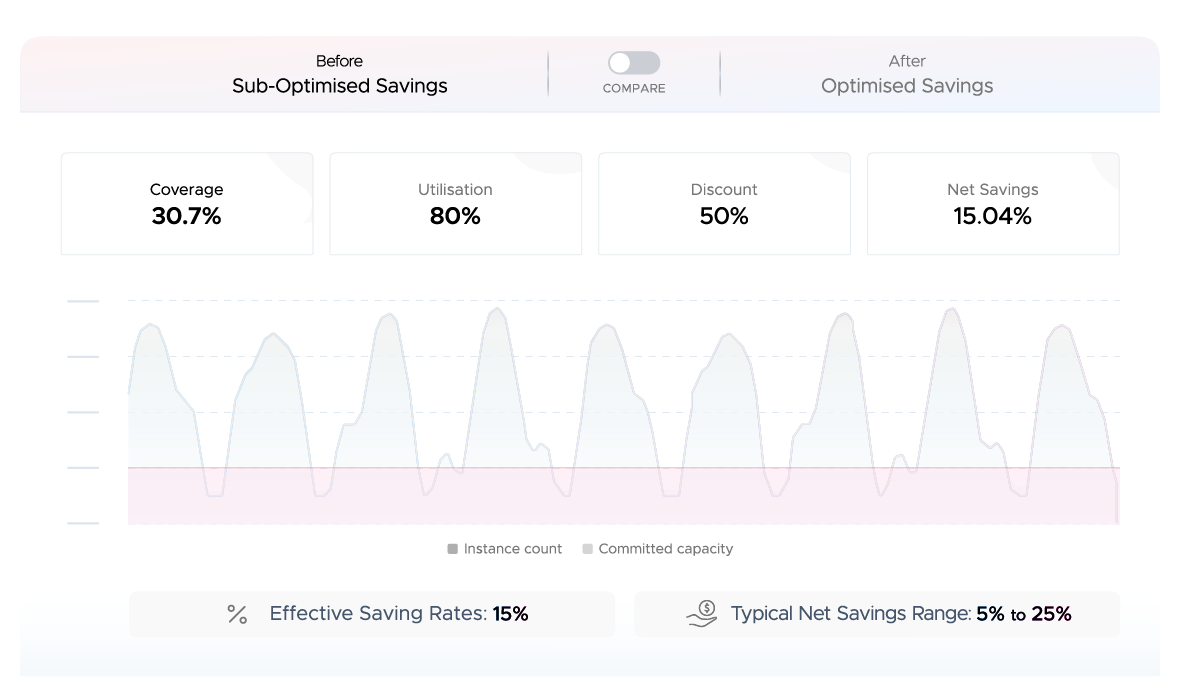
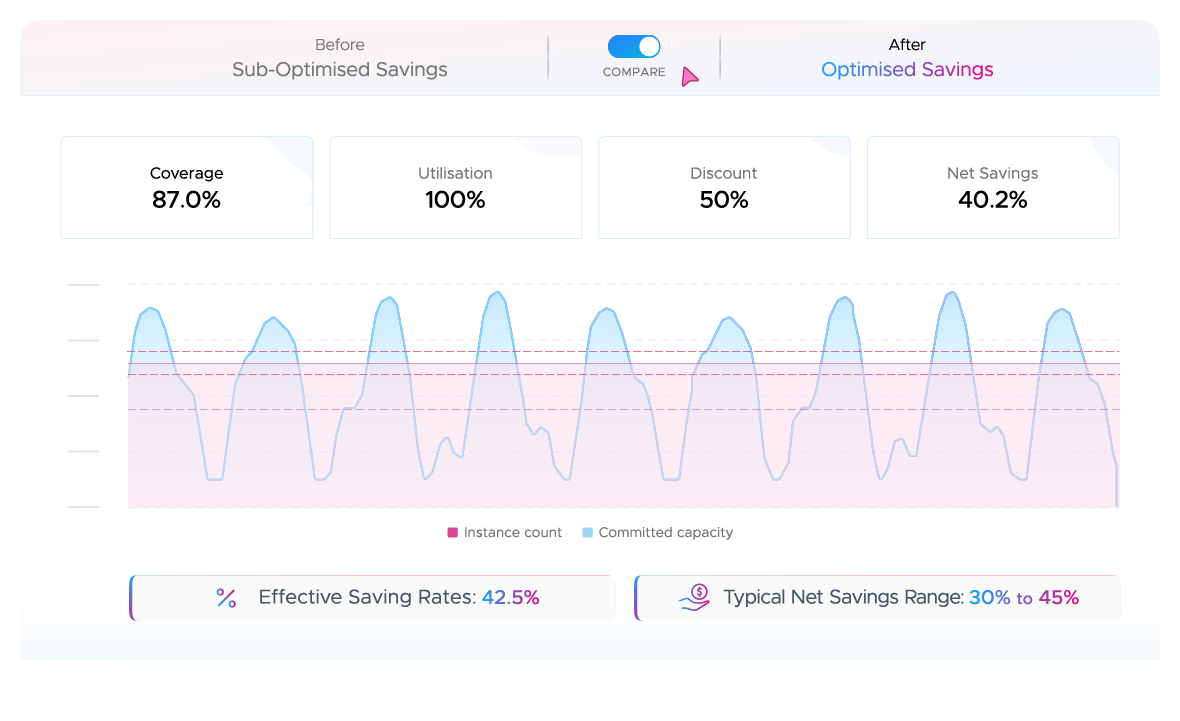
A few things make the model genuinely risk-free to try:
Savings from Day 1 - No waiting quarters for impact. Most customers see 30–45% savings on compute and database spend reflected in the very next bill.
5-minute onboarding - Read-only IAM access is all it takes. No agents, no infrastructure changes, no lengthy setup calls.
Outcome-based pricing - You pay only when you save. CloudKeeper earns a small share of the savings it actually delivers - and nothing if it doesn't.
That last one matters more than it looks. When a vendor only gets paid on realized cloud cost savings, your interests and theirs point the same direction - aggressive coverage that's still safe, because the downside is shared.
The batch-purchase model made sense when cloud environments were stable and forecasts held. They don't anymore. Workloads shift, AI spend is volatile, and the cloud commitment rules keep changing underneath you. Trying to win that game with a once-a-quarter lump sum is how teams end up either overcommitted and wasteful or undercommitted and overpaying on demand.
Intelligent laddering reframes the whole thing: lots of small, staggered commitments that track actual usage rather than one big guess about the future. It pushes coverage higher, lifts your effective savings rate, and keeps you flexible enough that the next migration isn't blocked by last quarter's decision.
If you're still buying commitments in bulk, the fastest way to see what you're leaving on the table is to look at your current effective savings rate and lock-in exposure - and then ask what continuous, automated laddering would do to both. That's a five-minute look, and for most teams, the gap it reveals is bigger than they'd like to admit.
Q1: What is intelligent laddering in cloud cost optimization?
Intelligent laddering is a commitment purchasing strategy where, instead of buying one large Reserved Instance or Savings Plan upfront, you make many small, incremental commitments with staggered expiry dates. As each commitment matures, you decide whether to renew, increase, or let it lapse based on current usage- not a forecast you made months ago. The result is higher coverage, lower waste, and far less lock-in risk.
Q2: How is intelligent laddering different from buying Savings Plans in bulk?
Bulk purchasing locks you into a fixed commitment level for a full term- typically 12 to 36 months. If usage drops below that level, you pay for capacity nobody's using until the term expires.
Intelligent laddering spreads commitment across many small purchases with rolling maturities, so any drop in usage is absorbed quickly rather than locked in for months.
Q3: What is the Effective Savings Rate (ESR) and why does it matter?
Effective Savings Rate is the real percentage you're saving across all eligible cloud spend- it accounts for coverage, utilization, and discount depth together. A high discount rate with low coverage still produces a poor ESR.
Most teams have a much lower ESR than they realize, not because they under-commit, but because their commitments don't track usage tightly enough to push coverage higher safely.
Q4: What is commitment lock-in risk?
Commitment lock-in risk refers to the risk of remaining exposed to a fixed spend level even if your usage drops. High lock-in risk means a usage decline today creates waste that persists for months or years with no exit.
Laddering compresses lock-in risk because some portion of your commitment portfolio is always near maturity- giving you regular opportunities to reduce coverage without waiting out a full term.
Q5 : Can intelligent laddering work for AI and GPU workloads?
Yes, and it's particularly valuable there. GPU instance commitments carry outsized risk because the hardware is expensive, capacity options shift frequently, and AI workload demand is harder to forecast than standard compute.
Smaller, incremental commitments with shorter effective durations mean a wrong-sized bet on GPU spend corrects itself quickly rather than bleeding for a year.
Q6: Does intelligent laddering work across multiple cloud providers?
The principle applies across AWS, GCP, and Azure, but the mechanics differ by provider. Each has different discount instruments, term structures, and modification rules. A laddering strategy needs to account for those differences individually rather than applying a one-size-fits-all approach.
Q7: What is outcome-based pricing in cloud commitment management?
Outcome-based pricing means the vendor only earns a fee when you actually save money - typically a small percentage of realized cloud savings. There's no platform fee and no charge if cloud savings don't materialize. This aligns the vendor's incentive with yours: they have no reason to over-commit you because their revenue depends on cloud savings that actually show up on your bill.
Q8 : How quickly can automated commitment management deliver cloud savings?
With AI-driven tools like CloudKeeper Commit, savings are typically visible in the next billing cycle rather than months later. Onboarding requires only read-only IAM access and takes around five minutes, with no infrastructure changes or agents required.
99% of companies saved up to 15% monthly with this plan & achieved peak performance.