


7
7As enterprises scale on Google Cloud Platform (GCP), managing cloud spend requires continuous cost optimization.
Organizations can waste up to 32% of their cloud budgets on inefficient resources and pricing. While native GCP tools provide cost visibility, turning insights into actionable savings remains a challenge.
A specialized GCP Cost Optimization partner can help bridge this gap. Here are seven key criteria to consider when choosing one.
1. Deep Workload Intelligence Across Key GCP Services (BigQuery & GKE)
Generic cloud cost management tools often treat GCP resources as simple virtual machines. But services such as BigQuery and GKE have more complex cost structures.
A strong GCP Cost Optimization partner should have a deep understanding of how these workloads work and where their costs come from.
- BigQuery Job-Level Attribution: BigQuery's on-demand pricing charges based on the amount of data scanned. This means a single unpartitioned query can cause a major increase in your bill. Flat-rate or Edition-based slot reservations also need continuous monitoring and tuning. Look for partners that can analyze query partitioning, cluster tables, optimize Flex slots, and detect cost anomalies at the job level instead of waiting for daily billing exports.
- GKE Workload Allocation & Rightsizing: GKE billing happens at the node pool level, while actual resource consumption happens at the pod level. Over-provisioned CPU and memory requests can therefore create significant waste. Your partner should support container-level cost allocation by namespace and workload label, along with smart bin-packing, node autoscaling, and Spot instance orchestration.
- Architectural Compute Tweaks: Small architectural changes can also reduce costs. For example, moving Compute Engine or GKE workloads from Intel-based N2 instances to AMD-based N2D instances can provide an immediate 13% cost reduction and 20% higher performance, based on CoreMark benchmarks.
2. Intelligent & Adaptive Commitment Automation (CUD Management)
Committed Use Discounts (CUDs) can provide 57% to 70% savings on predictable compute and database usage. However, managing CUDs manually can become a quarterly spreadsheet exercise. This can leave coverage gaps or create financial risks when workloads change.
When evaluating a GCP Cost Optimization partner, look at how they handle commitments.
- Spend-Based & Flexible CUD Mastery: Google Cloud has moved to a modernized spend-based CUD billing model. Your partner should understand Flexible CUDs across Compute Engine, GKE Standard/Autopilot, Cloud Run, and Cloud SQL so that commitments can continue to work even as your architecture changes.
- Adaptive Commitment Layering: Instead of relying on static three-year commitments that could become underutilized, modern partners should use automated and incremental commitment layering that adjusts with live demand.
- Downside & Underutilization Protection: Check whether the partner offers financial safeguards, buyback guarantees, or cashback mechanisms if usage falls below committed levels.
3. Automated Waste Elimination & Resource Hygiene
Before focusing on discounts, FinOps teams should first eliminate operational waste. In other words, optimize what you run before optimizing what you pay.
A capable GCP Cost Optimization partner should offer automated tools and workflows for keeping resources clean and optimized.
- Unattached Block Storage & Static IPs: Automatically identify and remove orphaned Persistent Disks and unattached external static IPs after a VM is terminated.
- Automated Non-Production Scheduling: Automatically start and stop development and testing environments outside business hours. This can save up to 80% on non-production compute costs.
- Storage Lifecycle Management: Use lifecycle policies to automatically move objects from Standard storage to Nearline, Coldline, or Archive tiers based on how frequently they are accessed.
- Logging & Network Egress Optimization: Filter unnecessary Cloud Logging entries and use Network Intelligence Center to identify "top talkers" and more cost-effective Network Service Tiers.
4. Verified Google Cloud Partner Status & Technical Depth
Your cloud infrastructure is critical, so you should verify a vendor's Google Cloud credentials before trusting them with your environment.
Here are some key credentials and criteria to check:
- Google Cloud Partner Specialization: Check whether the partner has audited Google Cloud Partner Specializations, such as Infrastructure, Managed Services, or Data Analytics.
- FinOps Foundation Alignment: Look for alignment with FinOps Foundation standards and support for the FOCUS™ (FinOps Open Cost and Usage Specification) schema. This can help maintain consistent cost attribution across multiple clouds.
- Security & Compliance Standards: A partner's tools and team may work with sensitive billing metadata and IAM structures. Look for SOC 2 Type II and ISO 27001 certifications, along with least-privilege, read-only IAM policies and zero standing access.
5. Forward Deployed Engineering & Hands-On Support
One common problem with cloud cost management is the "dashboard trap." A software platform may generate hundreds of recommendations, but internal engineering teams may not have the time to implement them.
So, when evaluating a partner, look beyond the recommendations and ask what happens after an optimization opportunity is identified.
- Forward Deployed Engineers (FDEs): Leading partners combine automated software platforms with senior cloud architects and Forward Deployed Engineers who can implement optimizations, write IaC/Terraform scripts, and work alongside your team to resolve issues.
- 24/7 Operations & On-Call SLAs: Look for clear and published SLAs, named engineers, and 24/7 global support instead of vague "best-effort" email support.
- Google Cloud Architecture Framework Reviews: A capable partner should be able to conduct formal Well-Architected Framework reviews to make sure cost optimizations do not compromise reliability or security.
6. Risk-Free Commercial Alignment & Guaranteed Savings
The way a cost optimization partner charges you can show how closely their business model is aligned with your goals.
FinOps teams should consider three main commercial models:
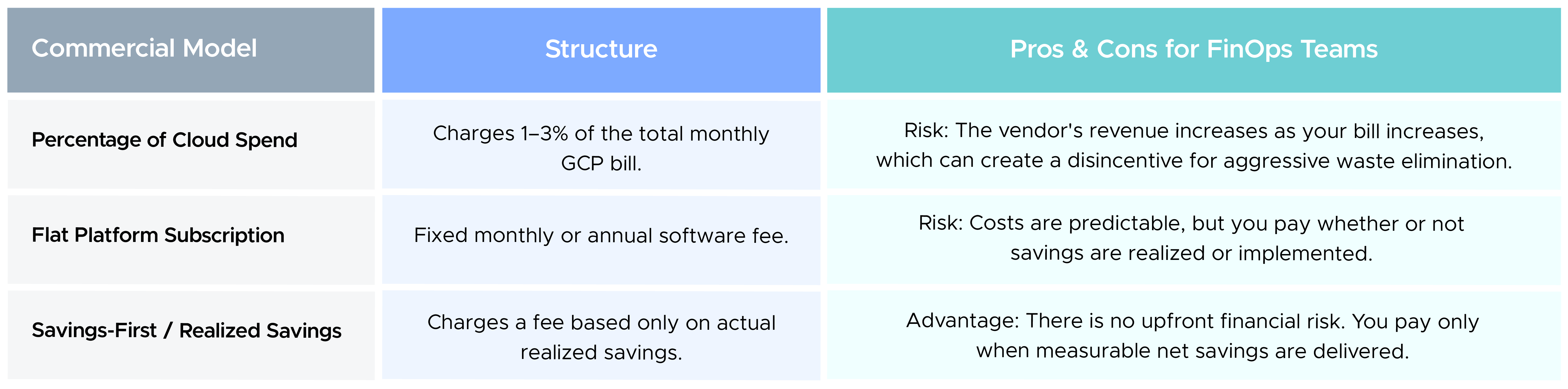
Look for partners that support their capabilities with guaranteed cost outcomes or savings-first pricing models. This can help ensure positive ROI from the beginning.
7. Holistic FinOps Enablement & Unit Economics
Cloud cost optimization is not a one-time cleanup exercise. It is an ongoing process that requires the right FinOps practices across the organization.
The right partner should help your team build and improve its FinOps processes.
- Business Unit & Team Allocation: Turn raw infrastructure SKUs into clear showback and chargeback reports by team or business unit without relying on rigid manual tagging.
- Unit Economics Tracking: Connect GCP spending to business outcomes by tracking metrics such as cost per active customer, cost per API call, or cost per AI query.
- Predictive Forecasting & Anomaly Alerts: Set up real-time Slack or Teams alerts for spending anomalies so teams can identify unexpected costs after operational changes and before they turn into bill shock.
Calculating the ROI of Your Partner Investment
To explain the value of a cost optimization partner to executive leadership, you can calculate ROI using the standard FinOps formula:
ROI (%) = (Total Annual Realized Savings − Partner/Tooling Costs) / Partner/Tooling Costs × 100
With effective waste elimination resulting in a 15–35% average bill reduction and automated rate optimization, most FinOps teams achieve 300% to 700%+ ROI within the first 30 to 90 days.
Summary Checklist: Evaluating Your GCP Cost Partner
Before signing a contract, use this checklist to evaluate your options:
- Does the vendor offer job-level BigQuery visibility and GKE pod allocation?
- Is CUD management automated with spend-based Flex CUD coverage?
- Are recommendations supported by hands-on engineering support, including IaC/Terraform?
- Does the partner have verified Google Cloud Partner credentials?
- Is the pricing model risk-free or tied to realized savings?
- Are security standards backed by SOC 2 Type II and ISO 27001 certifications?
Conclusion & Next Steps
Choosing the right partner for GCP Cost Optimization means finding one that turns cloud cost visibility into real savings.
By combining workload intelligence, automated rate optimization, and hands-on engineering support, FinOps teams can reduce waste while supporting engineering needs.
As a certified Google Cloud Partner, CloudKeeper combines CloudKeeper Lens and LensGPT for advanced cloud cost analytics with CloudKeeper Tuner for automated cloud cost optimization. These capabilities are backed by Forward Deployed Engineers and an outcome-driven model with guaranteed savings.
With zero upfront fees, zero long-term commitments, and 24/7 dedicated support, CloudKeeper helps Google Cloud teams reduce costs without compromising application performance.
Frequently Asked Questions (FAQs)
Q1. How does a specialized GCP cost optimization partner differ from native Google Cloud tools like GCP Cost Explorer or Recommender?
Native tools such as Google Cloud Billing Reports and Recommender provide basic spend visibility and rule-based recommendations. However, they do not automate execution or provide deep, job-level BigQuery and container-level GKE attribution.
A specialized partner combines advanced visibility platforms, such as hourly resource tracking, with automated remediation and hands-on engineering support to implement recommendations directly.
Q2. Is it safe to grant a third-party FinOps partner access to our Google Cloud environment?
Yes, as long as the partner follows strict enterprise security standards.
Top partners use least-privilege, read-only IAM billing permissions for platform visibility. This means no root access, no password sharing, and no operational access to workload data.
Look for verified SOC 2 Type II and ISO 27001 certifications.
Q3. How quickly can FinOps teams expect to see measurable ROI and savings?
With automated resource hygiene, such as shutting down non-production environments, and immediate rate optimization discounts, initial cost reductions can begin with the very first billing cycle.
Most organizations achieve a 10% to 20% average bill reduction within 30 days of onboarding.
Q4. How does automated CUD management protect against underutilization risks?
Traditional Committed Use Discounts require one-year or three-year commitments that can lock you into specific compute configurations or spending baselines.
Automated commitment management uses adaptive layering to continuously match commitments to changing demand.
Partners that offer guaranteed buybacks or cashback protection can also take on the financial risk if usage falls below committed levels.
Q5. Why choose CloudKeeper over traditional cloud cost management software platforms?
Unlike SaaS platforms that charge flat fees or a percentage of cloud spend for access to software dashboards, CloudKeeper operates as an outcome-driven FinOps partner.
CloudKeeper combines proprietary AI analytics through CloudKeeper Lens & Tuner with dedicated Forward Deployed Engineers (FDEs) and contractually guaranteed savings.
This delivers an average 20% reduction in cloud spend, with zero upfront fees and no long-term lock-in.