


12
12As LLM applications move into production, token usage can become a significant part of AI spending. Every prompt, conversation turn, retrieved context, and generated response adds to the tokens the model processes. Inefficient token usage can increase both costs and application latency.
The challenge is becoming more important as AI workloads grow more complex. Gartner predicts that AI inference costs per agentic workflow will increase more than fivefold through 2028, driven by rising token consumption and increasingly complex AI workflows.
This is where AI token optimization comes in. It involves reducing unnecessary token consumption while maintaining application quality and performance. This guide covers how tokens are billed, what drives token spend, common optimization mistakes, and practical ways to reduce usage.
What Is AI Token Optimization and How Are AI Tokens Billed?
AI token optimization is the practice of reducing unnecessary input and output tokens while maintaining the quality and performance of an LLM application. To optimize token usage effectively, let’s start with the basic unit of LLM consumption: the token.
What Are AI Tokens?
LLMs do not process text exactly as humans read it. Before text reaches the model, it is broken into smaller units called AI Tokens through a process called tokenization. Different models use different tokenization methods, including approaches such as Byte Pair Encoding (BPE) and SentencePiece.
How Does Tokenization Work?
Tokenization breaks text into subword units, characters, or punctuation marks. The same sentence can therefore use a different number of tokens depending on the words, language, formatting, and model tokenizer involved.
As a general rule of thumb for standard English text:
- 1 token is roughly 4 characters
- 1 token is roughly 0.75 words
- A 100-word paragraph may use around 130–140 tokens
Common words may be represented by a single token, while technical terminology, specialized words, non-English text, and code identifiers can be split into multiple subword tokens.
Formatting also contributes to token usage. Spaces, punctuation, indentation, XML tags, and JSON syntax can all affect the number of tokens processed.
For example:
Raw text:
“Token optimization reduces LLM costs significantly.”
Tokens:
["Token", " optim", "ization", " reduces", " LL", "M", " costs", " significantly", "."]
Total: 9 tokens for 6 words and 52 characters.
Input Tokens vs. Output Tokens
Major LLM providers, including OpenAI, Anthropic, Google Cloud, and AWS Bedrock, do not charge the same rate for every token.
There are two main types of token usage.
Input tokens are the information sent to the model. This can include:
- System instructions
- User prompts
- Conversation history
- Retrieved documents
- Context
- Tool definitions
Output tokens are the text generated by the model.
Output tokens are generally more expensive than input tokens. The examples used in this guide show output pricing at roughly 3x to 5x the input price.
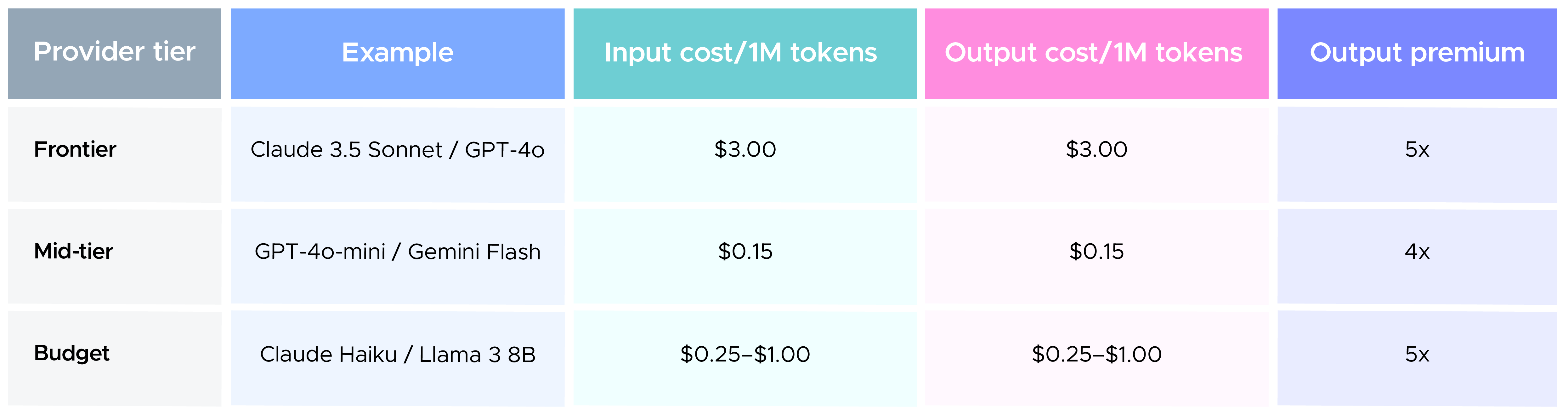
Because output tokens cost more, verbose model responses can increase token spend quickly, even when the input prompt is relatively small.
Note: Provider pricing changes over time, so these figures should be treated as examples rather than current pricing.
Why AI Token Count Impacts Cost and Latency?
Token optimization is not only about reducing an API bill. Token volume also affects how quickly an LLM application responds.
An LLM request generally involves two phases:
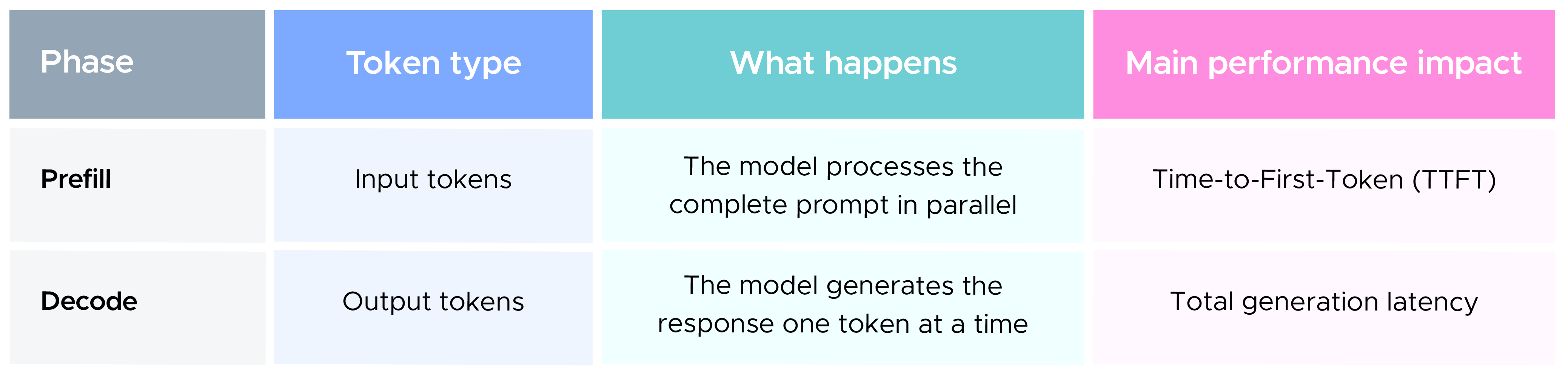
During the prefill phase, the model processes the input context before generating the response. A very large prompt therefore requires more work before the first token can be returned.
During decoding, output tokens are generated sequentially. Longer responses therefore increase the time users wait for the complete response.
This creates an important connection between AI cost management and application performance: unnecessary tokens can affect both.
The Compound Effect of Multi-Turn Workflows
In many stateless API environments, the model does not automatically remember previous messages. To maintain a conversation, the application sends the relevant conversation history again with each new request.
That means the amount of input context can grow quickly.
For example:
- Turn 1: 1,000-token system prompt + 200-token user query = 1,200 input tokens
- Turn 2: System prompt + previous query + response + new query = 2,700 input tokens
- Turn 10: Accumulated conversation history pushes input usage above 15,000 tokens per call
Agentic workflows can increase this even further because one user task may involve multiple tool calls and model interactions.
An unmanaged history can therefore result in a very large number of input tokens being processed for a single end-user task.
TTFT vs. Generation Speed
Two useful performance measures are:
Time-to-First-Token (TTFT): How long it takes before the model starts returning a response.
Inter-Token Latency (ITL): The time between generated tokens during the response.
A prompt containing 50,000 tokens requires substantially more processing before the model can begin generating an answer. Likewise, unnecessarily long outputs take longer to generate.
Reducing unnecessary context and output therefore has both cost and performance benefits.
The “Lost in the Middle” Effect
More context does not always mean better results.
As context becomes very large, important information placed in the middle of a long prompt can be overlooked. This is commonly referred to as the “Lost in the Middle” effect.
Keeping context focused and relevant helps the model concentrate on the information needed for the task rather than processing large amounts of unnecessary content.
4 Common Mistakes That Increase AI Token Spend
Teams moving from local experimentation to production LLM applications can introduce token waste without realizing it.
Here are four common sources.
1. Using Chatty Prompts and Unconstrained Outputs
Developers sometimes write prompts using conversational language such as:
“Hello! Could you please be so kind as to analyze the following document and write a summary for me?”
The additional wording increases input tokens without adding much useful information.
The model can also generate unnecessary conversational filler if the output is not constrained.
A response beginning with:
“Sure! I would be happy to help you summarize that document...”
uses output tokens without contributing to the actual result.
2. Sending the Full Chat History Every Time
Appending the entire raw conversation to every API request can cause token usage to grow quickly.
A simple follow-up such as “Can you fix the typo in line 3?” may cause thousands of historical tokens to be processed again even though most of that context is no longer relevant.
3. Using Naive RAG With Oversized Chunks
RAG systems retrieve information from external documents and add it to the model's context.
A common mistake is retrieving entire documents or very large chunks when only a small section contains the answer.
For example, if two sentences in a 10-page report answer a question, sending the remaining content to the model increases input token usage without necessarily improving the response.
4. Using Expensive Models for Simple Tasks
Not every task requires a frontier model.
Using models such as GPT-4o or Claude Sonnet for simple tasks such as:
- Sentiment analysis
- Language detection
- Basic classification
- Simple extraction
can increase costs unnecessarily.
Tool-calling and Model Context Protocol (MCP) integrations can also add hidden input tokens when many unused tool definitions are included in every request.
AI Token Optimization: A Practical Playbook
AI token optimization does not always require a major architecture change. Several straightforward LLM optimization changes can reduce unnecessary token consumption.
1. Trim Prompts and Use Direct Instructions
Replace conversational prompts with direct instructions.
Before — 42 tokens:
“Hello model. I am looking for your assistance in reviewing the text below. Please read through it carefully and provide a brief summary of the key takeaways, keeping it polite and clear.”
After — 14 tokens:
“Summarize the text below in 3 bullet points. Max 15 words per bullet. Be direct.”
The second prompt communicates the same basic task with considerably less text.
Remove:
- Repeated instructions
- Unnecessary filler
- Redundant examples
- Excessive conversational language
The goal is not to make prompts as short as possible. It is to remove tokens that do not contribute to the task.
2. Control Output Length
Because output tokens are generally more expensive than input tokens, controlling response length can directly reduce costs.
You can:
- Use API parameters such as max_tokens
- Tell the model exactly how long the response should be
- Ask for specific formats
- Remove conversational introductions
- Use structured outputs such as JSON
For example:
“Respond ONLY with valid JSON. Do not include introductions, explanations, or markdown.”
This gives the model a clear output boundary.
3. Manage the Context Window
Instead of sending the entire conversation history every time, keep only the context that is relevant.
Sliding window: Keep the system prompt and the most recent few turns, such as the last four turns.
Progressive summarization: Compress older interactions into a short summary, such as a 100-token summary generated using a fast, lower-cost model.
Optimized RAG chunking: Use smaller semantic chunks of around 300–500 tokens, with around 10% overlap, and retrieve only the top three relevant chunks instead of sending broad document dumps.
4. Route Requests to the Right Model
Not every request needs the same model.
A simple routing architecture can look like:
Incoming request → Intent router → Model based on task complexity
Simple tasks can go to budget or mid-tier models.
Complex reasoning or code-generation tasks can go to frontier models.
For example:
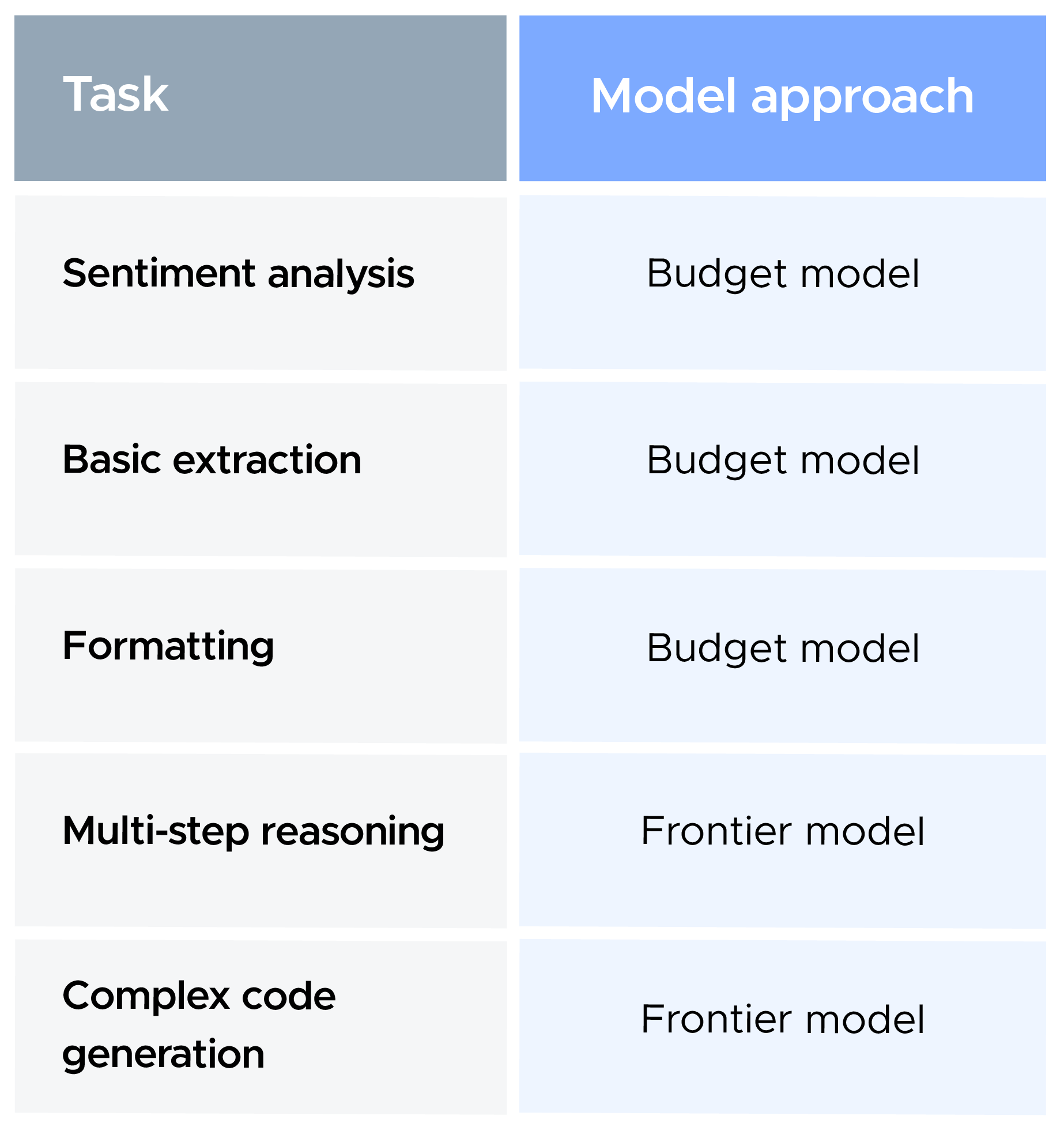
By routing routine tasks to lower-cost models and reserving frontier models for more complex workloads, teams can reduce unnecessary model spend.
5. Use Prompt Caching and Batch APIs
Provider-level caching can help when the same prompt prefixes are reused.
Static content such as:
- Long system instructions
- Codebase documentation
- Stable RAG references
can potentially be cached instead of processed from scratch every time.
The source material cites discounts of 50%–90% for cached input tokens across providers.
For non-real-time workloads, Batch APIs can also reduce costs. Examples include:
- Nightly data processing
- Offline evaluation
- Bulk document indexing
The source material cites a 50% discount for these asynchronous workloads.
When Should You Move From Manual Token Optimization to FinOps for AI?
Prompt trimming and context management are useful starting points. But they become harder to manage when AI usage grows across teams, applications, models, and cloud environments.
Once multiple teams are running different LLM services, a developer fixing one prompt at a time cannot provide a complete picture of AI spend.
This is where FinOps for AI becomes relevant.
FinOps for AI brings together visibility, optimization, governance, and unit economics to help teams manage AI spending.
Four Areas of AI Cost Management
1. Visibility and attribution
Understand where AI spend comes from.
Track token usage and costs by:
- Team
- Application
- Model
- Workload
2. Optimization
Improve efficiency through:
- Prompt trimming
- Caching
- Model routing
- Context management
- Automated optimization policies
3. Governance
Put controls around AI usage with:
- Budgets
- Rate limits
- Guardrails
- Circuit breakers
4. Unit economics
Connect AI spend to business activity.
For example:
- Token cost per active user
- Token cost per query
- Token cost per transaction
This makes AI spending easier to understand in terms of the value the workload is expected to generate.
When Token Optimization Is No Longer Enough
Your organization may need broader AI cost governance when:
You cannot attribute spend.
You receive a large combined API bill but cannot determine which team, product feature, or customer generated the cost.
AI spend spikes unexpectedly.
An agent loop or sudden traffic increase can consume significant amounts of tokens when there are no budgets or usage limits.
You use multiple models and providers.
Managing OpenAI, Anthropic, Google Cloud, AWS Bedrock, and open-source models makes cross-platform cost visibility more difficult.
You need AI unit economics.
Leadership wants to know how much AI costs per user, query, feature, or business transaction.
At this stage, token optimization becomes more than a prompt-engineering exercise. It becomes part of a broader AI cost management practice.
Beyond Token Optimization: Managing the Full AI Cost Stack
AI Token optimization primarily addresses one part of AI spend: inference and token usage.
But AI costs can come from several places.
CloudKeeper's full-stack FinOps for AI approach covers three broad areas: AI visibility and intelligence, AI rate optimization, and AI usage optimization.
AI Visibility and Intelligence
Lens AI provides visibility across:
- AI licensing
- AI inference
- AI infrastructure
- Token usage
- GPU utilization
- Multi-cloud AI spend
This helps teams understand where their AI costs are coming from before deciding what to optimize.
AI Rate Optimization
Cost is also affected by the rates an organization pays.
CloudKeeper's AI rate optimization capabilities include:
- AI commitments management
- Enterprise AI billing
- Claude access and procurement
- Cost-efficient pricing options
- Ongoing spend optimization
AI Usage Optimization
Optimization also extends beyond tokens.
This includes:
- GPU rightsizing
- AI infrastructure optimization
- Workload optimization
- Amazon Bedrock optimization
- Resource utilization insights
- Forward Deployed Engineer (FDE) support
The product orientation deck describes the overall CloudKeeper model as see it, use it better, and pay less for it.
Conclusion
AI token optimization is not a one-time prompt-editing task. It connects prompt design, context management, model selection, application performance, and AI cost management.
For teams getting started, simple steps such as trimming prompts, controlling outputs, managing context, choosing the right model, and using caching can help reduce unnecessary token consumption.
But as AI adoption grows, token spend becomes only one part of the overall cost picture. Teams also need visibility into inference, GPUs, infrastructure, AI licenses, workloads, and the rates they pay for AI services.
That's where a full-stack FinOps for AI approach becomes useful.
CloudKeeper helps organizations manage AI/LLM costs across models, workloads, and the cloud infrastructure powering them, bringing together AI visibility and intelligence, AI rate optimization, and AI usage optimization.
With Lens AI, teams can gain visibility into AI spend and usage across inference, infrastructure, licenses, tokens, and GPU utilization. Tuner AI focuses on eliminating AI waste, while Commit AI focuses on improving the rates organizations pay.
Take the Next Step in Your AI Cost Journey
Ready to move beyond individual token optimizations and take a broader approach to AI cost management?
Explore CloudKeeper's full-stack FinOps for AI to understand your AI spend, optimize workloads and infrastructure, and manage AI costs across models and cloud environments.
Book a demo and get 30 days of free access to FinOps for AI.
Frequently Asked Questions
Q1: What is AI token optimization, and why is it necessary for engineering teams?
AI token optimization is the systematic practice of auditing, managing, and reducing the number of input and output tokens consumed by LLM applications without affecting response quality.
It matters because unmanaged token consumption can significantly increase AI operational costs. High token volumes can also increase application latency, including Time-to-First-Token and generation time. Large amounts of unnecessary context can further affect model accuracy by making it harder for models to focus on relevant information.
Q2: Why do output tokens cost 3x to 5x more than input tokens?
The difference is related to how LLMs process input and generate output.
Input tokens are processed in parallel during the Prefill Phase. Output tokens, on the other hand, are generated sequentially during the Decoding Phase, one token at a time.
Because each generated token requires ongoing computation and memory access, output generation can require more resources. This is why output tokens are often priced significantly higher than input tokens.
Q3: What is the difference between Prompt Caching and Semantic Caching?
Prompt caching works at the LLM provider level. Providers such as Anthropic, OpenAI, and AWS Bedrock can cache static parts of a prompt, such as system instructions, tool schemas, or fixed reference material. Cached input tokens may receive significant pricing discounts.
Semantic caching works at the application or AI gateway layer. It identifies queries that are semantically similar to previous queries and can return an existing response without making another LLM API call.
In simple terms, prompt caching reduces the cost of processing repeated input, while semantic caching can avoid the model call altogether for equivalent requests.
Q4: How does Retrieval-Augmented Generation (RAG) reduce token costs compared to long context windows?
Large context windows allow applications to send a lot of information to an LLM, but sending entire documents with every request can increase token consumption unnecessarily.
RAG addresses this by splitting documents into smaller, relevant chunks and retrieving only the information needed for a particular query. For example, the optimization approach discussed in this guide uses 300–500-token chunks and retrieves the most relevant passages instead of injecting entire documents into the prompt.
This reduces unnecessary context, lowers token usage, and can also help avoid the “Lost in the Middle” effect, where important information in a very large context may be overlooked.
Q5: How does intelligent model routing cut costs without sacrificing response quality?
Model routing uses a router or gateway layer to classify requests based on their complexity and send them to an appropriate model.
Routine tasks such as intent classification, sentiment analysis, formatting, and basic extraction can be handled by faster, lower-cost models. More complex tasks, such as advanced reasoning or code generation, can be routed to more capable frontier models.
This approach avoids using an expensive model for every request while reserving higher-cost models for tasks that actually require their capabilities.
Q6: When should a team graduate from manual prompt tweaks to a formal FinOps for AI framework like CloudKeeper?
Manual prompt trimming and context optimization can be effective when AI usage is still limited. As AI adoption grows, however, teams may need a broader approach to understand and manage their spending.
A formal FinOps for AI approach becomes increasingly relevant when multiple teams or applications use different models, when AI spend cannot be attributed clearly, when usage spikes are difficult to control, or when teams need to connect AI costs with business metrics.
CloudKeeper's full-stack FinOps for AI approach brings together AI visibility and intelligence, AI rate optimization, and AI usage optimization across models, workloads, and the infrastructure powering them.