




8
8Cloud cost optimization for SaaS is about ensuring cloud spend grows more slowly than revenue as the business scales. As SaaS companies add customers, launch new features, and process more data, cloud costs naturally increase. The challenge is maintaining healthy margins through cloud cost optimization while supporting that growth.
Many organizations closely track revenue metrics such as ARR and MRR, but have limited visibility into how cloud costs are distributed across customers, tenants, features, and products. Without that understanding, cloud spending can grow faster than revenue, making profitability harder to improve.
This article explores why SaaS margins come under pressure, the biggest drivers of cloud spend, how to improve cloud cost visibility, and practical opportunities to optimize costs without slowing growth.
The SaaS Cost Trap: Revenue Grows, but So Does Cloud Spend
Growth is generally expected to improve profitability. More customers should lead to more revenue, stronger cash flow, and healthier margins.
However, SaaS businesses often experience a different reality.
As customer adoption increases, infrastructure requirements grow across almost every area of the platform. More users generate additional API requests, databases expand, storage requirements increase, and analytics workloads become more demanding. Engineering teams also create additional development, testing, and staging environments to support product growth.
As a result, cloud spending naturally rises alongside revenue.
The problem occurs when cloud costs increase at the same pace as revenue or even faster.
For example, a SaaS company may double its ARR over two years while cloud spending grows significantly due to increased customer usage, higher storage requirements, and inefficient resource allocation. Revenue grows, but profitability does not improve as expected because infrastructure costs are consuming a larger share of that revenue.
This is one of the main reasons cloud cost optimization for SaaS has become a business priority. The objective of cloud cost optimization is not to stop cloud spending from growing. Cloud costs will always increase as a platform scales. The objective is to ensure cloud spend grows more slowly than revenue so that growth contributes to stronger margins over time.
Why SaaS Unit Economics Break Without Cost Attribution?
One of the most common challenges in SaaS cloud cost management is understanding which customers, features, and workloads are responsible for cloud spending.
Most organizations can easily answer questions such as:
- Which customers generate the most revenue?
- Which products are growing fastest?
- What is the current ARR or MRR?
However, many struggle to answer:
- What is the cost per customer?
- What is the cost per tenant?
- What is the cost per feature?
- Which customer segments are most profitable?
Without cost attribution, SaaS cloud unit economics become difficult to measure.
Consider two customers on the same pricing plan.
One customer uses standard workflows and stores a moderate amount of data. The other runs high-volume API workloads, generates large datasets, and uses advanced analytics features daily.
Although both customers pay the same subscription fee, their infrastructure costs may be significantly different.
Without cloud cost visibility, both customers appear equally profitable, even though one may consume substantially more cloud resources than the other.
The same challenge exists at the feature level. Some features deliver significant customer value while consuming minimal infrastructure resources. Others may require large amounts of compute, storage, or network capacity.
Without visibility into costs by customer, tenant, feature, or pricing tier, organizations struggle to improve profitability, optimize pricing, and make informed product investment decisions.
 The 4 Biggest Cloud Cost Drivers for SaaS Companies
While every SaaS environment is different, most cloud spending can be traced back to a few common areas.
Multi-Tenancy Sprawl
Multi-tenancy allows SaaS companies to serve multiple customers using shared infrastructure. It is one of the foundations of SaaS scalability.
However, as environments grow, understanding how resources are consumed across tenants becomes increasingly difficult.
Common challenges include:
- Limited tenant-level cost allocation
- Resource-intensive customers hidden within shared environments
- Difficulty measuring customer profitability
- Limited visibility into tenant-specific resource consumption
Without proper cloud cost allocation, organizations often struggle to identify where to focus optimization efforts.
Over-Provisioned Development and Staging Environments
Production environments usually receive significant attention from engineering teams.
Development and staging environments often do not.
As SaaS organizations grow, non-production environments can expand rapidly. Development servers remain active outside working hours, temporary environments are forgotten, and unused databases continue generating costs.
While these resources may appear insignificant individually, they often represent a meaningful portion of overall cloud spending.
Data Transfer Costs
Data transfer costs are frequently overlooked because they are spread across multiple services.
As SaaS platforms scale, data moves continuously between applications, regions, users, and cloud services.
Common contributors include:
- Cross-region traffic
- API-heavy workloads
- Large data exports
- Egress charges
- Inefficient network architecture
Many organizations focus on compute and storage costs while data transfer expenses continue growing in the background.
Storage at Scale
Storage rarely causes sudden cost spikes, which is why it often goes unnoticed.
Over time, SaaS platforms accumulate:
- Customer data
- Application logs
- Snapshots
- Backups
- Analytics datasets
The issue is not active data. The issue is retaining inactive data in expensive storage tiers long after it is needed.
Without lifecycle policies and storage optimization strategies, storage costs continue increasing year after year.
These four areas are also among the most common focus areas in AWS cost optimization initiatives because they represent significant opportunities for cost reduction without impacting customer experience.
Why to build Cloud Cost Visibility Before Optimization?
Effective cloud cost optimization for SaaS begins with cloud cost visibility. Organizations cannot achieve effective cloud cost optimization if they do not understand what is driving cloud spending.
Before implementing optimization initiatives, SaaS companies should establish visibility into the metrics that directly affect profitability.
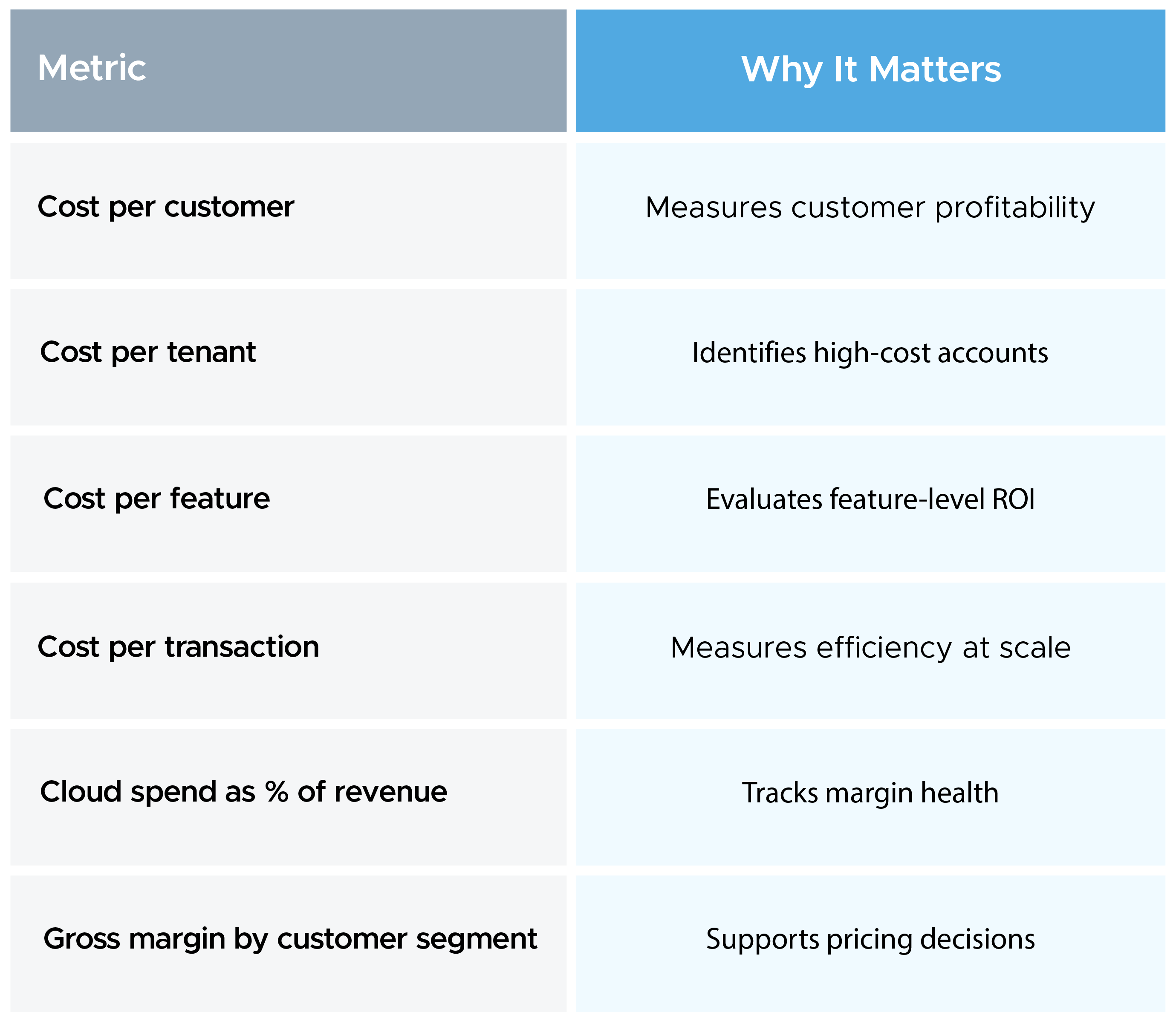 A simple starting point is calculating cost per customer:
Cost per customer = Total cloud spend ÷ Active customers
While this provides a high-level view, mature SaaS organizations often go further by tracking costs at the tenant, feature, and product level.
To improve cloud cost visibility, organizations should establish:
- Consistent tagging standards
- Cost allocation frameworks
- Customer-level reporting
- Product-level reporting
- Environment-level cost tracking
Once cloud spending is connected to business metrics, optimization opportunities become much easier to identify and prioritize. This is where FinOps practices become important, helping engineering, finance, and business teams use shared cost visibility to make better cloud spending decisions.
Cloud Cost Optimization Moves That Don't Require an Engineering Sprint
Not every cloud cost optimization initiative requires major architectural changes or months of engineering effort.
Several cloud cost optimization opportunities can deliver meaningful savings relatively quickly.
Schedule Non-Production Environments
Development and testing environments are often used only during working hours but remain active around the clock.
Automating start and stop schedules can reduce unnecessary spending without affecting productivity.
Remove Idle Resources
Regular reviews can uncover:
- Unattached storage volumes
- Unused snapshots
- Idle databases
- Forgotten workloads
- Unused load balancers
These resources frequently generate costs without delivering any business value.
Rightsize Resources
Over time, workloads often become overprovisioned as teams allocate additional compute, database, or storage capacity to support expected growth.
Regularly reviewing resource utilization and aligning capacity with actual demand can help reduce cloud costs without impacting performance.
Optimize Storage Policies
Implementing lifecycle management policies helps move inactive data into lower-cost storage tiers while ensuring critical data remains accessible.
Improve Commitment Coverage
For organizations running on AWS, commitment-based discounts remain one of the most effective AWS cost optimization strategies.
Examples include:
- AWS Savings Plans
- Reserved Instances
Regular reviews help ensure commitment coverage aligns with actual usage patterns and business requirements.
Review Data Transfer Patterns
Analyzing network traffic can reveal opportunities to reduce:
- Cross-region communication
- Egress costs
- Unnecessary data movement
Even small improvements can generate meaningful savings at scale.
What Good Looks Like: Measuring SaaS Cloud Efficiency
There is no single benchmark that applies to every SaaS business. Cloud spend and gross margins vary depending on product complexity, customer usage patterns, infrastructure requirements, and deployment models.
Instead of comparing performance against generic industry averages, SaaS organizations should establish and regularly monitor FinOps KPIs that measure cloud efficiency and profitability. The metrics discussed earlier, such as cost per customer, cost per tenant, cost per feature, cloud spend as a percentage of revenue, and gross margin by customer segment, serve as valuable KPIs for evaluating whether cloud cost optimization initiatives are improving business outcomes.
Regularly tracking these KPIs helps SaaS organizations improve cloud cost visibility, identify optimization opportunities, and ensure cloud cost optimization for SaaS contributes to healthier margins as the business scales.
Conclusion: Growth Should Improve Margins, Not Erode Them
Cloud cost optimization for SaaS is about ensuring cloud spend remains aligned with business growth. As customer adoption increases, organizations need cloud cost visibility, cost attribution, and continuous optimization to prevent infrastructure costs from outpacing revenue.
Tools such as CloudKeeper Lens help SaaS teams gain deeper visibility into cloud spending, making it easier to identify cost drivers, improve cost allocation, and uncover optimization opportunities.
Organizations that understand their cost per customer, cost per tenant, and cost per feature are better positioned to scale efficiently while maintaining healthy margins. Growth should create more value for the business, not simply result in larger cloud bills.
Growth should create more value for the business, not simply result in larger cloud bills.
Frequently Asked Questions
Q1: What is cloud cost optimization for SaaS?
Cloud cost optimization for SaaS is the process of reducing unnecessary cloud spending while ensuring infrastructure costs remain aligned with business growth. It helps organizations improve profitability, strengthen unit economics, and maintain healthy margins as customer adoption increases.
Q2: Why is cloud cost optimization important for SaaS companies?
As SaaS businesses grow, cloud spending often increases alongside customer usage, data volumes, and infrastructure requirements. Without effective cloud cost optimization, cloud costs can grow faster than revenue, reducing profitability and putting pressure on margins.
Q3: What are the biggest cloud cost drivers for SaaS companies?
The most common cloud cost drivers include multi-tenancy sprawl, over-provisioned development and staging environments, data transfer costs, and storage growth at scale. These areas often account for a significant portion of cloud spending and represent major optimization opportunities.
Q4: What is cloud cost visibility and why does it matter?
Cloud cost visibility is the ability to understand where cloud spending originates across customers, tenants, products, features, and workloads. It helps organizations identify cost drivers, improve cost allocation, and make informed optimization decisions.
Q5: How can SaaS companies reduce cloud costs without impacting performance?
SaaS companies can reduce cloud costs by eliminating idle resources, optimizing storage policies, improving commitment coverage, scheduling non-production environments, and increasing cloud cost visibility. These measures help reduce cloud waste while maintaining performance and reliability.
Q6: How does AWS cost optimization help SaaS businesses?
AWS cost optimization helps SaaS businesses improve cloud efficiency through strategies such as AWS Savings Plans, Reserved Instances, rightsizing resources, storage optimization, and cost visibility improvements. These practices help control spending while supporting business growth.