



14
14Unlike conventional applications, AI workloads depend on GPU-intensive infrastructure, continuous model inference, vector databases, large-scale storage, networking, and token-based APIs. Even seemingly small architectural decisions such as selecting a larger language model, increasing context length, or deploying AI agents can significantly impact cloud spending.
For cloud engineers, platform teams, DevOps professionals, and FinOps practitioners, the challenge isn't simply reducing cloud costs. It's understanding where AI costs originate, improving infrastructure efficiency, and ensuring AI investments continue delivering measurable business value as adoption scales.
This guide answers the most common questions around AI cost optimization, combining industry best practices with insights from engineering communities to help cloud teams optimize AI workloads without compromising performance.
What is AI cost optimization?
AI cost optimization is the process of reducing the cost of developing, deploying, and operating AI workloads while maintaining application performance, reliability, and business outcomes.
Unlike traditional cloud cost optimization, AI cost optimization extends beyond compute, storage, and networking. It includes optimizing GPU infrastructure, model inference, token usage, vector databases, AI agents, managed AI services, and the supporting cloud architecture.
The goal isn't simply to lower AI spending, it's to ensure organizations maximize the value generated by every AI workload.
Common AI cost optimization strategies include:
- Selecting the right model for each workload.
- Improving GPU utilization.
- Eliminating idle AI infrastructure.
- Optimizing prompts and inference requests.
- Using caching and batching for repeated workloads.
- Continuously monitoring AI resource consumption.
How is AI cost optimization different from cloud cost optimization?
While both disciplines aim to improve efficiency, AI introduces additional cost drivers that require a different optimization approach.
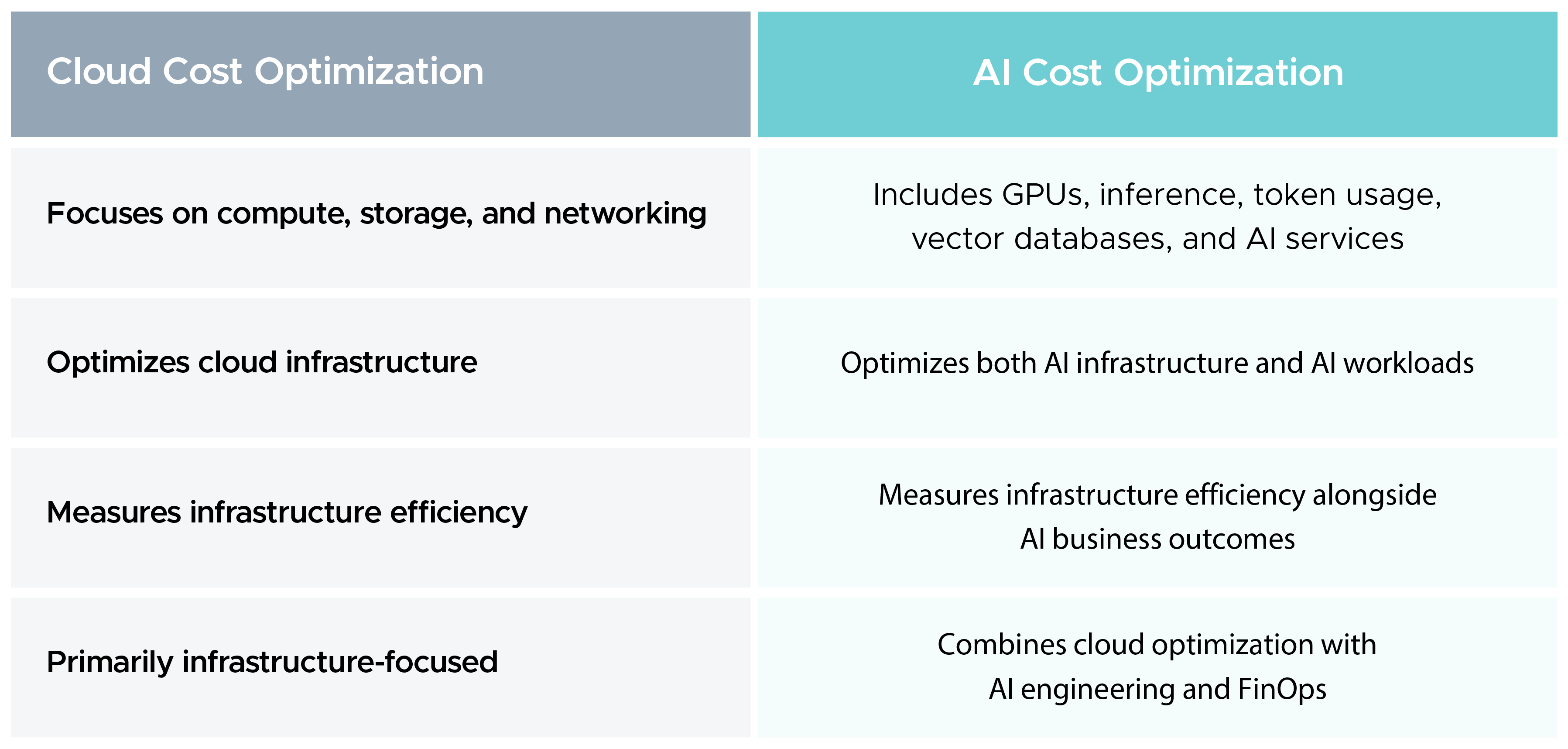
As enterprise AI adoption grows, organizations increasingly treat AI cost optimization as a natural extension of cloud FinOps.
What drives AI infrastructure costs?
As organizations scale AI from experimentation to production, cloud costs often increase much faster than expected. Unlike traditional applications, AI workloads continuously consume GPU resources, generate inference requests, process large volumes of data, and rely on specialized infrastructure. Even seemingly small architectural decisions such as deploying a larger language model, increasing context windows, or introducing AI agents can significantly impact monthly cloud spending.
Understanding what's driving these costs is the first step toward building an effective AI cost optimization strategy.
What contributes the most to AI infrastructure costs?
Although every deployment is unique, most AI environments are affected by the same major cost drivers.
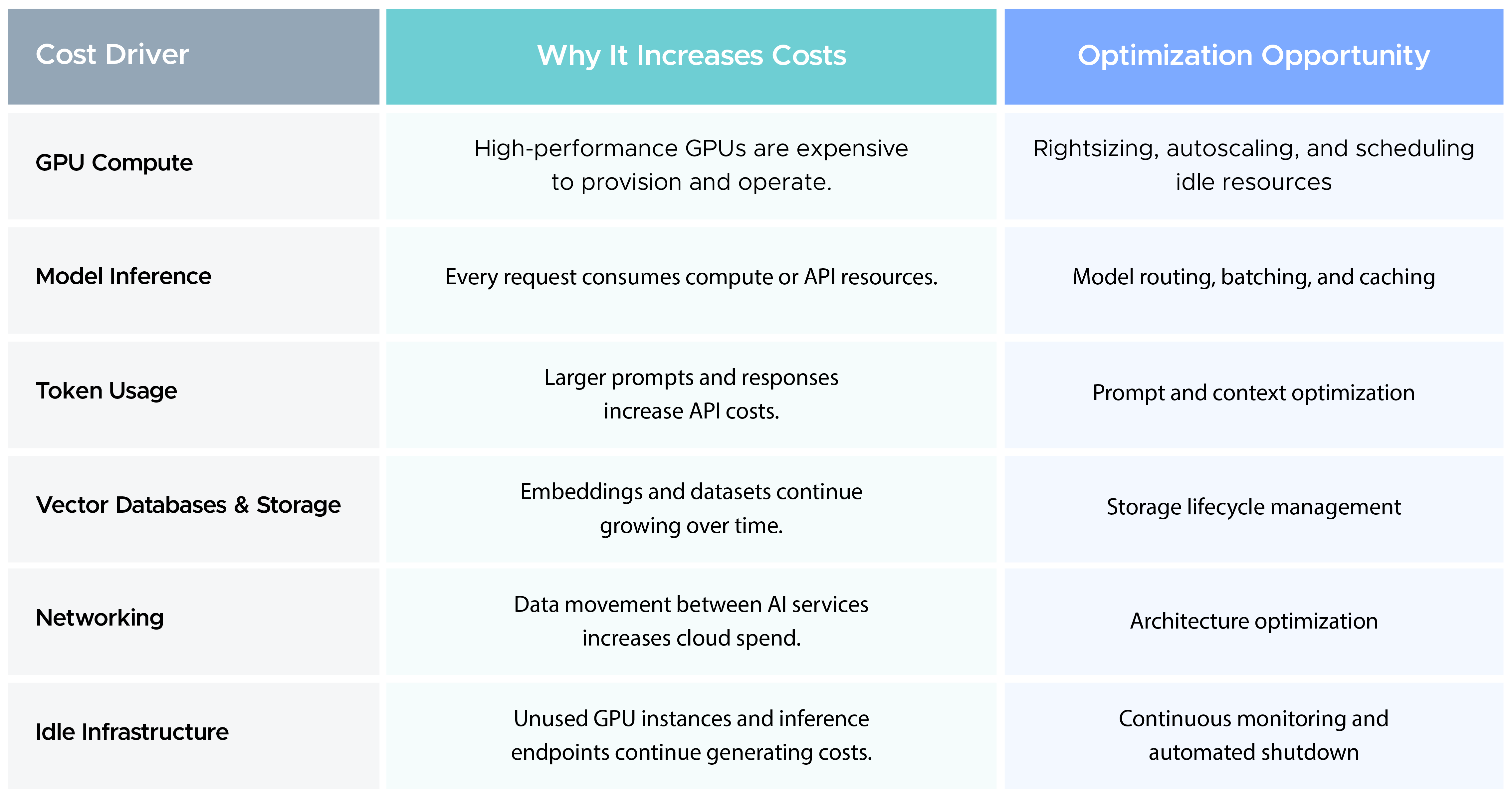
One of the biggest misconceptions is that token usage is the primary driver of AI costs. In practice, organizations often discover that underutilized GPUs, oversized infrastructure, inefficient model selection, and limited workload visibility contribute far more to overall AI spending than prompt length alone.
Why do AI bills suddenly spike?
Unexpected cost spikes rarely result from a single event. More often, they're caused by several infrastructure and architectural decisions accumulating over time.
Consider a team launching an AI-powered customer support assistant. Initially, costs remain manageable because usage is low. As adoption grows, the team upgrades to a larger language model, provides additional GPU capacity, enables AI agents to perform multiple reasoning steps, and shares the same infrastructure across several applications.
Each decision seems reasonable on its own. Together, however, they can significantly increase monthly cloud costs without teams realizing it until the next billing cycle.
What are the biggest drivers of unexpected AI spending?
Recurring discussions across engineering and FinOps communities point to the same cost drivers:
- Idle GPU infrastructure.
- Oversized compute resources.
- High inference volumes.
- Premium models used for routine tasks.
- Poor workload visibility.
- Lack of cost allocation across teams or applications.
- Autonomous AI agents executing unnecessary requests.
Before making optimization decisions, organizations should first identify which workloads, applications, and teams are driving AI spending. Greater visibility enables cloud teams to focus on the changes that will deliver the greatest impact instead of reacting to unexpected cloud bills.
How can cloud teams reduce AI costs without compromising performance?
AI cost optimization isn't about cutting AI usage, it's about making AI workloads more efficient. The goal is to maximize the value of every GPU hour, inference request, and model invocation while maintaining performance.
Across Reddit and engineering communities, one recommendation appears consistently: there's no single optimization that dramatically reduces AI costs. Instead, organizations achieve meaningful savings by combining several smaller improvements across their AI stack.
How do you reduce LLM costs by a large margin?
One of the most effective strategies for LLM cost optimization is using the right model for the right workload.
Not every request requires a frontier model. Tasks such as text classification, summarization, sentiment analysis, or content tagging can often be handled by smaller models with comparable accuracy at a fraction of the cost.
Many organizations also implement model routing, automatically directing simple requests to lightweight models while reserving larger models for complex reasoning or code generation. This reduces inference costs without affecting the overall user experience.
How do you reduce API and AI inference costs without hurting quality?
Inference often becomes the largest recurring AI expense once applications reach production.
Rather than limiting AI adoption, organizations should focus on eliminating unnecessary inference requests by:
- Caching frequently requested responses.
- Sending only relevant context to the model.
- Batching background or non-real-time workloads.
- Removing duplicate API calls.
- Continuously monitoring inference patterns.
- These optimizations reduce operational costs while maintaining application performance.
How do you reduce AI token costs?
Although token usage isn't always the biggest contributor to AI infrastructure costs, it can become a significant expense for applications handling large volumes of requests. Every input prompt and generated response consumes tokens, so inefficient prompt design can quickly increase API costs at scale.
Organizations can reduce token-related costs by:
- Keeping prompts concise and sending only the context the model needs.
- Limiting unnecessary output length.
- Removing redundant system instructions and repeated prompts.
- Using prompt caching for frequently repeated requests.
- Choosing smaller models for routine tasks that don't require advanced reasoning.
However, token optimization should be part of a broader AI cost optimization strategy. In many production environments, improvements in GPU utilization, model selection, and workload visibility often deliver greater savings than reducing token usage alone.
When should you use caching or batching?
Caching is useful when AI applications repeatedly generate the same or similar responses, such as FAQs, document summaries, or embeddings.
Batching is more effective for workloads that don't require immediate responses, including document processing, report generation, or large-scale content analysis. Processing these requests together improves infrastructure utilization and reduces overall compute costs.
How do you keep AI costs from spiraling as AI agents scale?
AI agents introduce a new layer of cost complexity because they can perform multiple actions before completing a task. A single user request may trigger several model calls, API requests, vector database lookups, and reasoning steps.
Without appropriate controls, these workflows can generate unexpected infrastructure costs.
How do you stop runaway AI usage?
Organizations can prevent uncontrolled AI spending by implementing practical guardrails such as:
- Execution limits for AI agents.
- Usage budgets for AI-powered applications.
- API rate limiting.
- Cost alerts and anomaly detection.
- Continuous monitoring of agent activity.
These controls help ensure AI workloads remain predictable as adoption increases.
What guardrails should organizations implement for AI agents?
Beyond infrastructure controls, organizations should establish cloud governance policies that define:
- Which models can be used for specific workloads.
- Maximum execution limits for autonomous agents.
- Resource quotas for development and production environments.
- Approval processes for deploying new AI services.
Strong governance allows teams to scale AI responsibly without introducing unnecessary operational costs.
How do you decide whether to use a cheaper model, a larger model, or no LLM at all?
One of the most overlooked optimization opportunities is questioning whether every workload actually requires a large language model.
Traditional automation, search, or machine learning models can often solve repetitive tasks more efficiently and at a lower cost. When an LLM is necessary, the choice should depend on workload complexity, latency requirements, and business value, not simply model size.
Should you fine-tune a model or use prompt engineering instead?
Prompt engineering is usually the fastest and most cost-effective way to improve model performance because it doesn't require retraining or maintaining custom models.
Fine-tuning becomes worthwhile when organizations need consistent domain-specific behavior or highly specialized outputs. However, it also increases costs related to training, storage, infrastructure, and ongoing maintenance.
When does RAG make more sense than fine-tuning?
For applications that rely on frequently changing information such as internal documentation, knowledge bases, or support articles, Retrieval-Augmented Generation (RAG) is often the better choice because information can be updated without retraining the model.
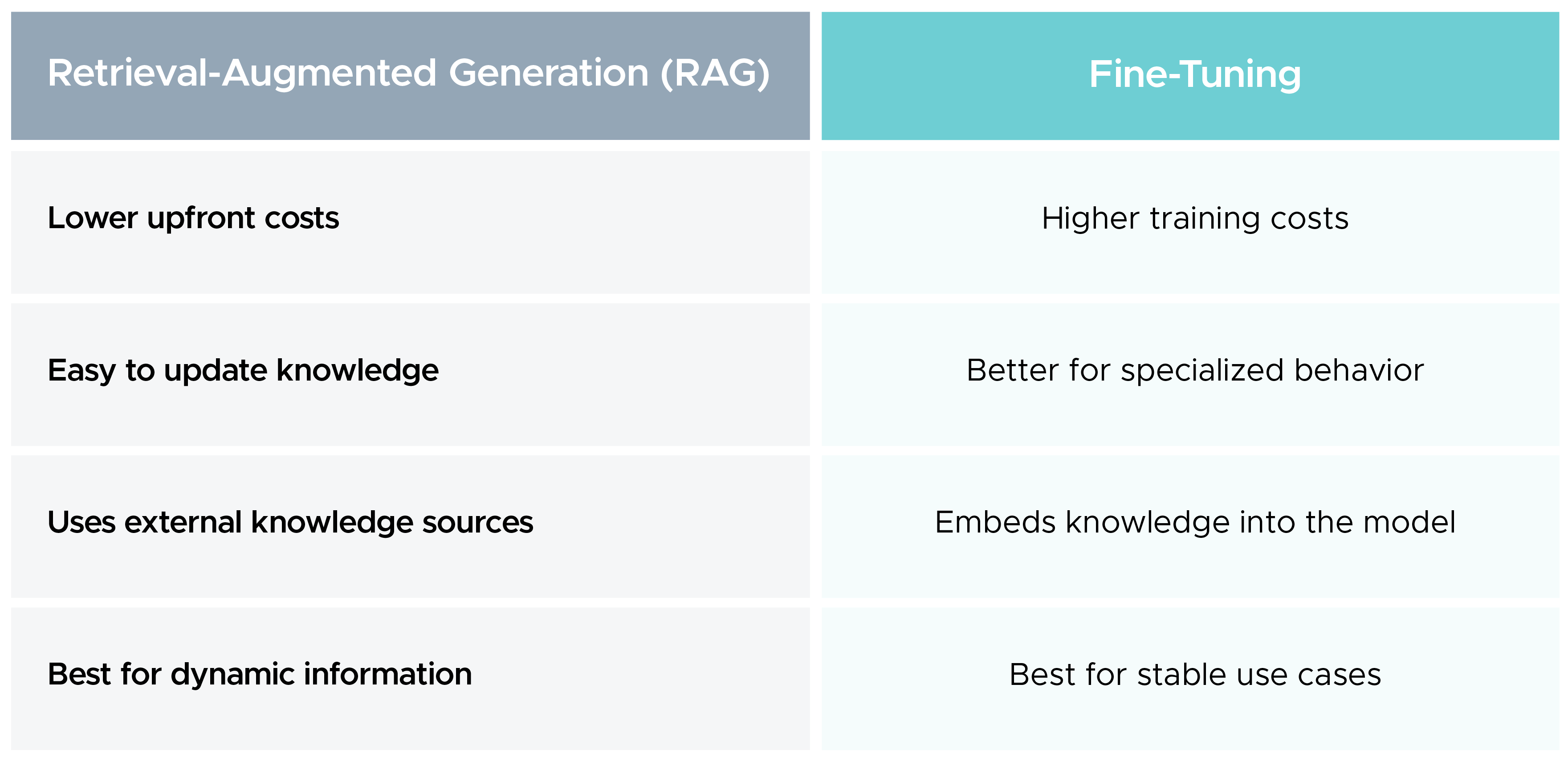
The right approach depends on maintenance effort, workload requirements, and total cost of ownership rather than performance alone.
Should you self-host AI models or use managed AI services?
Managed AI services simplify deployment and operations, making them suitable for organizations that want faster adoption with less operational overhead.
Self-hosted models provide greater control and may reduce cloud costs for consistently high-volume workloads, but they also require investment in GPU infrastructure, monitoring, security, and ongoing maintenance.
Rather than comparing API pricing alone, organizations should evaluate the total cost of ownership (TCO) before making a decision.
How do you manage AI costs across teams and budgets?
As AI adoption expands, managing costs becomes less about infrastructure alone and more about governance and accountability.
AI workloads are often shared across multiple teams, products, and business units. Without clear ownership, organizations struggle to understand who is consuming resources, which applications generate the highest costs, and whether AI investments are delivering measurable value.
A mature AI cost optimization strategy starts with visibility. Organizations should allocate AI costs by application, environment, or team so spending can be tracked and optimized effectively.
What FinOps practices improve AI cost efficiency?
Traditional FinOps focuses on optimizing cloud infrastructure through visibility, budgeting, and continuous improvement. AI extends these principles to include model usage, GPU utilization, inference costs, and AI-specific resources.
Some proven AI FinOps practices include:
- Allocating AI costs across teams and applications.
- Monitoring GPU utilization and idle resources.
- Setting budgets for AI workloads.
- Tracking inference costs alongside infrastructure costs.
- Reviewing model usage regularly.
- Identifying spending anomalies before monthly cloud bills arrive.
The goal isn't simply to reduce costs it's to ensure every AI investment delivers measurable business value.
How do you track and allocate AI spend?
Organizations should treat AI as a measurable business service rather than a shared cloud expense.
Track AI costs by:
- Teams and business units.
- Applications or products.
- Development, staging, and production environments.
- AI agents and automated workflows.
This level of visibility makes it easier to prioritize optimization efforts and justify future AI investments.
How are startups and enterprises approaching AI cost reduction differently?
While the goal of AI cost optimization is the same for every organization maximizing value while controlling spend, the approach often differs depending on scale and operational maturity.
Startups typically focus on keeping AI infrastructure lean. They rely on smaller language models where possible, optimize prompts, cache responses, and closely monitor API spending to extend runway. Their priority is delivering acceptable performance at the lowest possible cost.
Enterprises, on the other hand, face a different challenge. With multiple teams, products, and AI workloads sharing infrastructure, governance becomes just as important as optimization. They invest in cloud cost allocation, AI FinOps, workload visibility, and policies that help balance performance, compliance, and financial accountability across the organization.
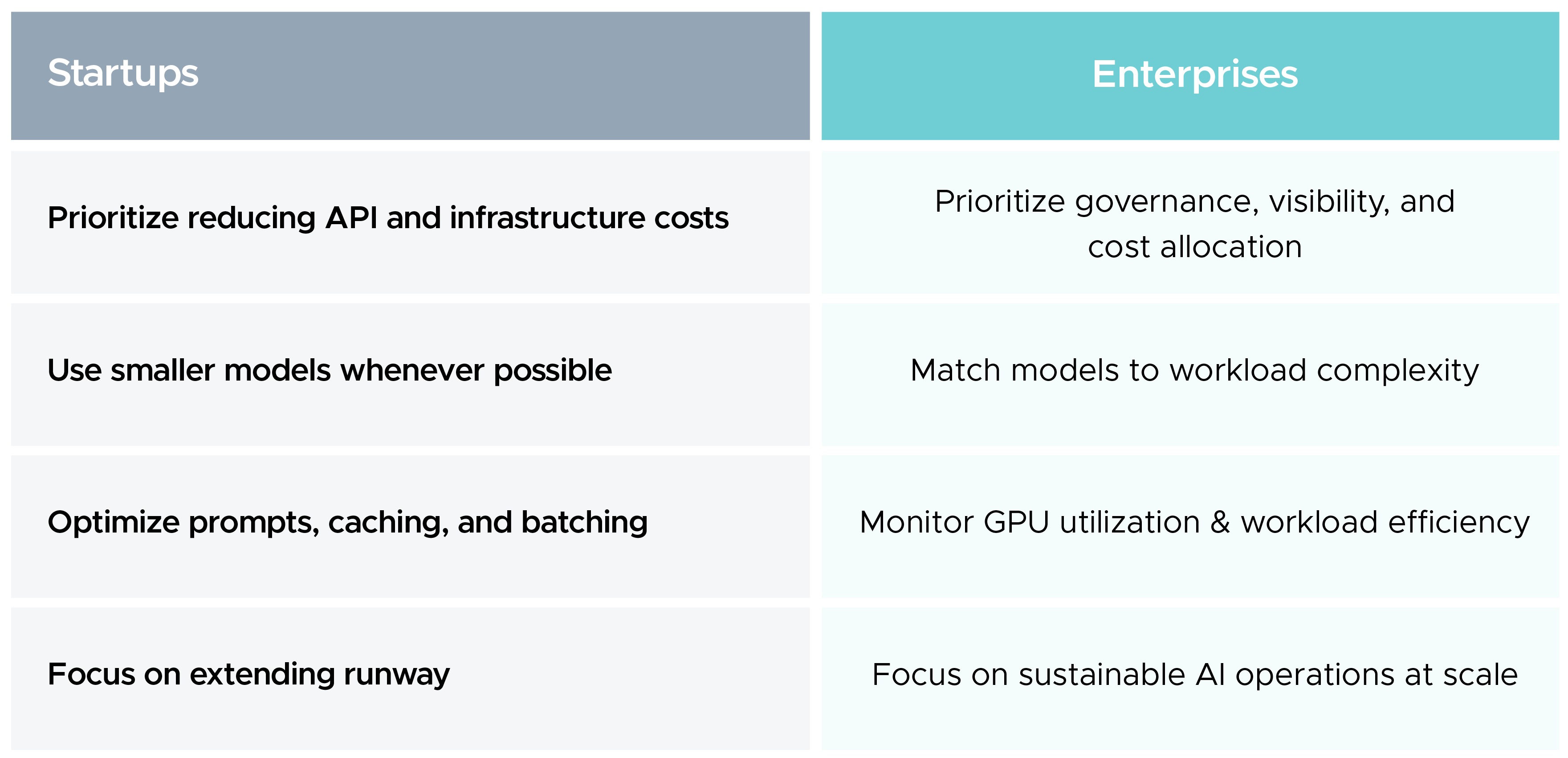
Regardless of organization size, the most successful teams treat AI cost optimization as an ongoing process rather than a one-time exercise. As AI adoption grows, continuous monitoring, workload optimization, and FinOps practices become increasingly important.
How do you know if your AI cost optimization strategy is actually working?
Reducing cloud spend is only one measure of success.
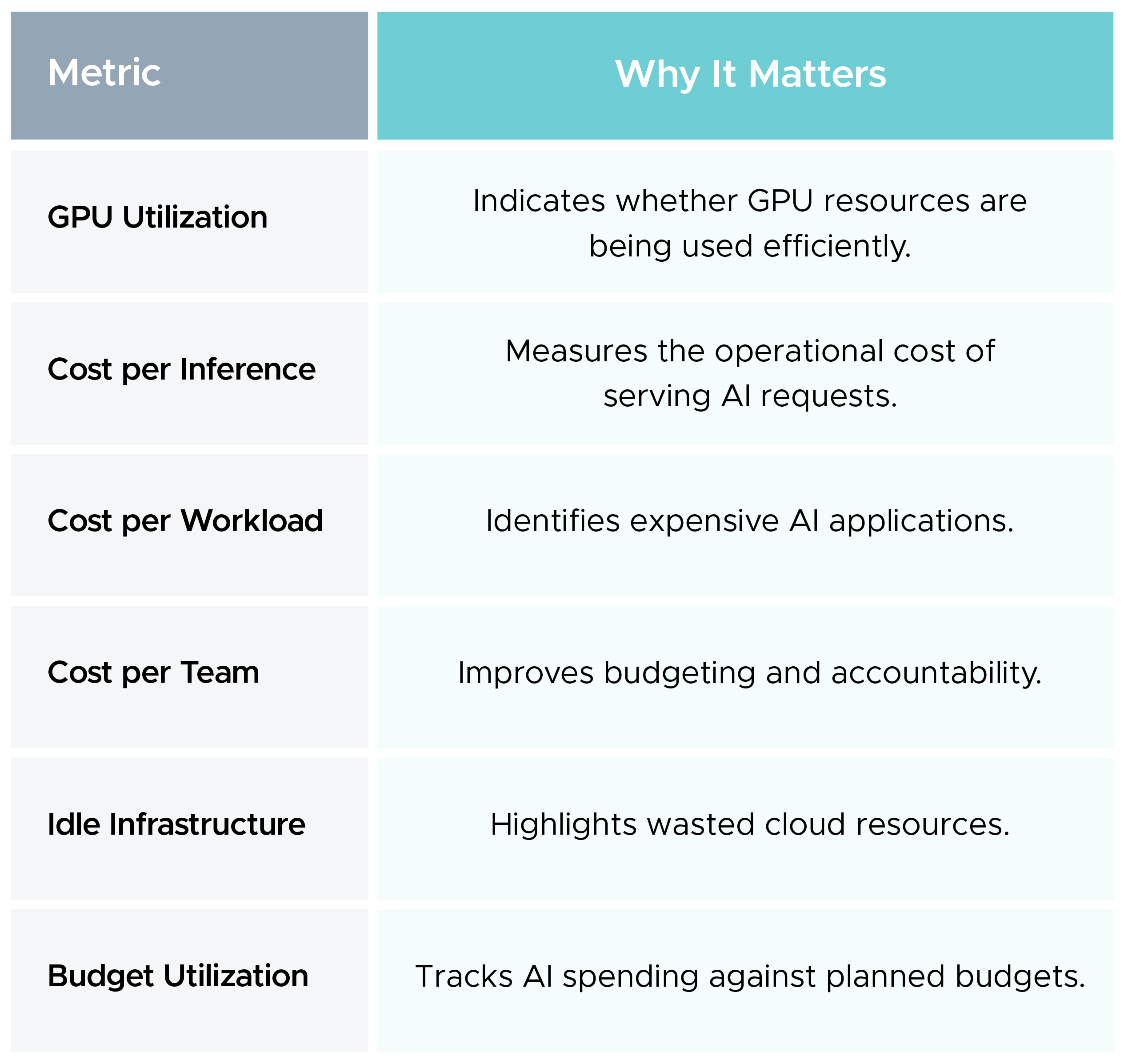
Organizations should evaluate AI efficiency using infrastructure, operational, and business metrics together.
What metrics should cloud teams monitor?
The following KPIs provide a more complete view of AI efficiency than monthly cloud bills alone.
How do you measure ROI from AI spending?
AI cost optimization should always be evaluated alongside business outcomes.
Useful ROI metrics include:
- Faster customer support resolution.
- Increased developer productivity.
- Reduced manual effort through automation.
- Adoption of AI-powered features.
- Revenue generated from AI-enabled products.
Lower costs are valuable, but sustainable AI adoption depends on balancing efficiency with measurable business impact.
What are the best practices for AI cost optimization?
Successful organizations don't rely on a single optimization technique. Instead, they combine infrastructure optimization, intelligent model selection, and continuous monitoring.
Some best practices include:
Match AI models to workload complexity.
- Improve GPU utilization.
- Cache repeated requests.
- Batch background workloads.
- Optimize prompts and context.
- Monitor AI workloads continuously.
- Allocate AI costs across teams.
- Review AI architecture regularly.
What should organizations prioritize first?
Before optimizing infrastructure or changing models, organizations should first answer a simple question:
Do we know where our AI costs are coming from?
Without visibility into workloads, applications, and resource utilization, optimization efforts often focus on the wrong areas.
Understanding cost drivers first allows cloud teams to prioritize improvements that deliver the greatest impact.
Conclusion
As AI adoption grows, so does the need for disciplined cost management.
Effective AI cost optimization isn't about reducing AI usage, it's about improving visibility, selecting the right architecture, optimizing infrastructure, and continuously measuring business value.
The same principle applies to SaaS businesses, where improving cost visibility and eliminating waste often has a greater impact than simply reducing cloud usage.
By combining cloud optimization, FinOps principles, intelligent model selection, and ongoing monitoring, organizations can scale AI responsibly while keeping infrastructure costs under control.
For organizations looking to simplify this process, platforms like CloudKeeper help bring cloud cost optimization and FinOps for AI together by providing deeper visibility into cloud spending, improving cost allocation, and identifying optimization opportunities across AI workloads. As AI infrastructure continues to evolve, having the right visibility and governance in place will be key to maximizing both performance and cost efficiency.
Frequently Asked Questions
Q1: What are the hidden costs of running open-source LLMs?
Open-source LLMs eliminate licensing fees, but they don't eliminate operational costs. Organizations still need to invest in GPU infrastructure, storage, networking, monitoring, security, software updates, and engineering resources to deploy and maintain these models. Depending on workload size, these operational expenses can exceed the cost of using managed AI services. Before choosing between open-source and proprietary models, organizations should evaluate the total cost of ownership (TCO), including infrastructure, maintenance, scalability, and ongoing operational effort—not just the initial software cost.
Q2: How do you compare serverless inference with provisioned GPUs?
The right deployment model depends on workload characteristics. Serverless inference is generally more cost-effective for unpredictable or low-volume workloads because organizations only pay for the requests they process. Provisioned GPU infrastructure, however, often becomes more economical for consistently high-volume AI applications where GPU resources can be utilized efficiently over long periods. Cloud teams should evaluate workload predictability, utilization, latency requirements, and total infrastructure costs before deciding which approach best supports their AI applications.
Q3: Which AI model is the most cost-effective for my workload?
There isn't a single AI model that's the most cost-effective for every use case. The right choice depends on workload complexity, expected request volume, latency requirements, accuracy expectations, and business objectives. Many organizations reduce AI infrastructure costs by using smaller language models for routine tasks such as classification, summarization, or tagging, while reserving larger models for advanced reasoning or code generation. Matching the model to the workload helps balance performance, user experience, and operational costs.
Q4: Should every AI workload use a large language model (LLM)?
Not necessarily. While LLMs are powerful, they aren't always the most efficient solution. Many repetitive or rule-based tasks can be handled using traditional automation, search systems, or machine learning models at a much lower cost. Before deploying an LLM, organizations should evaluate whether the task genuinely requires natural language reasoning or whether a simpler approach can deliver similar results. Choosing the right technology for each workload is often one of the most effective ways to optimize AI infrastructure costs.
Q5: How do cloud teams prevent AI costs from spiraling as usage grows?
As AI adoption scales, organizations need more than infrastructure optimization—they need governance. Cloud teams typically combine AI FinOps practices with technical controls such as budgets, cost allocation, workload monitoring, autoscaling, execution limits for AI agents, and continuous optimization. Establishing clear ownership for AI workloads and monitoring spending across teams helps organizations identify inefficiencies early and prevent unexpected increases in cloud costs as AI usage grows.
Q6: Can AI help optimize cloud costs?
Yes. AI is increasingly being used to improve cloud cost management by analyzing usage patterns, detecting anomalies, forecasting future spending, identifying rightsizing opportunities, and recommending optimization actions. Combined with FinOps practices, AI can help engineering and cloud teams gain better visibility into cloud infrastructure, automate repetitive optimization tasks, and make faster, data-driven decisions about resource utilization and cost efficiency.
Q7: How often should organizations review AI costs?
AI workloads evolve much faster than traditional cloud environments. New models, changing workloads, fluctuating traffic, and evolving business requirements can all affect infrastructure costs over time. Rather than reviewing spending only at the end of the billing cycle, organizations should continuously monitor AI infrastructure costs and perform regular optimization reviews. Continuous visibility helps cloud teams identify inefficiencies early, forecast future spending more accurately, and optimize workloads before costs become difficult to control.
Q8: What are the biggest AI cost optimization mistakes?
One of the most common mistakes is focusing only on token usage while ignoring larger cost drivers such as GPU utilization, model selection, and workload efficiency. Other frequent issues include overprovisioning GPU resources, using premium models for routine tasks, failing to allocate AI costs across teams, and treating AI cost optimization as a one-time initiative instead of an ongoing process. Organizations that continuously monitor workloads, improve visibility, and combine technical optimization with AI FinOps practices are generally better positioned to scale AI sustainably while controlling infrastructure costs.
Q9: How can organizations measure the success of their AI cost optimization strategy?
Reducing cloud spend alone doesn't necessarily indicate success. Organizations should evaluate AI cost optimization using a combination of infrastructure and business metrics, such as GPU utilization, cost per inference, workload efficiency, application performance, and return on investment (ROI). Measuring how AI contributes to productivity, customer experience, or operational efficiency provides a more complete picture than tracking infrastructure costs alone. The most successful strategies balance cost savings with measurable business outcomes.
Q10: What role does AI FinOps play in AI cost optimization?
AI FinOps extends traditional FinOps principles to AI workloads by helping organizations monitor, allocate, govern, and optimize AI infrastructure costs. It combines cloud cost visibility with insights into GPU usage, model inference, token consumption, and workload efficiency. As AI adoption grows across teams and business units, AI FinOps enables organizations to establish accountability, forecast spending more accurately, and ensure AI investments deliver long-term business value while keeping cloud costs under control.