



9
9Buying AWS Reserved Instances manually follows a predictable process: a cloud or finance team pulls 30 to 90 days of usage data, identifies a baseline workload, selects a commitment type (Savings Plans or Reserved Instances), decides on a term length, enters a fixed hourly spend in the Billing Console, and submits the purchase. Once that purchase closes, the budget is locked in against an infrastructure picture that continues shifting regardless of what was committed.
The costs embedded in this process rarely surface in reviews and are hardly tackled in cloud cost optimization efforts. They accumulate through misaligned reservations, underutilized RIs, missed renewal windows, and the sustained redirection of engineering time toward purchasing oversight that generates no product value. As AWS environments grow in complexity, the financial and operational consequences of manual AWS RI management increase in proportion.
5 Hidden Costs of Manual AWS RI Buying
1. Purchases Are Based on Data That Is Already Outdated
Every manual Amazon Reserved Instance purchase and, subsequently, manual AWS RI management is sized against historical consumption, typically a 30- to 90-day baseline that reflects what the infrastructure was doing, not what it will be doing once the commitment takes effect. AWS environments change continuously as services launch, applications are refactored, and traffic patterns evolve, so a reservation purchased based on last month's usage quickly becomes misaligned.
Over weeks and months, this drift compounds into what practitioners call commitment decay, producing coverage that is either over-sized or under-sized relative to actual demand.
2. Underutilized AWS Reserved Instances Represent Purchases That Do Not Pay Off
When an AWS Reserved Instance goes underutilized, the commitment cost has been incurred, and the discount it was purchased to deliver has not been fully realized a direct financial loss that scales with the number of active reservations in the environment. At scales of dozens or hundreds of RIs, low utilization is typically identified during periodic billing reviews, by which point the loss has already been recorded.
The structural issue then carries into the next purchase cycle unchanged, because corrective action still depends on the same manual oversight that failed to prevent the problem.
3. Buying the Right AWS RI at the Right Time Requires Constant Vigilance
AWS Reserved Instances expire on fixed schedules, and AWS Savings Plans carry hourly commitments that persist independently of whether actual usage justifies them. Managing renewals across AWS Compute Savings Plans, AWS EC2 Instance Savings Plans, and AWS Database Savings Plans, each with different flexibility and discount profiles, demands sustained, accurate attention across multiple commitment types and expiry windows.
A missed renewal pushes workloads to full on-demand instance pricing, while an oversized or poorly timed purchase locks the budget into capacity that no longer reflects the current state of the infrastructure.
4. Manual RI Buying Does Not Scale With Infrastructure Growth
Manual AWS Reserved Instance purchasing and manual AWS RI management depend on the team's ability to maintain an accurate picture of a complex, changing environment, creating a dependency that becomes increasingly difficult to satisfy as infrastructure expands. Additional services require individual usage analysis before each purchase decision.
Additional regions create parallel workflows with independent coverage requirements. Moreover, Additional engineering teams introduce usage changes without centralized visibility into how these changes affect existing AWS Reserved Instances or AWS Savings Plans. As this complexity accumulates, decision cycles lengthen and coverage accuracy declines.
5. RI Purchasing Overhead Consumes Engineering Capacity
Manual AWS RI buying and manual AWS RI management have a legitimate upside at small scale: direct control over purchasing decisions and full visibility into the organization's commitment posture. As environments grow, however, the time required to maintain that control increases substantially.
Analyzing usage history before each purchase, recalculating hourly commitment levels, monitoring utilization alerts, and evaluating term renewals are repetitive, data-intensive tasks, and the engineering hours devoted to manual AWS RI Management are diverted from architecture work, reliability improvements, and product development.
Why Spreadsheet-Driven RI/SP Management Doesn't Scale
Spreadsheet-based AWS RI management functions as a workable system within a narrow set of conditions: a small number of commitment types, a stable workload baseline, and a team with consistent availability to maintain the process. Each of those conditions degrades as AWS environments expand.
The volume of data that must be processed before each purchasing decision grows with the environment. An organization running workloads across multiple regions, instance families, and account structures generates usage data that a spreadsheet can store but cannot analyze in real time.
Coverage gaps are identified retrospectively, after the billing cycle has closed, rather than prospectively, when they can still be addressed. Commitment decay, which refers to the gradual drift between purchased reservations and actual usage, goes undetected until a billing review surfaces it, by which point several cycles of avoidable waste have already occurred.
The process also creates a single point of organizational dependency. When the team member who owns the spreadsheet changes roles or leaves, the institutional knowledge embedded in that workflow leaves with them.
Reconstruction takes time, and coverage typically suffers during the transition. Automated systems carry no such dependency: the optimization logic operates independently of any individual and persists across team changes without degradation.
At the enterprise level, the problem extends further. Multi-account AWS environments require consolidating usage data across accounts before any commitment analysis can begin, adding coordination overhead before the actual purchasing work even starts.
Spreadsheet workflows are not architected for this scale, and the manual effort required to maintain coverage accuracy across a large account structure grows faster than most teams can sustainably absorb.
Manual vs. Automated AWS RI Buying: What the Numbers Show
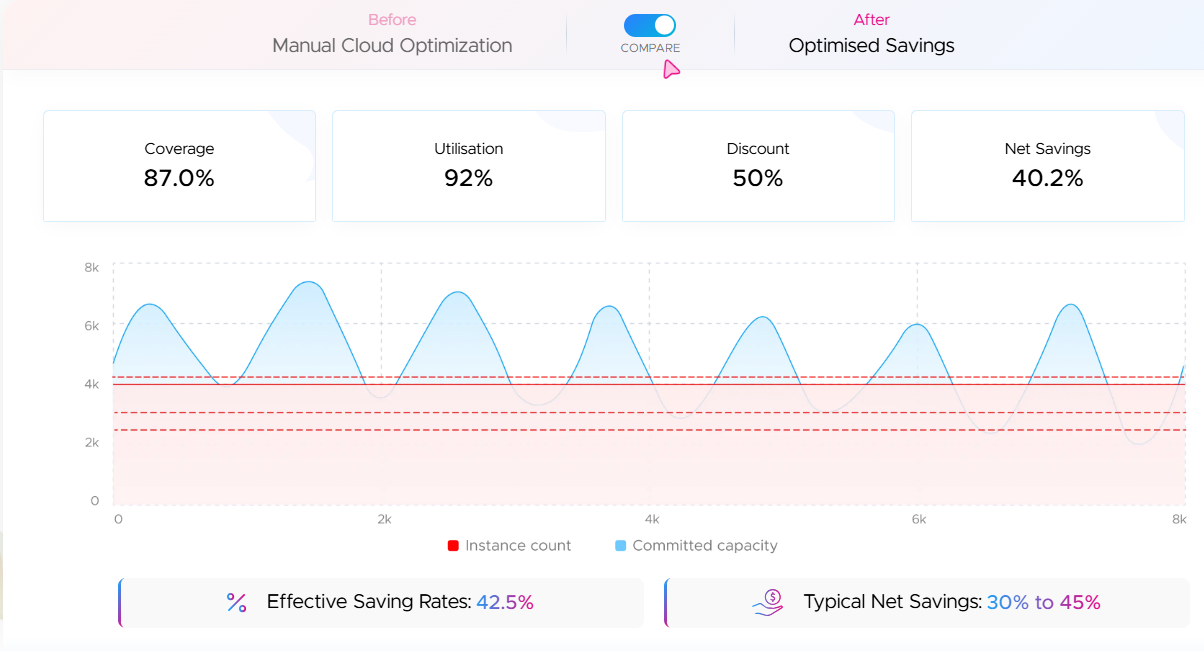
The difference between manual and automated AWS Reserved Instance and AWS Savings Plan management is measurable on the AWS bill. Organizations that manage AWS RI manually typically achieve AWS RI coverage in the 30 percent range, with utilization rates that leave a significant portion of available discounts unrealized. The outcome is effective savings rates well below the discount levels that Reserved Instances can deliver.
Automated AWS RI management, applied continuously against real-time usage data, consistently produces coverage above 85 percent at high utilization rates. When coverage and utilization are both sustained at those levels across Compute and Database workloads, the effective savings rate moves into the 30-45 percent range, savings that are reflected directly in the AWS billing statement rather than modeled in a spreadsheet.
The gap between the two approaches widens as environments grow because automation scales with infrastructure, whereas manual processes do not.
Why AWS RI Buying Needs to Be Automated
The core problem with purchasing AWS Reserved Instances manually is timing. Every purchase is a point-in-time decision made against historical data, applied to an environment that continues changing after the purchase closes, and the gap between the infrastructure state at the moment of commitment and its actual state weeks later is precisely where financial leakage concentrates.
As AWS environments scale, the volume of purchase decisions required to maintain accurate coverage exceeds what manual processes can consistently sustain. Adding headcount to the purchasing function addresses capacity without addressing the timing problem; skilled engineers are directed toward work that produces no compounding return.
Automation resolves the issue at its source by removing the lag between workload changes and commitment adjustments, keeping reservations aligned to actual usage without depending on manual review cycles to initiate corrections.
What to Look for in an AWS Reserved Instance and AWS Savings Plan Automation Tool
AWS RI automation platforms vary significantly in what they actually deliver. The capabilities that determine whether a tool produces real, billable outcomes include:
- Real-time usage monitoring: Continuous tracking of actual AWS consumption across Compute and Database services, rather than periodic batch analysis ahead of each purchase cycle
- Dynamic commitment recalculation: Automatic adjustment of RI coverage as workloads evolve, without requiring a manual review to trigger changes
- Incremental, low-risk purchases: Flexible commitment structures that reduce financial exposure when usage patterns shift unexpectedly
- Automated execution through AWS: The ability to implement purchasing decisions directly, without requiring manual approval at each step
- Full coverage across Compute and Databases: End-to-end optimization that addresses the complete scope of RI-eligible spend
- Outcome-based pricing: A vendor model where fees are tied directly to savings realized on the AWS bill, not charged as a flat fee regardless of results
CloudKeeper Commit: Automated AWS RI and Savings Plan Optimization
CloudKeeper Commit is an AI/ML-driven platform built for end-to-end AWS Reserved Instance and Savings Plan optimization. It continuously monitors cloud usage in near real time, recalculates the optimal RI purchase structure as workloads change, and automatically executes purchases through AWS, with zero manual intervention required after onboarding.
Where traditional RI buying treats each purchase as a discrete, periodic decision, CloudKeeper Commit approaches optimization as a continuous process in which coverage decisions are made with full awareness of current usage patterns.
The platform applies dynamic recalculation across both Compute and Database workloads, keeping the entire commitment layer aligned to what is actually running.
CloudKeeper Commit operates on an outcome-based pricing model with no platform fees and no subscription costs. CloudKeeper earns a percentage of the savings actually realized on the AWS bill, and if savings are not delivered, CloudKeeper does not charge. Onboarding takes under five minutes, after which the platform autonomously manages all RI purchases, recalculations, and AWS execution.
What Else Does CloudKeeper Commit Include
CloudKeeper Commit is backed by a support structure that extends beyond the platform itself. Every customer receives 24/7 support access and a designated account manager for ongoing account-level guidance, along with periodic AWS Well-Architected Reviews conducted by certified engineers and actionable cost-optimization recommendations that cover spend well beyond RI management.
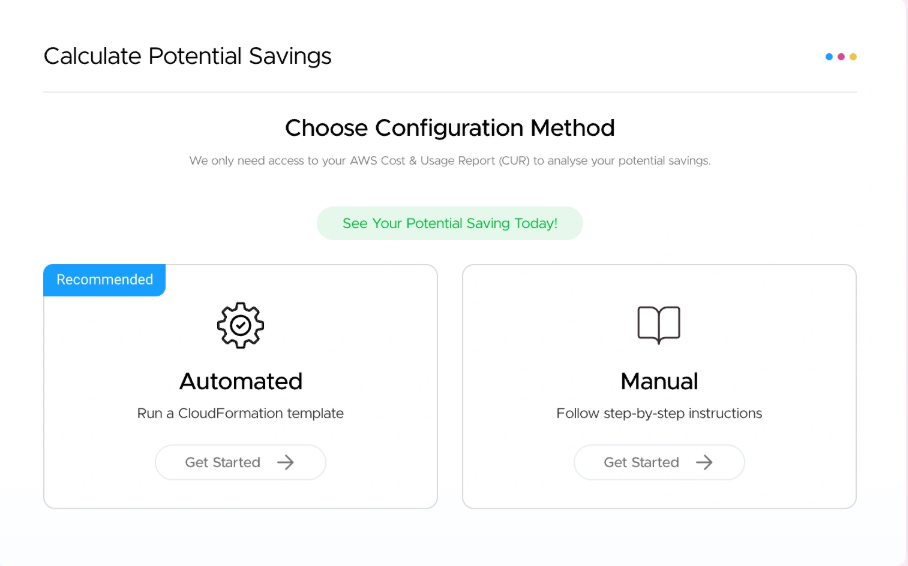
Mission Possible: See Your Potential AWS Savings in Minutes
Want to know how much you're overpaying on AWS commitments? Mission Possible, powered by CloudKeeper Commit , analyzes your live AWS usage to uncover optimization opportunities across Reserved Instances and Savings Plans and delivers a personalized estimate of your potential savings in just a few minutes.
Get started with CloudKeeper Commit today and uncover your AWS savings potential in under five minutes.
To Sum Up
Manual AWS RI Management incurs costs that compound gradually and rarely become apparent until they are already significant. Reservations drift from alignment as workloads shift, underutilized RIs absorb committed budget without delivering their intended discount, missed renewals expose infrastructure to full on-demand rates, and the engineering hours required to sustain the purchasing process represent a persistent diversion of capacity away from work that builds organizational value.
For early-stage environments, manual purchasing offers a degree of control that remains manageable within a limited operational scope. As infrastructure grows, the overhead of sustaining that control rises faster than the team's capacity to absorb it, and the cost of the process itself begins to erode the financial benefit it was designed to protect.
CloudKeeper Commit replaces that cycle with continuous, AI-driven RI optimization, aligning purchases with actual usage, coverage, and utilization, while sustaining high rates and returning engineering capacity to the work that advances the organization.












Spot on. Underutilized RIs and missed renewals are definitely silent ROI killers for growing infrastructure. How does the automated management handle highly dynamic auto-scaling environments compared to native AWS tools?
I will love to know more