




11
11AI Inference cost is the part of the AI budget that simply keeps growing after launch. A model trains once, but it runs inference every time a customer, employee, or software agent sends a request. As AI spreads across products, teams, and workflows, AI inference cost shifts from a small line item to a glaring one, taking a much larger chunk of the AI cost allocation you set at the start.
That makes AI inference cost the part of the AI budget that scales directly with adoption.
This guide gives executives, cloud FinOps leaders, and engineers a shared way to look at that spend. It covers what makes up LLM inference cost, why teams often under-track it, how to find the biggest cost drivers, and which AI inference cost optimization tactics work for each one.
Why AI Inference Cost Needs Its Own Line in the AI Budget
AI inference cost behaves like a usage-based operating expense. The more people use an AI feature, the more requests, tokens, and model calls it generates.
That makes it harder to forecast with the same assumptions you’d use for traditional cloud infrastructure.
Two trends show why inference deserves its own place in the AI budget.
1. Inference Spend Grows With Every User, Feature, and Agent
In August 2026, Gartner predicted that AI inference costs per agentic workflow will rise more than fivefold through 2028, even as model economics improve.
Gartner calls this the Inference Paradox: better unit economics can increase overall AI costs when they encourage wider adoption without a clear path to matching business value.
It estimates that routing a task to an Agentic AI reasoning model raises provider inference costs at least fivefold compared with a basic chatbot interaction. That gap can widen as tasks become more complex.
2. Falling Token Prices Can Still Mean Higher Total Spend
Stanford's 2025 AI Index reports that the cost of querying a model at GPT-3.5 level fell from $20 to $0.07 per million tokens between November 2022 and October 2024. That’s more than a 280x drop.
Epoch AI measured annual price declines ranging from 9x to 900x, depending on the capability milestone.
Gartner also expects that running inference on a one-trillion-parameter LLM will cost providers more than 90% less in 2030 than in 2025.
But cheaper tokens also make it easier to build agents, use longer contexts, and add always-on AI features. All of those consume more tokens per task.
So even when unit prices fall, total spend can keep rising as adoption grows. Sustaining AI at scale requires ongoing AI inference cost optimization, backed by FinOps and cloud unit economics.
What Makes Up AI Inference Cost?
AI inference cost is the expense of running a trained model to generate text, predictions, classifications, images, or other outputs.
For LLM applications, four components make up most of the bill. Our LLM pricing table lists current provider rates side by side.
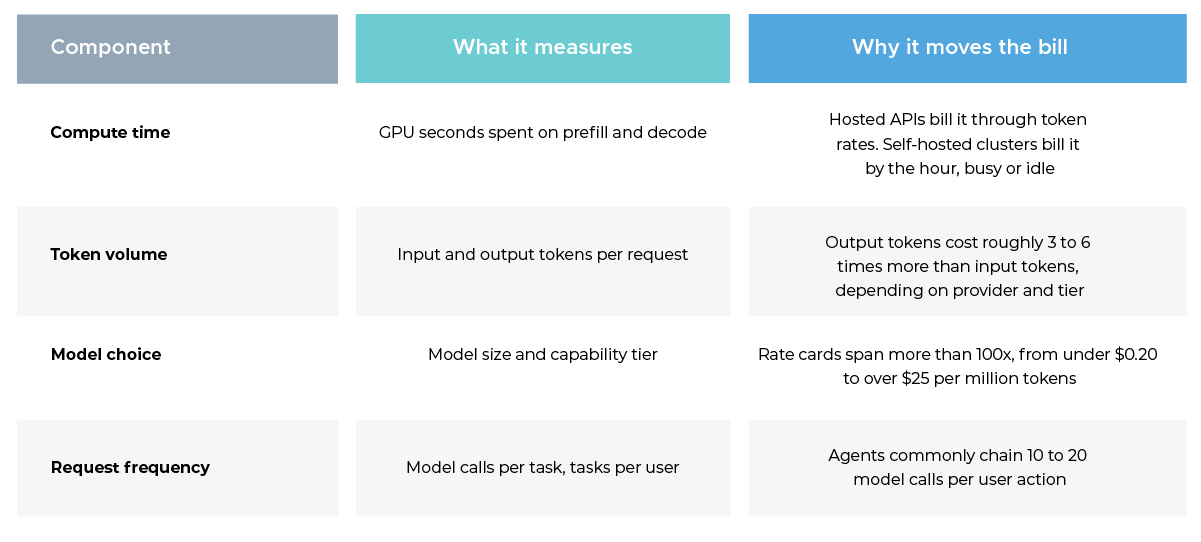
1. Compute Time Splits Into Prefill and Decode
Every request goes through two phases:
- Prefill processes the whole prompt in parallel. It’s compute-bound and scales with prompt length.
- Decode emits output one token at a time. Memory bandwidth limits it, and it scales with output length multiplied by batch size.
This split helps explain why providers don’t price input and output in the same pricing bracket.
Caching removes repeated prefill work, while batching keeps hardware busy during the decode cycle.
2. Token Volume Drives Both Input and Output Costs
A token is roughly three-quarters of an English word:
Providers quote separate per-million-token rates for input, which includes your prompt and context, and output, which covers what the model generates.
Context length can push the input side up quickly because the model processes every token in the window on every call. Long documents, conversation histories, tool outputs, and other context can all get reprocessed each time.
Our guide to token economics covers this line item in more detail.
3. Model Choice and Request Frequency Multiply Cost Per Task
Model choice sets the price per token. Request frequency determines how many times you pay it.
Model size matters just as much. A 7B-parameter model at FP16 occupies about 14 GB before it serves a request, and larger models need more GPUs and memory bandwidth per token.
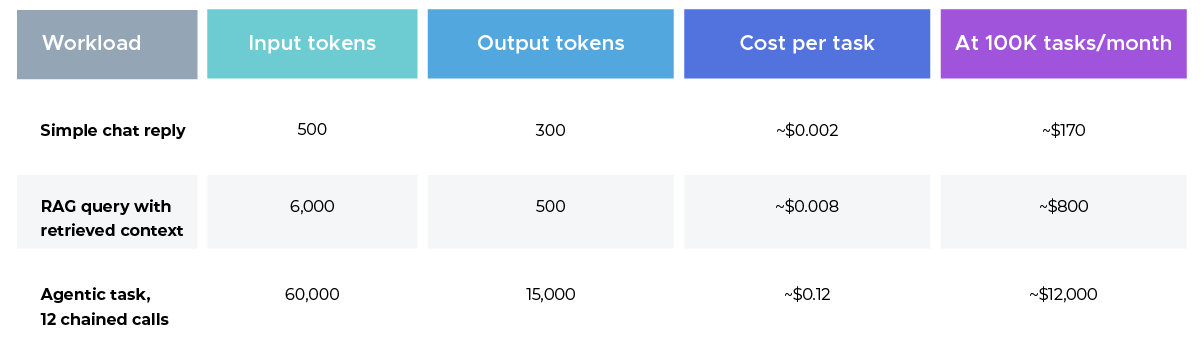
The table below combines model choice and request volume using an illustrative blended rate of $1 per million input tokens and $4 per million output tokens.
4. Four Different Prices Can Apply to the Same Model
The headline token price isn’t always the price you’ll actually pay.
A model can carry at least four rates, and your effective LLM inference cost will usually be a mix of them:
- Standard input and output rates: These are the headline prices shown on provider pricing pages.
- Cached input rates: Anthropic bills cache reads at 10% of the base input rate, with cache writes at 1.25x for a five-minute window or 2x for a one-hour window. OpenAI caches automatically for prompts above 1,024 tokens.
- Reasoning tokens: Thinking tokens bill at the output rate, although users never see them.
- Batch rates: Asynchronous batch processing runs at 50% off at major providers. When stacked with cached input, the combined discount approaches 95% off list.
That’s why comparing models only by their standard input and output rates won’t always reflect the actual economics of a production workload.
5. Self-Hosted Cost Per Token Depends on Utilization
Self-hosted inference works differently because GPU-hours cost money whether the device is generating tokens or sitting idle.
So utilization directly affects the effective cost per token.
One formula converts the hourly rate into a token price:
Cost per million tokens = GPU $/hr ÷ (tokens per second × 3,600 ÷ 1,000,000)
An 8-GPU node at $19.20 per hour producing 2,800 tokens per second works out to about $1.90 per million tokens.
But that assumes full use.
At 30% utilization, the effective LLM inference cost per token roughly triples because the hourly bill stays fixed while useful output falls. If you double useful throughput at the same hourly rate, you halve the cost per token.
Why AI Inference Cost Gets Misunderstood and Under-Tracked?
Many organizations learn their true AI inference cost from the invoice. By that point, the engineering change that caused the increase may have been running for weeks.
Four gaps make LLM inference cost harder to track.
1. Provider Consoles Show Spend but Often Hide Ownership
API consoles can tell you how much an account or key spent.
They usually won’t tell you which feature, team, or customer generated that spend.
Without cost allocation tags, it's difficult to assign ownership of AI inference costs.
FinOps for AI workloads supports AI inference cost optimization by tying spend to the products and teams generating it.
2. Reasoning Tokens and Multi-Model Stacks Hide Part of the Usage
Reasoning tokens appear on the bill but not in the response. So a short answer doesn’t necessarily mean a cheap request.
Multi-model stacks make this harder because each provider reports usage differently. If those numbers haven’t been normalized, teams can’t compare LLM inference cost consistently across models.
3. Cache Hit Rate and GPU Utilization Rarely Make It Into Cost Dashboards
A small prompt change can break caching without creating an obvious product issue. If no one is monitoring cache hit rate, the cost increase can go unnoticed.
GPU utilization can also be misleading when it’s viewed on its own.
NVIDIA's DCGM documentation defines SM Activity as the fraction of time at least one warp was active. Warps waiting on memory can still count as active, so even a high utilization percentage doesn’t prove the GPU is being used efficiently.
You need to read utilization alongside throughput and latency.
4. Seven Engineering Patterns Push Cost Up Faster Than Usage
Large overruns don’t always come from one major mistake. They often come from smaller design decisions that compound.
- Call multiplication from agents : A chatbot may need one call per question. An agent can reason, call tools, verify, and retry, so consumption can rise by an order of magnitude without changing pricing.
- Context growth: Retrieval pipelines that insert every document and conversation histories that never truncate keep adding input tokens.
- Defaulting to the largest model: Routing routine work to a frontier model can raise LLM inference cost per task by 10x to 20x.
- Unbounded output and reasoning: If you don’t set max-token limits or leave reasoning modes on for simple tasks, more spend shifts toward output tokens.
- Broken caching: One dynamic value placed early in a prompt can invalidate the cacheable prefix on every call.
- Idle GPUs: Self-hosted clusters at low utilization still carry the full hourly cost while producing less useful output.
- Uncontrolled retries: Every retry pays the full token cost again.
How to Identify Your Biggest AI Inference Cost Drivers
You don’t need to start with a complicated framework.
Finance leaders can begin with five questions:
- Which feature is generating the spend?
- What does one completed task cost?
- How many model calls does each task need?
- How much input gets repeated from one call to the next?
- Which model carries which traffic?
Engineering teams can answer those questions by tracking a small set of task-level metrics.
1. Track Eight Task-Level Metrics 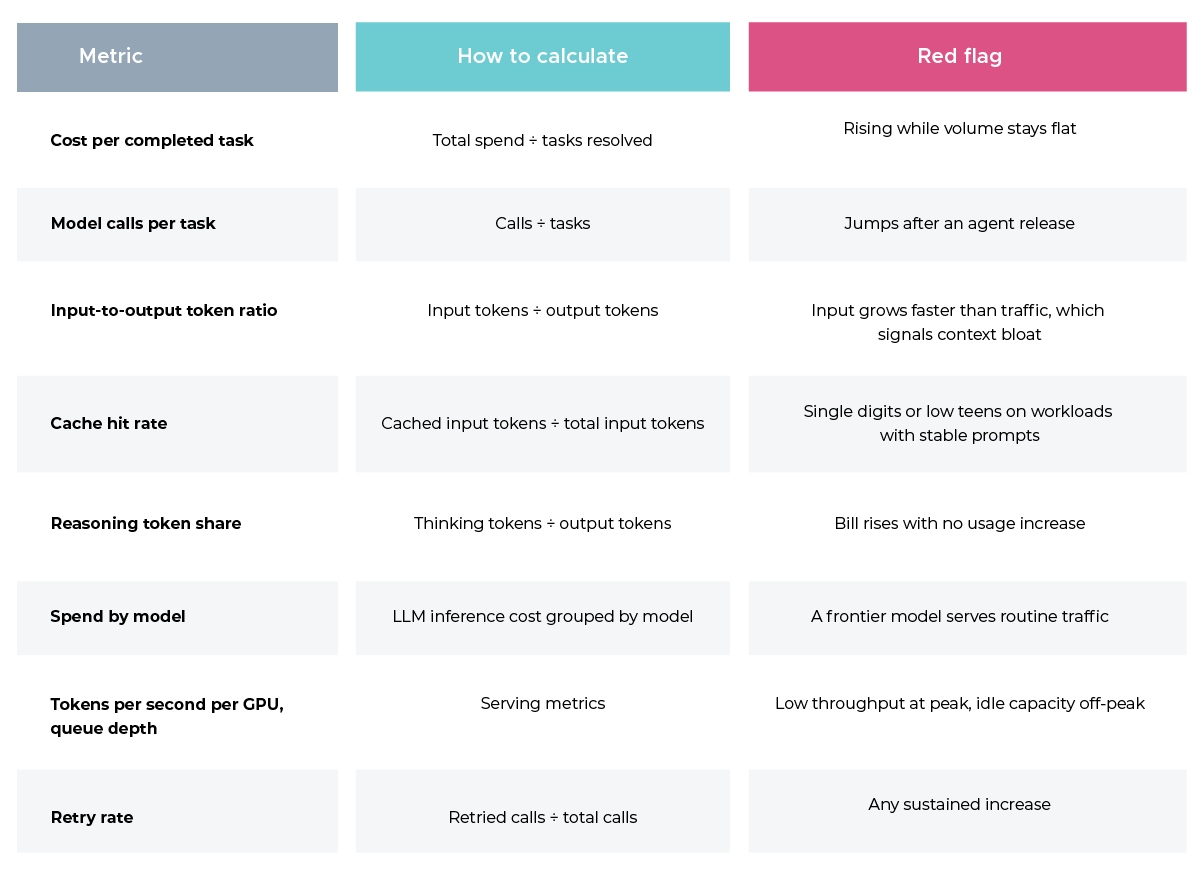
Once you can see these numbers at the task level, you can start explaining why spend moved.
A rising input-to-output ratio can point to context bloat. Higher calls per task can signal a more expensive agent flow. Weak cache hit rates may mean a prompt change has made repeated context billable again.
2. Rank Spend by Feature, Then Trace the Biggest Item to One Driver
Run the same review every month.
Rank AI inference cost by feature. Take the largest item and identify the main reason it’s expensive. Then change one variable and measure the result.
This gives you a much clearer optimization loop than trying several changes at once and hoping the bill comes down.
3. Set Budget Alerts Before the Billing Cycle Closes
If you only look at spend after the invoice arrives, you’ve lost most of the time you could’ve used to act.
An alert at 80% of the monthly target gives teams time to investigate rising spend before the billing cycle closes.
A cloud cost optimization review that includes AI workloads follows the same pattern, with inference spend tagged by feature alongside compute and storage.
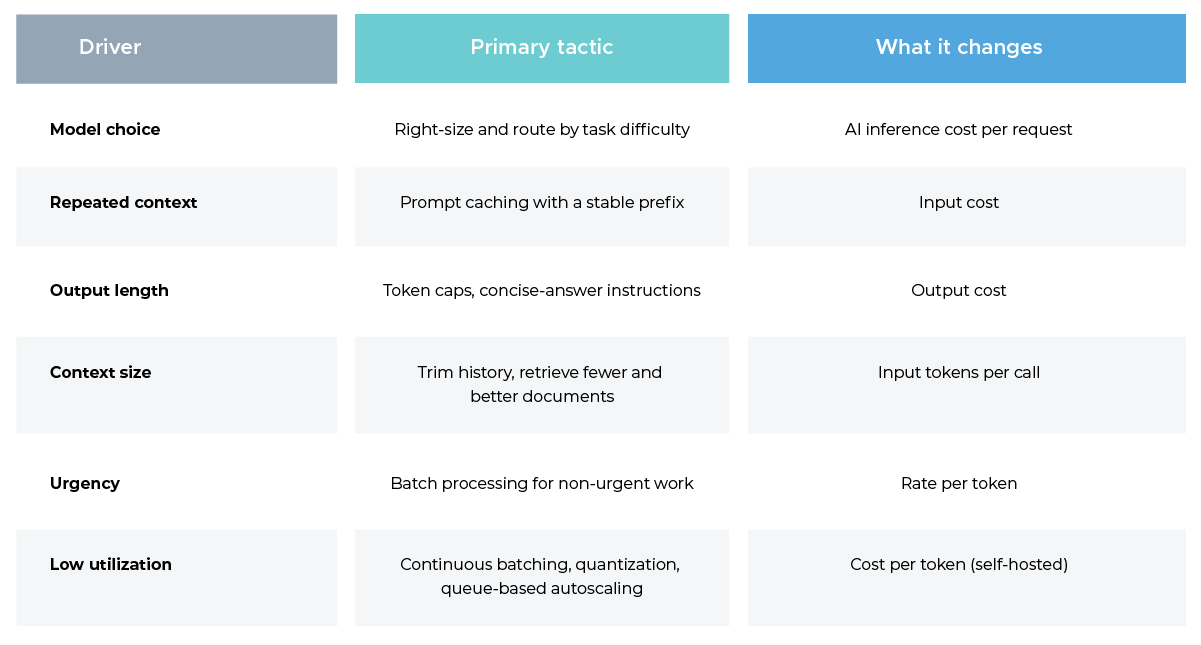
Match each AI Inference Cost Driver with the Right Optimization
Effective AI token cost optimization practice starts with the driver.
1. Right-Size Models and Route Requests by Complexity
Not every request needs your most capable model.
Classification, extraction, and summarization can often go to smaller models, while frontier models can be reserved for tasks that genuinely need the extra capability.
A two-tier router can try the cheaper model first and escalate when confidence is low.
Smaller models can also replace larger ones completely on stable, narrow tasks. When they do, the lower AI inference cost applies to every call that workflow handles.
2. Reduce Repeated Input Costs With Prompt Caching
Prompt and API gateway caching lets applications reuse work on repeated prompt prefixes.
Put stable content such as system prompts, tool definitions, and reference documents at the beginning of the prompt. Keep variable content at the end.
At Anthropic's rates, sending the same prefix twice costs 1.25x to write plus 0.1x to read, or 1.35x overall, compared with 2.0x when both calls are uncached.
You’ll also want to keep timestamps, user IDs, and other changing values out of the cached prefix so they don’t invalidate it.
3. Reduce Token Spend by Trimming Context and Capping Output
Long prompts often grow a little at a time.
Conversation history accumulates. More documents get pulled into retrieval. System instructions expand. The model starts receiving far more context than it actually needs.
Trim old conversation history, summarize earlier turns, and rerank retrieved chunks so only the most relevant ones reach the model.
Output needs limits too.
Set max-token limits for each use case and define explicit reasoning budgets so simple requests don’t run with unbounded thinking.
Context trimming is one of the most direct AI inference cost optimization levers because every unnecessary token you remove is a token you won’t pay to process on future calls.
4. Lower AI Inference Cost With Batch Processing
Not every inference workload needs an instant response.
Nightly summarization, bulk classification, and evaluation runs can usually wait.
Batch processing at half price makes these workloads a straightforward AI inference cost optimization opportunity.
5. Optimize Self-Hosted Inference by Tuning the Serving Stack
If you’re self-hosting models, cost per token depends heavily on how efficiently the serving stack uses the available GPUs.
Continuous batching rebuilds the batch every iteration so completed requests can leave and new ones can join.
Quantization reduces memory use per token, although the actual gains depend on kernel and hardware support because weight-only schemes keep activations at higher precision.
Speculative decoding uses a draft model to propose tokens that the main model verifies in parallel. It helps least when the server is already saturated.
The goal across all three is the same: get more useful inference work from every GPU-hour you’re paying for.
Quick Wins vs. Comprehensive AI Inference Cost Optimization Fixes
You don’t need to redesign your AI stack to start reducing inference cost.
Some changes can be tested in days or weeks. Others take more engineering work and make sense once you know where the bigger, persistent cost sits.
1. Start With Quick Wins
- Move simple tasks to smaller models.
- Reorder prompts so stable content comes first, and cap output length.
- Move non-urgent jobs to batch endpoints.
- Tag spend by feature, team, and environment, and alert at 80% of budget.
- Set retry limits.
These changes give teams a way to remove obvious waste before committing to larger architecture projects.
2. Move to Deeper Architectural Fixes When the Data Supports Them
- Build a routing layer with quality checks.
- Redesign agent loops and context management.
- Quantize models for stable tasks.
- Track cost per task and per customer as a product KPI.
- Decide on self-hosting using measured utilization.
These changes take longer, so you’ll want the data to show that the remaining cost is material enough to justify them.
Models, prices, and traffic patterns also change constantly. A router that works well today may drift several months from now.
That’s why AI inference cost optimization works better as an ongoing discipline than a one-time cleanup exercise.
To Sum Up
AI inference cost grows with model choice, token volume, request frequency, and compute efficiency. As applications add larger models, longer contexts, and more agent steps, those costs can compound quickly.
Start by tracking where the spend is actually coming from. Look at cost per task, model calls, token usage, cache hit rate, retries, and GPU efficiency. Once you know the main driver, you can focus on the fix that addresses it, whether that’s model routing, caching, context trimming, output limits, batching, or better infrastructure utilization.
As AI adoption grows, keeping LLM inference cost connected to the value each workload delivers will matter more. If you want a second set of eyes on your AI inference cost, explore CloudKeeper's cloud cost optimization services and see how a structured review can map your spend to the drivers above.